
Work-Zone and Highway Construction Crashes in Washington: Flaggers, Speed, and Fault
Key Takeaways
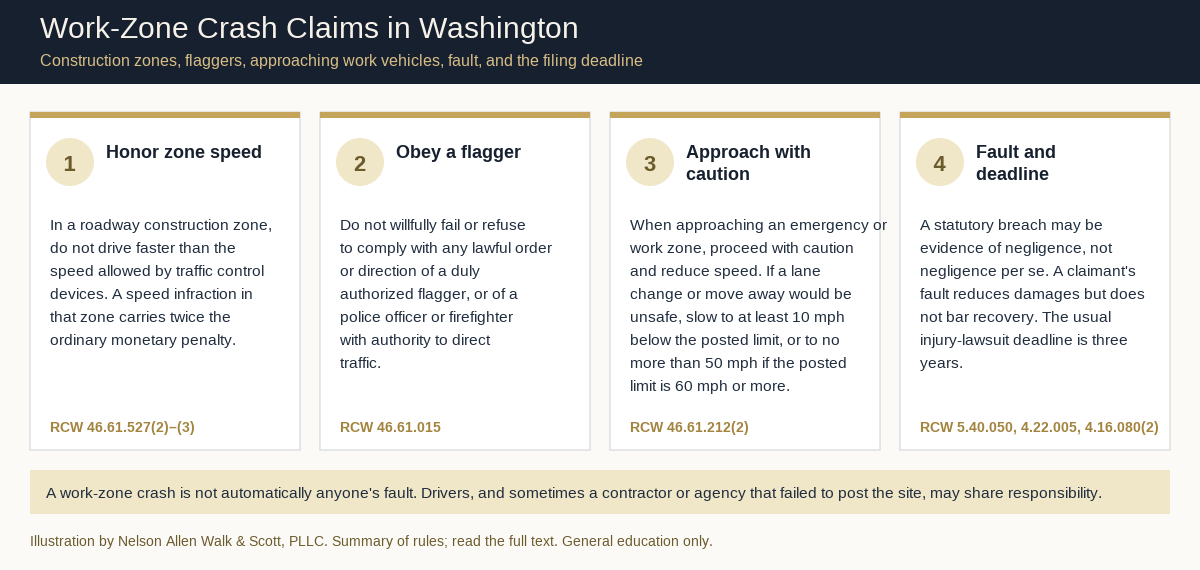
- A roadway construction zone is an area where construction, repair, or maintenance work is being conducted by public employees or private contractors, on or adjacent to any public roadway (RCW 46.61.527(1)). No person may drive in that zone at a speed greater than that allowed by traffic control devices (RCW 46.61.527(2)).
- No person shall willfully fail or refuse to comply with any lawful order or direction of any duly authorized flagger, or of a police officer or firefighter invested by law with authority to direct, control, or regulate traffic (RCW 46.61.015(1)).
- When approaching an emergency or work zone, as defined in RCW 46.61.212, a driver shall proceed with caution and reduce speed, and shall change lanes or move away when the statute's conditions are met, or slow further if a move would be unsafe (RCW 46.61.212(2)).
- When construction, repair, or maintenance work on or adjacent to a public thoroughfare interferes with the normal and established mode of travel, the location shall be properly posted by prominently displayed signs or flaggers or both. Any contractor, firm, corporation, political subdivision, or other agency performing such work shall comply (RCW 47.36.200).
- A statutory breach of these rules may be considered as evidence of negligence, but it is not negligence per se (RCW 5.40.050). A claimant's own fault reduces damages proportionately but does not bar recovery (RCW 4.22.005). The general deadline for an injury lawsuit is three years (RCW 4.16.080(2)). Claims against the State or a local government have extra pre-suit steps (RCW 4.92.100, 4.92.110, 4.96.010, 4.96.020).
Hypothetical example: a driver on a Pierce County highway enters a stretch with cones, a reduced-speed sign, and a flagger. The driver and another vehicle collide near a highway maintenance truck that has its warning lights on. Each person says the other went too fast or failed to yield.
Work-zone crashes raise questions about construction-zone speed, flaggers, duties when approaching a work vehicle, and whether a contractor or public agency had to post the site. This article explains those statutes. It is general education, not advice about any one crash.
What Is a Roadway Construction Zone
RCW 46.61.527(1) defines a roadway construction zone as an area where construction, repair, or maintenance work is being conducted by public employees or private contractors, on or adjacent to any public roadway.
The same section directs the secretary of transportation to adopt standards and specifications for the use of traffic control devices in roadway construction zones on state highways.
Speed in a Roadway Construction Zone
Under RCW 46.61.527(2), no person may drive a vehicle in a roadway construction zone at a speed greater than that allowed by traffic control devices.
A person found to have committed any infraction relating to speed restrictions in a roadway construction zone shall be assessed a monetary penalty equal to twice the penalty assessed under RCW 46.63.110. That penalty may not be waived, reduced, or suspended (RCW 46.61.527(3)).
Other speed rules can still apply. Under RCW 46.61.400(1), no person shall drive a vehicle on a highway at a speed greater than is reasonable and prudent under the conditions and having regard to the actual and potential hazards then existing.
Subsection (3) of the same statute requires an appropriate reduced speed when a special hazard exists with respect to pedestrians or other traffic, or by reason of weather or highway conditions.
Key point
Key point: a work-zone crash is not automatically anyone's fault
- Construction-zone speed, flagger, and work-vehicle rules impose duties on drivers. A posting statute also imposes duties on those performing the work.
- No statute in this article says that the passing driver, the work-vehicle operator, the contractor, or a public agency is automatically at fault in every work-zone crash.
Obeying Flaggers and Official Devices
Under RCW 46.61.015(1), no person shall willfully fail or refuse to comply with any lawful order or direction of any duly authorized flagger or any police officer or firefighter invested by law with authority to direct, control, or regulate traffic.
A violation of that section is a misdemeanor (RCW 46.61.015(2)). A criminal charge is not, by itself, a civil verdict.
Drivers must also obey official traffic control devices under RCW 46.61.050. Work-zone signs, lane-shift signs, and similar devices fall under that general duty when they are official traffic control devices.
Approaching an Emergency or Work Zone
RCW 46.61.212 uses a different definition. An emergency or work zone is the adjacent lanes of the roadway 200 feet before and after listed vehicles. Those vehicles include a stationary or slow moving highway construction vehicle, highway maintenance vehicle, solid waste vehicle, or utility service vehicle making use of flashing lights that meet RCW 46.37.300 or warning lights with 360 degree visibility.
The same definition includes certain authorized emergency vehicles, tow trucks, roadside-assistance vehicles, and police vehicles, when they are using the signals or lights the statute describes.
On a highway having four or more lanes, at least two of which are intended for traffic proceeding in the same direction as the approaching vehicle, the driver shall proceed with caution, reduce speed, and, if the opportunity exists, with due regard for safety and traffic conditions, yield the right-of-way by making a lane change or moving away from the lane or shoulder occupied by the emergency or work zone vehicle (RCW 46.61.212(2)(a)).
On a highway having less than four lanes, the driver shall proceed with caution, reduce speed, and, if the opportunity exists, with due regard for safety and traffic conditions and under the rules of chapter 46.61 RCW, yield the right-of-way by passing to the left at a safe distance and simultaneously yield the right-of-way to all vehicles traveling in the proper direction upon the highway (RCW 46.61.212(2)(b)).
If changing lanes or moving away would be unsafe, the driver shall proceed with due caution and continue to reduce the speed of the vehicle to at least 10 miles per hour below the posted speed limit. If the posted speed limit exceeds 60 miles per hour or more, the driver shall reduce speed to no more than 50 miles per hour (RCW 46.61.212(2)(c)).
A person may not drive in an emergency or work zone at a speed greater than the posted speed limit or greater than what is permitted under subsection (2)(c) (RCW 46.61.212(3)). A speed-related violation of this section is assessed a monetary penalty equal to twice the penalty under RCW 46.63.110, and that penalty may not be waived, reduced, or suspended (RCW 46.61.212(4)).
Caution
Caution: two different zone definitions
- RCW 46.61.527 applies in a roadway construction zone, which is defined by construction, repair, or maintenance work on or adjacent to a public roadway.
- RCW 46.61.212 applies in an emergency or work zone, which is defined as the adjacent lanes 200 feet before and after certain vehicles using the required lights or signals.
- Both sets of rules can matter in the same stretch of road, depending on the facts. They are not the same definition.
Reckless Endangerment of Roadway Workers
RCW 46.61.527(4) makes it a crime to drive a vehicle in a roadway construction zone in such a manner as to endanger or be likely to endanger any persons or property, or to remove, evade, or intentionally strike a traffic safety or control device. That offense is called reckless endangerment of roadway workers, and a violation is a gross misdemeanor.
The department shall suspend for sixty days the license or permit to drive, or a nonresident driving privilege, of a person convicted of that offense (RCW 46.61.527(5)).
RCW 46.61.212(5) and (6) have a similar offense, called reckless endangerment of emergency or work zone workers, with the same classification and a 60-day suspension after conviction. A conviction is not, by itself, a civil finding of negligence.
Posting Duties of Contractors and Agencies
RCW 47.36.200(1) applies when construction, repair, or maintenance work is conducted on or adjacent to a public highway, county road, street, bridge, or other thoroughfare commonly traveled, and when the work interferes with the normal and established mode of travel.
In that situation, the location shall be properly posted by prominently displayed signs or flaggers or both. Signs used for posting shall be consistent with the provisions found in the state of Washington Manual on Uniform Traffic Control Devices for Streets and Highways, obtainable from the department of transportation.
Subsection (3) is direct about who must comply. Any contractor, firm, corporation, political subdivision, or other agency performing such work shall comply with this section.
Subsection (4) adds that each driver of a motor vehicle used in connection with such work shall obey traffic signs posted for, and flaggers stationed at, such location in the same manner and under the same restrictions as is required for the driver of any other vehicle.
If the work includes or uses grooved pavement, abrupt lane edges, steel plates, or gravel or earth surfaces, subsection (2) requires additional posting, including a motorcycle warning when the hazard or condition exists on a paved public thoroughfare. Our article on motorcycle accident claims discusses motorcycle crashes more generally.
A violation of or a failure to comply with RCW 47.36.200 is a misdemeanor, and each day of violation or noncompliance constitutes a separate violation. That posting duty is the verified statutory support, in this article, for asking whether a contractor or public agency may share responsibility.
| Topic | What the statute requires | Source |
|---|---|---|
| Roadway construction zone | An area where construction, repair, or maintenance work is being conducted by public employees or private contractors, on or adjacent to any public roadway | RCW 46.61.527(1) |
| Speed in that zone | Do not drive at a speed greater than that allowed by traffic control devices | RCW 46.61.527(2) |
| Flagger or officer | Do not willfully fail or refuse to comply with a lawful order or direction of a duly authorized flagger, or of a police officer or firefighter with authority to direct traffic | RCW 46.61.015(1) |
| Approaching a work vehicle | Proceed with caution, reduce speed, and change lanes or move away when the statute's conditions are met; if a move would be unsafe, slow to the statute's reduced speeds | RCW 46.61.212(2) |
| Posting the worksite | When the work interferes with the normal mode of travel, properly post the location with prominently displayed signs or flaggers or both | RCW 47.36.200(1) |
| Who must post | Any contractor, firm, corporation, political subdivision, or other agency performing such work shall comply | RCW 47.36.200(3) |
How a Violation Relates to a Negligence Claim
A traffic citation or a criminal charge is not a civil verdict. Under RCW 5.40.050, a breach of a duty imposed by statute, ordinance, or administrative rule shall not be considered negligence per se, but may be considered by the trier of fact as evidence of negligence.
The same statute lists categories that are treated as negligence per se, including driving under the influence. The work-zone, flagger, approach, and posting rules discussed here are not in that list.
Comparative Fault and Other Responsible Parties
More than one person may have had a duty in a work-zone crash. A driver may have exceeded the speed allowed by devices, failed to obey a flagger, or failed to approach a work vehicle as RCW 46.61.212 requires. A contractor or agency performing the work may have failed to post the location as RCW 47.36.200 requires.
Under RCW 4.22.005, any contributory fault chargeable to the claimant diminishes damages proportionately but does not bar recovery. Our comparative fault article explains that rule.
Hypothetical: a driver enters a poorly marked lane shift at the same time another driver fails to slow for a flagger. The statutes in this article do not automatically assign all of the fault to either driver, or to the company doing the work.
Claims Against a Government Entity
If a state agency may be responsible, RCW 4.92.100 requires that a claim against the state, or against the state's officers, employees, or volunteers acting in such capacity, for damages arising out of tortious conduct, be presented to the office of risk management.
RCW 4.92.110 provides that no action subject to those claim-filing requirements shall be commenced until sixty calendar days have elapsed after the claim is presented. The applicable period of limitations is tolled during that sixty calendar day period.
RCW 4.96.010 makes local governmental entities liable for damages arising out of their tortious conduct, or the tortious conduct of their officers, employees, or volunteers in the circumstances the statute describes, to the same extent as if they were a private person or corporation. Filing a claim for damages within the time allowed by law is a condition precedent to commencing an action.
Under RCW 4.96.020, no action subject to that section's claim-filing requirements shall be commenced against a local governmental entity, or against its officers, employees, or volunteers acting in such capacity, until sixty calendar days have elapsed after the claim has first been presented to the agent of the governing body. The applicable period of limitations is tolled during that period.
Our article on injury claims against government entities covers those presentation and waiting-period rules in more detail. This article does not address those procedures beyond the points just stated.
Evidence and Practical Steps
Useful evidence after a work-zone crash can include photos of signs, cones, flaggers, work vehicles and their lights, and the posted speed. Dashcam or other video, and witness accounts of speed and flagger directions, often matter.
- Photos of signs, flaggers, cones or barriers, work vehicles, warning lights, and vehicle damage, if you can take them safely
- Dashcam, traffic-camera, or other video of the zone and each vehicle's path
- Names of witnesses, including workers or flaggers, and what they say about speed, signals, and posted directions
- The police report number and any citation numbers
- Medical records and your insurance declarations page
This is practical guidance, not a list of what any court will require or admit.
Get medical care promptly, even if you feel fine at the scene. Some injuries show up later. Keep copies of bills and notes about missed work.
Insurance and Filing Deadline
Personal injury protection and underinsured motorist coverage may apply, depending on the policies. Our PIP and UIM article explains both, and our article on insurance claim handling rules covers dealing with adjusters.
RCW 4.16.080(2) requires an action for injury to the person to be commenced within three years. Our article on the personal injury statute of limitations explains accrual, tolling, and what counts as commencing an action. Claims against a government entity have the additional presentation steps described above.
What to do
Next steps
- Get medical care and keep every record.
- Photograph signs, flaggers, work vehicles, and the posted speed if you can do so safely.
- Preserve dashcam or other video and write down witness names.
- Contact us to talk about your situation.
Related reading includes our guide on what to do after a car accident in Washington, and our articles on distracted driving, truck accident claims, and hit-and-run claims.
To talk through a work-zone crash, visit our personal injury practice page or contact us. Nelson Allen Walk & Scott, PLLC is at 1103 Shaw Road, Puyallup, WA 98372, and the phone is (253) 845-8895.
Written by Nathan D. Sukhia, Of Counsel.
Frequently Asked Questions
Is a driver who crashes in a Washington work zone always at fault?+
What is a roadway construction zone?+
Do I have to obey a flagger in a work zone?+
How much do I have to slow down when approaching a construction vehicle with warning lights?+
Can a contractor or government agency share responsibility for a work-zone crash?+
How long do I have to file a lawsuit after a work-zone crash?+
Sources & Further Reading
- 1.RCW 46.61.527 — Roadway Construction ZonesDefinition of a roadway construction zone; speed limited to that allowed by traffic control devices; doubled monetary penalty for speed infractions; reckless endangerment of roadway workers.
- 2.RCW 46.61.015 — Obedience to Police Officers, Flaggers, or FirefightersDo not willfully fail or refuse to comply with a lawful order or direction of a duly authorized flagger, or of a police officer or firefighter with authority to direct traffic.
- 3.RCW 46.61.212 — Emergency or Work ZonesDefinition of an emergency or work zone; approach, lane-change, and reduced-speed duties; doubled monetary penalty; reckless endangerment of emergency or work zone workers.
- 4.RCW 46.61.400 — Basic Rule and Maximum LimitsReasonable and prudent speed under the conditions; appropriate reduced speed when a special hazard exists by reason of weather or highway conditions.
- 5.RCW 46.61.050 — Obedience to Traffic Control DevicesDrivers shall obey official traffic control devices, subject to listed exceptions.
- 6.RCW 47.36.200 — Signs or Flaggers at Thoroughfare WorksitesWhen work interferes with the normal mode of travel, properly post with signs or flaggers or both; contractors and agencies performing the work shall comply.
- 7.RCW 5.40.050 — Breach of Duty as Evidence of NegligenceA statutory breach may be evidence of negligence; listed negligence-per-se exceptions.
- 8.RCW 4.22.005 — Effect of Contributory FaultA claimant's fault reduces damages but does not bar recovery.
- 9.RCW 4.92.100 — Claims Against the StateA tort claim against the state must be presented to the office of risk management.
- 10.RCW 4.92.110 — Presentment Prerequisite to Suit Against the StateNo action until sixty calendar days after the claim is presented; the limitation period is tolled during that wait.
- 11.RCW 4.96.010 — Liability of Local Governmental EntitiesLocal governmental entities are liable for tortious conduct to the same extent as a private person; filing a claim is a condition precedent.
- 12.RCW 4.96.020 — Claim Filing Against Local Governmental EntitiesNo action until sixty calendar days after the claim is presented to the agent of the governing body; the limitation period is tolled during that wait.
- 13.RCW 4.16.080 — Actions Limited to Three YearsSubsection (2): injury to the person.
Disclaimer
This article is provided for general informational purposes only and does not constitute legal advice. It is based on Washington law as of the date noted above; statutes, court rules, and case law can and do change, and this article may not reflect the most current legal developments or apply to your specific facts.
Reading this article, contacting Nelson Allen Walk & Scott through this website, or submitting information through our contact form does not create an attorney-client relationship. An attorney-client relationship is formed only after both parties sign a written engagement agreement. Please do not send any confidential or time-sensitive information until that relationship has been established.
Every case is different, and past outcomes described or implied on this site do not guarantee or predict a similar result in any future matter. If you need advice about your specific situation, please consult directly with Nathan D. Sukhia or another licensed Washington attorney.
Attorney Advertising.
Experience · Expertise · Excellence
Talk to Nathan D. Sukhia
Nathan D. Sukhia and our team are happy to talk through your specific situation.