
Teen-Driver Crashes in Washington: Intermediate License Rules, Insurance, and Fault
Key Takeaways
- An intermediate license authorizes a driver who is at least 16 years of age to drive only under the conditions in RCW 46.20.075.
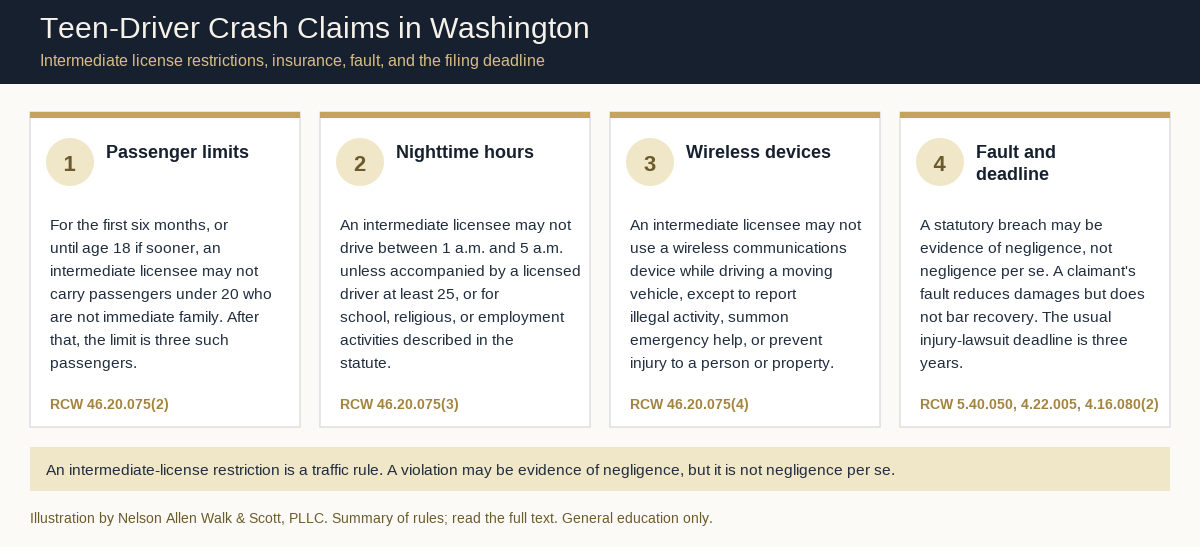
- For the first six months after issuance, or until the holder reaches 18, whichever occurs first, the holder may not carry any passengers under 20 who are not members of the holder's immediate family. For the remaining period of the license, the holder may not carry more than three such passengers (RCW 46.20.075(2)).
- The holder may not drive between 1 a.m. and 5 a.m. except when accompanied by a licensed driver who is at least 25, or for school, religious, or employment activities for the holder or a member of the holder's immediate family (RCW 46.20.075(3)).
- The holder may not operate a moving motor vehicle while using a wireless communications device, except to report illegal activity, summon medical or other emergency help, or prevent injury to a person or property (RCW 46.20.075(4)).
- A breach of these restrictions may be considered as evidence of negligence, but it is not negligence per se (RCW 5.40.050). A claimant's own fault reduces damages proportionately but does not bar recovery (RCW 4.22.005). The general deadline for an injury lawsuit is three years (RCW 4.16.080(2)). If the injured person was under 18 when the claim accrued, RCW 4.16.190 addresses tolling.
Hypothetical example: a 16-year-old with an intermediate driver's license is driving a household vehicle in Pierce County after a school event. Friends under 20 are in the car.
Another vehicle is involved in a crash. Each driver has a different account of speed, attention, and who should have been in the car.
Crashes involving teen drivers often raise questions about intermediate license restrictions, insurance on a household vehicle, and how a traffic-rule violation relates to fault. This article explains those statutes. It is general education, not advice about any one crash.
What an Intermediate License Authorizes
Under RCW 46.20.075(1), an intermediate license authorizes the holder to drive a motor vehicle under the conditions specified in that section. An applicant must be at least 16 years of age.
The applicant must also have possessed a valid instruction permit for at least six months, have passed a driver licensing examination administered by the department, and have passed a course of driver's education in accordance with the standards in RCW 46.20.100.
Until January 1, 2031, the applicant must also have met the applicable driver work zone and first responder safety course requirement in RCW 46.20.1191(3). The parent, guardian, employer, or responsible adult must certify at least 50 hours of supervised driving experience, 10 of which were at night, under the conditions in RCW 46.20.075(1)(e).
RCW 46.20.100(1) requires that the application of a person under the age of 18 for a driver's license or a motorcycle endorsement be signed by a parent, guardian, employer, or responsible adult as defined in RCW 46.20.075. Signing the application is not, in that section, a rule that automatically makes the signer liable for a later crash.
RCW 46.20.105(3) requires an intermediate license to be identified as an intermediate license and issued in a distinctive form determined by the department.
Passenger Limits
For the first six months after the issuance of an intermediate license, or until the holder reaches 18 years of age, whichever occurs first, the holder may not operate a motor vehicle that is carrying any passengers under the age of 20 who are not members of the holder's immediate family (RCW 46.20.075(2)).
For the remaining period of the intermediate license, the holder may not operate a motor vehicle that is carrying more than three passengers who are under the age of 20 who are not members of the holder's immediate family.
RCW 46.20.075(9)(a) defines immediate family. The definition includes an individual's spouse or domestic partner, child, stepchild, grandchild, parent, stepparent, grandparent, brother, half-brother, sister, or half-sister, including foster children living in the household, and the spouse or domestic partner of any such person, plus corresponding relatives of the individual's spouse or domestic partner.
Nighttime Driving
The holder of an intermediate license may not operate a motor vehicle between the hours of 1 a.m. and 5 a.m., with two listed exceptions (RCW 46.20.075(3)).
The holder may drive in those hours when accompanied by a licensed driver who is at least 25 years of age. The holder may also drive in those hours for school, religious, or employment activities for the holder or a member of the holder's immediate family, as defined in the same section.
Wireless Communications Devices
The holder of an intermediate license may not operate a moving motor vehicle while using a wireless communications device unless the holder is using the device to report illegal activity, summon medical or other emergency help, or prevent injury to a person or property (RCW 46.20.075(4)).
Washington also has generally applicable phone-use and distracted-driving rules. Our article on distracted-driving accident claims covers those statutes.
Key point
Key point: an IDL violation is not automatically civil negligence
- RCW 46.20.075(5) makes it a traffic infraction for an intermediate licensee to drive in violation of the restrictions in that section.
- A traffic infraction is not a civil verdict. Under RCW 5.40.050, a statutory breach may be considered as evidence of negligence, but it is not negligence per se.
How These Restrictions Are Enforced
Except for a violation of the wireless-device rule in subsection (4), enforcement of RCW 46.20.075 by law enforcement officers may be accomplished only as a secondary action when a driver has been detained for a suspected violation of Title 46 RCW or an equivalent local ordinance or some other offense (RCW 46.20.075(6)).
Two other exceptions affect the passenger and hour limits. An intermediate licensee may drive at any hour without restrictions on the number of passengers if necessary for agricultural purposes (RCW 46.20.075(7)).
An intermediate licensee may also drive at any hour without restrictions on the number of passengers if, for the 12-month period following issuance of the intermediate license, the holder meets all of the conditions in RCW 46.20.075(8). Those conditions include not having been involved in an accident involving only one motor vehicle, and not having been involved in an accident where the holder was cited in connection with the accident or was found to have caused the accident.
The same subsection also requires that the holder not have been involved in an accident where no one was cited or was found to have caused the accident, and not have been convicted of or found to have committed a traffic offense described in chapter 46.61 RCW or to have violated intermediate-license restrictions.
| Topic | What the statute requires | Source |
|---|---|---|
| Passenger limits, first period | For the first six months, or until age 18 if sooner, no passengers under 20 who are not immediate family | RCW 46.20.075(2) |
| Passenger limits, remaining period | No more than three passengers under 20 who are not immediate family | RCW 46.20.075(2) |
| Nighttime hours | No driving between 1 a.m. and 5 a.m., except when accompanied by a licensed driver at least 25, or for listed school, religious, or employment activities | RCW 46.20.075(3) |
| Wireless devices | No use of a wireless communications device while operating a moving motor vehicle, except to report illegal activity, summon emergency help, or prevent injury to a person or property | RCW 46.20.075(4) |
| Enforcement | A violation is a traffic infraction. Except for the wireless-device rule, enforcement is secondary | RCW 46.20.075(5)–(6) |
How a Violation Relates to a Negligence Claim
A traffic citation is not a civil verdict. Under RCW 5.40.050, a breach of a duty imposed by statute, ordinance, or administrative rule shall not be considered negligence per se, but may be considered by the trier of fact as evidence of negligence.
The same statute lists categories that are treated as negligence per se, including driving under the influence. The intermediate-license passenger, nighttime, and wireless-device restrictions are not in that list.
So if a teen drove in violation of RCW 46.20.075, the trier of fact may consider that breach as evidence of negligence. It does not automatically establish negligence as a matter of law.
Comparative Fault
Both drivers in a crash involving a teen may have had a role. One may have violated an intermediate-license restriction. The other may have been speeding, following too closely, or failing to yield.
Under RCW 4.22.005, any contributory fault chargeable to the claimant diminishes damages proportionately but does not bar recovery. Our comparative fault article explains that rule.
Hypothetical: a teen with an intermediate license is carrying a friend who is not immediate family, and another driver changes lanes without signaling. The statutes in this article do not automatically assign all of the fault to either driver.
Parents, Owners, and RCW 4.24.190
RCW 4.24.190 addresses a narrower situation than a typical teen-driver crash. It applies to the parent or parents of a minor child under the age of 18 who is living with the parent or parents and who willfully or maliciously destroys or defaces property, or who willfully and maliciously inflicts personal injury on another person.
For that kind of willful or malicious conduct, the statute creates a civil claim against the parent and sets a monetary limit. This article does not restate that limit as a figure. Ordinary negligent driving is not the willful or malicious injury described in that sentence.
The same section also says that it shall in no way limit the amount of recovery against the parent or parents for their own common law negligence. No statute cited here automatically makes a parent or vehicle owner liable for a teen's ordinary negligent driving.
Whether a parent or owner has an independent duty in a particular case depends on facts and on legal rules this article does not attempt to catalog. This article does not treat court-made doctrines as if they were statutes.
Caution
Caution: do not treat RCW 4.24.190 as a general parent-pays rule
- The statute is limited to willful or malicious destruction of property, or willful and malicious personal injury, by a minor living with the parent.
- It is not a rule that a parent is automatically liable whenever a teen is in a crash. The same section preserves claims against a parent for the parent's own common law negligence, without defining every such claim.
Insurance Coverage for Teen Drivers
RCW 46.30.020(1) provides that no person may operate a motor vehicle subject to registration under chapter 46.16A RCW in this state unless the person is insured under a motor vehicle liability policy with liability limits of at least the amounts provided in RCW 46.29.090, or meets another listed form of financial responsibility.
A household auto policy may cover a teen who lives in the home or who is listed on the policy, but that depends on the policy terms. The declarations page and the policy language control who is an insured.
Personal injury protection and underinsured motorist coverage may also apply, depending on the policies. Our PIP and UIM article explains both, and our article on insurance claim handling rules covers dealing with adjusters.
Evidence and Practical Steps
Useful evidence after a crash involving a teen driver can include the type of license, the time of day, who was in the car, and whether a wireless device was in use. The police report, witness accounts, and any dashcam or phone records often matter.
- The driver's license type, and photos of the vehicles, passengers, and the scene if you can take them safely
- The time of the crash, and the names and ages of passengers if they are known
- Dashcam, traffic-camera, or other video, and any information about wireless-device use
- The police report number and any citation numbers
- Medical records and the insurance declarations page for the household vehicle
This is practical guidance, not a list of what any court will require or admit.
Get medical care promptly, even if you feel fine at the scene. Some injuries show up later. Keep copies of bills and notes about missed work or missed school.
Filing Deadline
RCW 4.16.080(2) requires an action for injury to the person to be commenced within three years.
If the person entitled to bring the action was under the age of 18 at the time the cause of action accrued, RCW 4.16.190 provides that the time of that disability shall not be a part of the time limited for the commencement of the action, unless otherwise provided in that section.
Our article on the personal injury statute of limitations explains accrual, tolling, and what counts as commencing an action.
What to do
Next steps
- Get medical care and keep every record.
- Preserve the police report, the license information, and any video or witness names.
- Gather the household insurance declarations page.
- Contact us to talk about your situation.
Related reading includes our guide on what to do after a car accident in Washington, and our articles on distracted driving, truck accident claims, and hit-and-run claims.
To talk through a crash involving a teen driver, visit our personal injury practice page or contact us. Nelson Allen Walk & Scott, PLLC is at 1103 Shaw Road, Puyallup, WA 98372, and the phone is (253) 845-8895.
Written by Nathan D. Sukhia, Of Counsel.
Frequently Asked Questions
What is an intermediate driver's license in Washington?+
Can a teen with an intermediate license carry friends as passengers?+
Can an intermediate licensee drive between 1 a.m. and 5 a.m.?+
Can an intermediate licensee use a phone while driving?+
Is a parent automatically liable if their teen causes a crash?+
How long do I have to file a lawsuit after a crash involving a teen driver?+
Sources & Further Reading
- 1.RCW 46.20.075 — Intermediate LicenseEligibility, passenger limits, nighttime hours, wireless-device restrictions, enforcement, and listed exceptions.
- 2.RCW 46.20.100 — Persons Under 18A license application for a person under 18 must be signed by a parent, guardian, employer, or responsible adult; traffic safety education requirements.
- 3.RCW 46.20.105 — Identifying Types of Licenses and PermitsAn intermediate license must be identified as an intermediate license and issued in a distinctive form.
- 4.RCW 5.40.050 — Breach of Duty as Evidence of NegligenceA statutory breach may be evidence of negligence; listed negligence-per-se exceptions.
- 5.RCW 4.22.005 — Effect of Contributory FaultA claimant's fault reduces damages but does not bar recovery.
- 6.RCW 4.24.190 — Action Against Parent for Willful Injury by MinorLimited to willful or malicious injury or property damage by a minor living with the parent; does not limit a parent's own common law negligence.
- 7.RCW 46.30.020 — Liability Insurance or Other Financial Responsibility RequiredA person may not operate a registrable motor vehicle in this state unless insured under a liability policy meeting statutory minimum limits, or another listed form of financial responsibility.
- 8.RCW 4.16.080 — Actions Limited to Three YearsSubsection (2): injury to the person.
- 9.RCW 4.16.190 — Statute Tolled by Personal DisabilityIf the person entitled to bring the action was under 18 when the claim accrued, the time of that disability is not part of the time limited for commencing the action, unless otherwise provided in the section.
Disclaimer
This article is provided for general informational purposes only and does not constitute legal advice. It is based on Washington law as of the date noted above; statutes, court rules, and case law can and do change, and this article may not reflect the most current legal developments or apply to your specific facts.
Reading this article, contacting Nelson Allen Walk & Scott through this website, or submitting information through our contact form does not create an attorney-client relationship. An attorney-client relationship is formed only after both parties sign a written engagement agreement. Please do not send any confidential or time-sensitive information until that relationship has been established.
Every case is different, and past outcomes described or implied on this site do not guarantee or predict a similar result in any future matter. If you need advice about your specific situation, please consult directly with Nathan D. Sukhia or another licensed Washington attorney.
Attorney Advertising.
Experience · Expertise · Excellence
Talk to Nathan D. Sukhia
Nathan D. Sukhia and our team are happy to talk through your specific situation.