
Dealing With Insurance Adjusters in Washington: Your Rights and the Insurer's Duties
Key Takeaways
- A first-party claim is made to your own insurer as a covered person. A third-party claim is made against someone else's insurer, such as the at-fault driver's. Some duties and remedies apply only to first-party claims.
- Washington's claim-handling regulation, WAC 284-30, sets time standards for insurers, including acknowledging a claim within 10 business days and completing an investigation within 30 calendar days unless that cannot reasonably be done. The rules were amended effective October 18, 2026.
- The Insurance Fair Conduct Act (RCW 48.30.015) lets a first party claimant sue for unreasonable denial of coverage or benefits. It requires 20 days' written notice to the insurer and the insurance commissioner first.
- A release is meant to end the claim it covers, so read it before signing. The general deadline to sue for injury to the person is three years (RCW 4.16.080(2)).
Hypothetical example: a driver is rear-ended on a Tuesday, and an adjuster calls on Thursday. The adjuster is friendly, asks for a recorded statement, offers a quick payment, and mentions a form to sign. The driver is still in pain and has not yet seen a specialist.
This article explains what Washington requires of insurers in that situation, and how those duties differ depending on whose insurer is calling. It is general education, not advice about any one claim.
Caution
Caution: the rules changed on October 18, 2026
- The insurance commissioner's claim-handling regulation was amended effective October 18, 2026 (WSR 26-17-089). This article reflects the text now shown on the Washington Legislature's website.
- Older articles, forms, and adjuster scripts may describe the earlier version.
First-Party vs. Third-Party Claims
The regulation defines a first party claimant as someone asserting a right as a covered person to payment under an insurance policy (WAC 284-30-320). Claims you make under your own policy, such as PIP or UIM benefits, fit that description. Our article on Washington PIP and UIM coverage explains those coverages.
A third-party claimant is someone asserting a claim against a person insured under the insurer's policy. After a crash, that is usually your claim against the at-fault driver, handled by the driver's liability insurer.
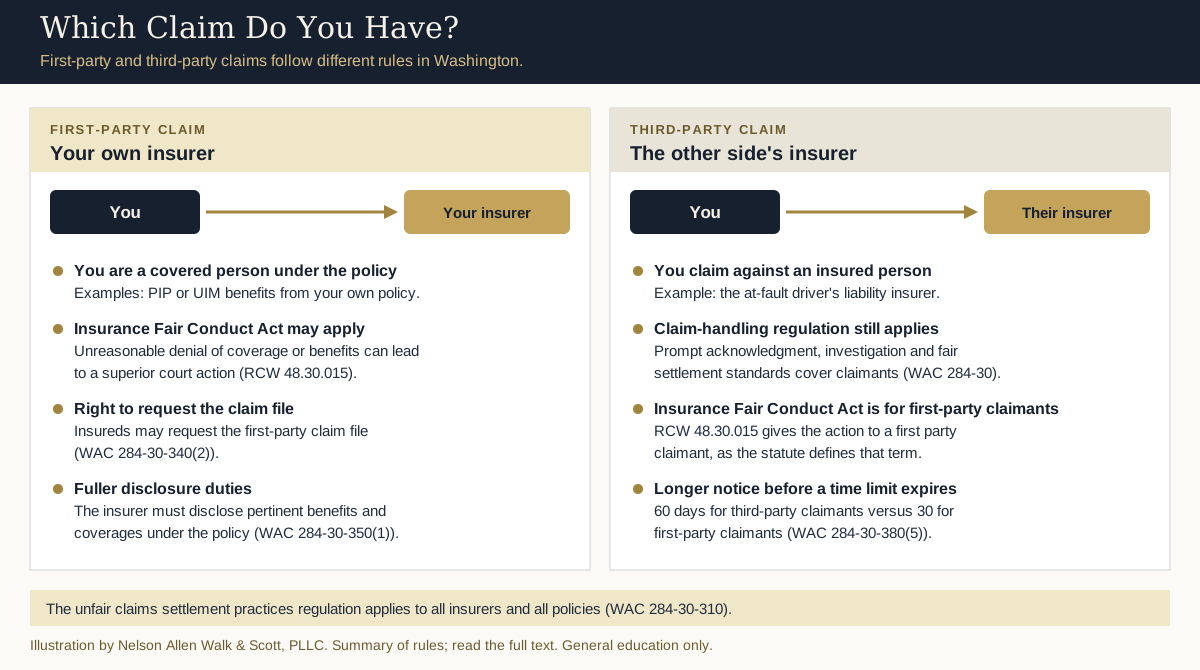
| Duty or remedy | First-party claim | Third-party claim | Source |
|---|---|---|---|
| Acknowledge notice of claim within 10 business days | Yes | Yes | WAC 284-30-360(1) |
| Complete investigation within 30 calendar days or explain in writing | Yes | Yes | WAC 284-30-370(1) |
| Accept-or-deny notice within 30 calendar days | Yes | Not stated in this subsection | WAC 284-30-380(1) |
| Right to request the claim file | Yes, for insureds | Not stated | WAC 284-30-340(2) |
| Lawsuit for unreasonable denial | Yes, after 20 days' notice | Not under this statute | RCW 48.30.015 |
| Written warning before a time limit, when negotiating with an unrepresented claimant | 30 days before | 60 days before | WAC 284-30-380(5) |
The Good-Faith Foundation
RCW 48.01.030 declares the business of insurance to be affected by the public interest. It requires all persons to act in good faith, abstain from deception, and practice honesty and equity in all insurance matters.
The commissioner's regulation builds on that. WAC 284-30-310 says it applies to all insurers and all insurance policies, and it is not exclusive, so other acts may also be violations.
Insurer Time Standards
Under WAC 284-30-360(1), an insurer must acknowledge receipt of a notice of claim within 10 business days for an individual policy, and notice to the insurer's agent counts. Other pertinent communications that reasonably suggest a response is expected need an appropriate reply within 10 business days.
WAC 284-30-370(1) requires an insurer to complete its investigation within 30 calendar days after a notification of claim, unless it cannot reasonably be completed in that time. If more time is needed, the insurer must explain the reasons in writing, and must send updates every 30 days.
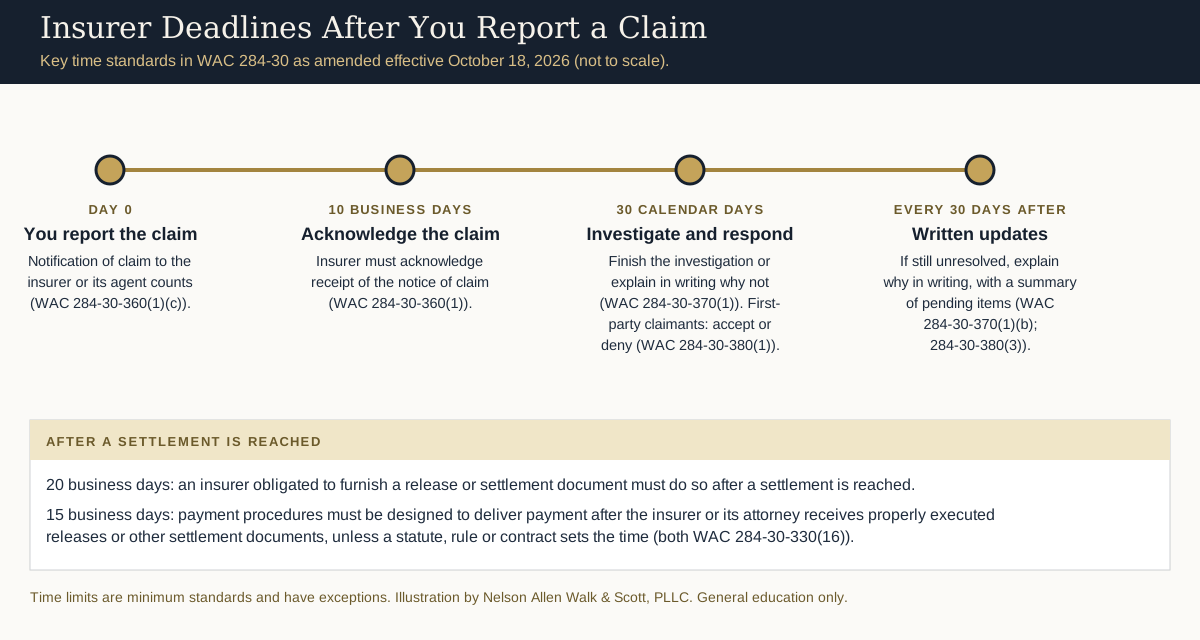
For first-party claims, WAC 284-30-380(1) requires notice of whether the claim is accepted or denied within 30 calendar days. A denial based on a policy provision must reference that provision, and it must be in writing.
After a settlement, WAC 284-30-330(16) says payment procedures must be designed to deliver payment within 15 business days after the insurer or its attorney receives properly executed releases or other settlement documents. The insurer must furnish a release within 20 business days after a settlement is reached, if it is obligated to furnish one.
Key point
Key point: these are standards, not guarantees
- The regulation sets minimum standards, and some timelines have exceptions, such as when an investigation cannot reasonably be completed in 30 days.
- Write down the date you reported the claim and keep the insurer's acknowledgment.
The Insurance Fair Conduct Act
RCW 48.30.015, known as the Insurance Fair Conduct Act, lets a first party claimant who is unreasonably denied a claim for coverage or payment of benefits sue in superior court. The claimant may recover actual damages, plus costs and reasonable attorneys' fees and litigation costs.
A court that finds an unreasonable denial, or a violation of certain listed claim-handling rules, may increase the award to as much as three times actual damages. Those listed rules include WAC 284-30-330, -350, -360, -370 and -380.
The statute has a notice step. Twenty days before filing, the first party claimant must give written notice of the basis for the action to both the insurer and the insurance commissioner's office. If notice is served within the filing period, the statute of limitations is tolled during those 20 days.
Caution
Caution: the Act is limited to first-party claims
- By its terms, RCW 48.30.015 gives its action to a first party claimant, and it does not apply to a health plan offered by a health carrier.
- The Act also says it does not limit other remedies available at law.
Recorded Statements and Medical Records
None of the claim-handling sections discussed here says that you must give a recorded statement to the other driver's insurer. Whether and how to give one is a decision to make carefully, ideally after talking with a lawyer. Your own policy may contain separate duties, so read it.
Medical records have their own rule. Under RCW 70.02.030(3), a disclosure authorization is valid only if it is written, dated, and signed, and identifies the information, the recipient, the provider, and the patient. It must also contain an expiration date or event.
On the insurer's side, WAC 284-30-330(11) identifies as an unfair practice delaying an investigation or payment by requiring a claimant or provider to submit documents and then requiring later submissions with substantially the same information.
What to do
What to do before signing an authorization
- Read what information it covers and who will receive it.
- Check the expiration date or event.
- Keep a copy, and ask what the insurer needs the records for.
Low Offers and Early Releases
Hypothetical example: an adjuster offers a modest payment in the first week, when treatment is just starting. The offer arrives with a release. The injured person does not yet know whether the pain will resolve in a month or require surgery.
A release is meant to end the claim it covers. Depending on its wording, it may prevent you from seeking more later, so read it before signing and understand exactly what it covers.
The regulation offers some protection. An insurer must promptly give a reasonable explanation of the policy basis, in relation to the facts or applicable law, for a denial or for an offer of compromise (WAC 284-30-330(13)). It may not ask a first party claimant to sign a release that extends beyond the subject matter that gave rise to the payment (WAC 284-30-350(5)).
For third-party claimants, WAC 284-30-380(6) bars statements suggesting that rights may be impaired if a form or release is not completed within a specified time, unless the statement notifies the claimant of a statute of limitations. And an insurer may not negotiate directly with a claimant known to be represented by an attorney without the attorney's knowledge and consent (WAC 284-30-330(19)).
Fault also affects what an insurer offers. Under RCW 4.22.005, contributory fault reduces damages proportionately but does not bar recovery. Our article on Washington's pure comparative fault rule explains how insurers use it.
Caution
Caution: do not sign because of a short deadline
- If an adjuster says a form must be signed quickly, ask for the reason in writing.
- A claim's real deadline is usually the statute of limitations, discussed below.
Keep Your Own Claim File
WAC 284-30-340(1) requires the insurer's claim files to contain all notes and work papers in enough detail that pertinent events and dates can be reconstructed. You should keep your own file too.
- The date and time you reported the claim, who you spoke to, and the claim number.
- Every letter, email, and acknowledgment, plus notes of each call.
- Photographs, the police report number, and witness names.
- Medical records and bills in order, and records of missed work.
- Any authorization or release you were asked to sign, and your copy of what you did sign.
For first-party claims, WAC 284-30-340(2) lets an insured request any portion of the first-party claim file at reasonable intervals. The insurer has 15 business days from receipt to provide the appropriate documents, and must say whether anything was redacted or withheld.
Our guide on what to do after a car accident in Washington covers the early steps in more detail.
Deadlines
RCW 4.16.080(2) requires an action for injury to the person to be commenced within three years. That is the general rule, and it is not a calculation for any one person. Policies can have their own time limits and notice requirements, so read yours.
RCW 48.30.015 states one tolling rule, for the 20-day notice period, and only when the notice is served within the time for filing. Do not assume that an insurer's delay pauses any deadline.
To talk through an insurance claim, visit our personal injury practice page or contact us. Nelson Allen Walk & Scott, PLLC is at 1103 Shaw Road, Puyallup, WA 98372, and the phone is (253) 845-8895.
Written by Nathan D. Sukhia, Of Counsel.
Frequently Asked Questions
How quickly must an insurer respond after I report a claim?+
Can I sue my own insurer if it unreasonably denies my claim?+
Does the Insurance Fair Conduct Act apply to the at-fault driver's insurer?+
Do I have to give a recorded statement?+
Can I get a copy of my own insurer's claim file?+
How long do I have to file a lawsuit for an injury claim?+
Sources & Further Reading
- 1.RCW 48.30.015 — Unreasonable Denial of a Claim for Coverage or Payment of BenefitsThe Insurance Fair Conduct Act: first party claimant action, enhanced damages, fees and costs, the 20-day notice, and the list of regulations.
- 2.RCW 48.01.030 — Public InterestGood faith, honesty and equity in all insurance matters.
- 3.WAC 284-30-300, 284-30-310 and 284-30-320Purpose, scope, and definitions of first party claimant, third-party claimant, claimant, and notification of claim.
- 4.WAC 284-30-330 — Specific Unfair Claims Settlement Practices DefinedSubsections (11), (13), (16) and (19), as amended effective October 18, 2026.
- 5.WAC 284-30-340 — File and Record DocumentationInsurer claim files and the insured's right to request the first-party claim file.
- 6.WAC 284-30-350 — Misrepresentation of Policy ProvisionsDisclosure of pertinent benefits and the limit on release scope.
- 7.WAC 284-30-360 — Standards to Acknowledge Pertinent CommunicationsThe 10-business-day acknowledgment and reply standards.
- 8.WAC 284-30-370 — Standards for Prompt Investigation of a ClaimThe 30-calendar-day investigation standard and written updates.
- 9.WAC 284-30-380 — Settlement Standards Applicable to All InsurersAccept or deny notice, time-limit warnings, and release statements.
- 10.RCW 70.02.030 — Patient Authorization of DisclosureRequirements for a valid health care information disclosure authorization.
- 11.RCW 4.22.005 — Effect of Contributory FaultContributory fault diminishes damages proportionately and does not bar recovery.
- 12.RCW 4.16.080 — Actions Limited to Three YearsSubsection (2) covers an action for any other injury to the person not otherwise enumerated.
Disclaimer
This article is provided for general informational purposes only and does not constitute legal advice. It is based on Washington law as of the date noted above; statutes, court rules, and case law can and do change, and this article may not reflect the most current legal developments or apply to your specific facts.
Reading this article, contacting Nelson Allen Walk & Scott through this website, or submitting information through our contact form does not create an attorney-client relationship. An attorney-client relationship is formed only after both parties sign a written engagement agreement. Please do not send any confidential or time-sensitive information until that relationship has been established.
Every case is different, and past outcomes described or implied on this site do not guarantee or predict a similar result in any future matter. If you need advice about your specific situation, please consult directly with Nathan D. Sukhia or another licensed Washington attorney.
Attorney Advertising.
Experience · Expertise · Excellence
Talk to Nathan D. Sukhia
Nathan D. Sukhia and our team are happy to talk through your specific situation.