
Truck Accidents in Washington: Who Can Be Responsible and What Evidence Matters
Key Takeaways
- Washington allocates fault by percentage among every entity that caused the harm, and a party is responsible for the fault of its agent or servant (RCW 4.22.070(1)(a)).
- Federal rules limit driving time for property-carrying drivers and require records of duty status, usually kept on an ELD (49 CFR 395.3; 395.8).
- Carriers must keep certain records only for set minimum periods, such as six months for duty status records and three months for driver inspection reports (49 CFR 395.8(k); 396.11(a)(4)).
- Federal rules set minimum public liability coverage for listed types of motor carriers (49 CFR 387.7; 387.9).
- The general deadline to sue for injury to the person is three years (RCW 4.16.080(2)).
Hypothetical example: a loaded tractor-trailer drifts across a lane on I-5 and sideswipes a car. The car's driver is hurt, and the trucking company's insurer calls within days.
Truck crashes can involve more parties than car crashes, and federal rules create records that can show what happened.
This article explains what the law says. It is general education, not advice about any one crash.
Who Can Be Responsible
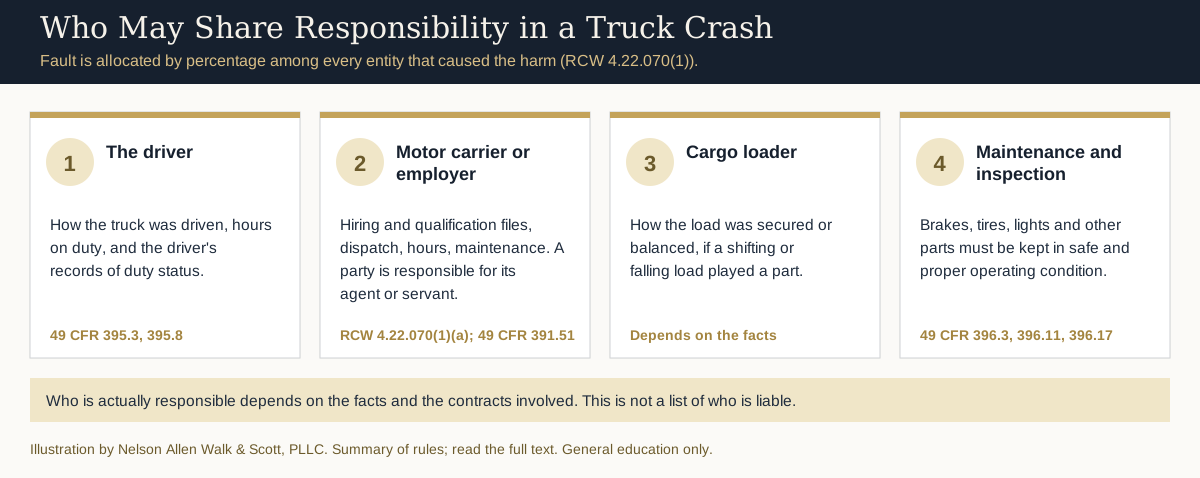
A truck crash can involve several businesses besides the driver. Depending on the facts, these may include the motor carrier that employed or dispatched the driver, a company that loaded the cargo, and whoever inspected and maintained the truck.
Washington law allocates fault among all of them. Under RCW 4.22.070(1), the trier of fact determines the percentage of total fault attributable to every entity that caused the claimant's damages, and the percentages total one hundred percent.
Liability is generally several only, meaning each defendant pays its own share. The statute lists exceptions, described below.
Joint and Several Liability Exceptions
RCW 4.22.070(1)(a) makes a party responsible for the fault of another person when both were acting in concert, or when a person was acting as an agent or servant of the party. Whether a driver was acting as a carrier's agent or servant is a fact question.
Under RCW 4.22.070(1)(b), if the claimant is found not at fault, the defendants against whom judgment is entered are jointly and severally liable for the sum of their proportionate shares. Joint and several liability means each such defendant can be required to pay that combined amount.
Key point
Key point: identify every party early
- Fault is allocated among every entity that caused the harm, so it matters who was involved.
- Contracts, leases and dispatch records can show who controlled the truck, the driver and the load.
Hours-of-Service Rules
Federal rules limit how long a property-carrying commercial driver may drive. Under 49 CFR 395.3(a), a driver may not drive without first taking 10 consecutive hours off duty, and may not drive after 14 consecutive hours on duty following that break.
Within that 14-hour period, a driver may drive a total of 11 hours. Driving is not permitted after 8 hours of driving time without at least a 30-minute interruption, except for drivers who qualify for certain short-haul exceptions.
Section 395.3(b) also bars driving after 60 hours on duty in 7 consecutive days, or 70 hours in 8 consecutive days if the carrier operates every day of the week. These rules apply "except as otherwise provided in § 395.1," which lists exceptions.
| Rule | What the regulation says | Source |
|---|---|---|
| Start of shift | 10 consecutive hours off duty before driving | 395.3(a)(1) |
| 14-hour window | No driving after 14 consecutive hours on duty | 395.3(a)(2) |
| Driving time | Up to 11 hours of driving in the 14-hour window | 395.3(a)(3)(i) |
| Break | At least a 30-minute interruption after 8 hours of driving | 395.3(a)(3)(ii) |
| Weekly limit | 60 hours in 7 days, or 70 hours in 8 days | 395.3(b) |
Records That Can Show What Happened
49 CFR 395.8(a) requires a motor carrier to have each driver record duty status for each 24-hour period. Carriers generally must use an electronic logging device (ELD), with limited exceptions for manual records.
Under 49 CFR 391.51, each motor carrier must keep a driver qualification file for each driver it employs. The file includes the employment application, motor vehicle records, the road test certificate or equivalent, and the medical examiner's certificate.
49 CFR 396.3(a) requires carriers to systematically inspect, repair and maintain the vehicles they control, and keep parts in safe and proper operating condition at all times. 49 CFR 396.11 requires drivers to prepare a written report at the end of each day's work on each vehicle, listing any defect discovered or reported, with exceptions. 49 CFR 396.17 requires periodic inspections at least once every 12 months.
Before a vehicle is operated again, the carrier or its agent must repair any listed defect likely to affect safe operation, and certify on the report that it was repaired or that repair is unnecessary (49 CFR 396.11(a)(3)). Those reports and certifications can help show whether a known problem was fixed.
How Long Carriers Keep Records
The federal rules set minimum retention periods, and some are short. After a period ends, a carrier may no longer be required to keep the record.
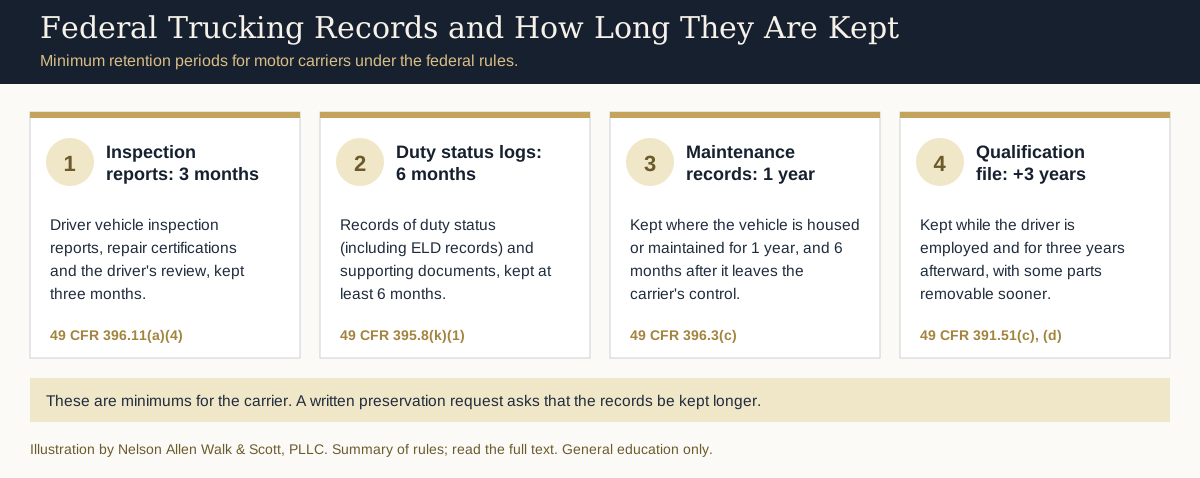
- Records of duty status and supporting documents: at least 6 months from receipt (49 CFR 395.8(k)(1)).
- Driver vehicle inspection reports and repair certifications: three months from the date prepared (49 CFR 396.11(a)(4)).
- Inspection, repair and maintenance records: 1 year where the vehicle is housed or maintained, and 6 months after it leaves the carrier's control (49 CFR 396.3(c)).
- Driver qualification file: while the driver is employed and three years after, with some items removable after three years (49 CFR 391.51(c), (d)).
What to do
Preserving evidence: general information
- A preservation letter is a written request asking a carrier and its insurer to keep specific evidence, such as ELD data, logs, dispatch records, inspection reports, maintenance files, and camera footage.
- Send it early, before minimum retention periods run. A lawyer can tailor what it asks for.
- Keep your own photos, witness names, medical records, and the police report number.
Insurance Minimums for Motor Carriers
Under 49 CFR 387.7(a), a covered motor carrier may not operate a motor vehicle until it has the minimum financial responsibility set out in 49 CFR 387.9. Proof must be kept at the carrier's principal place of business and is public information available on reasonable request.
The 387.9 schedule sets $750,000 for for-hire carriage of nonhazardous property in interstate or foreign commerce in vehicles of 10,001 pounds or more. Higher minimums of $1,000,000 or $5,000,000 apply to listed hazardous materials. These are minimums, not amounts anyone recovers.
Caution
Caution: minimums are not the whole picture
- Whether the federal schedule applies depends on the type of carrier and cargo.
- Your own policy may also apply. Our PIP and UIM article explains that coverage.
Fault and Deadlines
Under RCW 4.22.005, contributory fault chargeable to the claimant reduces damages proportionately but does not bar recovery. Our comparative fault article explains how that works.
RCW 4.16.080(2) requires an action for injury to the person to be commenced within three years. That is the general rule, not a calculation for any one person. Families who lost someone can read our wrongful death article.
For first steps after any crash, see our guide on what to do after a car accident in Washington. If an adjuster calls, our article on dealing with insurance adjusters explains the claim-handling rules. If the truck left the scene, see our hit-and-run article.
To talk through a truck crash, visit our personal injury practice page or contact us. Nelson Allen Walk & Scott, PLLC is at 1103 Shaw Road, Puyallup, WA 98372, and the phone is (253) 845-8895.
Written by Nathan D. Sukhia, Of Counsel.
Frequently Asked Questions
Can the trucking company be responsible, not just the driver?+
How many hours can a truck driver drive?+
What is an ELD and why does it matter?+
What is a preservation letter?+
What if I was partly at fault?+
How long do I have to file a lawsuit after a truck crash?+
Sources & Further Reading
- 1.RCW 4.22.070 — Percentage of FaultAllocation of fault, several liability, and the agent or servant and fault-free claimant exceptions.
- 2.RCW 4.22.005 — Effect of Contributory FaultContributory fault reduces damages but does not bar recovery.
- 3.RCW 4.16.080 — Actions Limited to Three YearsSubsection (2) covers an action for any other injury to the person not otherwise enumerated.
- 4.49 CFR 395.3 — Maximum Driving Time for Property-Carrying Vehicles10-hour off-duty, 14-hour window, 11-hour driving, 30-minute break, and 60/70-hour limits.
- 5.49 CFR 395.8 — Driver's Record of Duty StatusELD requirement and six-month retention of records of duty status.
- 6.49 CFR 391.51 — Driver Qualification FilesContents and retention of driver qualification files.
- 7.49 CFR 396.3, 396.11 and 396.17 — Inspection, Repair and MaintenanceSystematic maintenance, driver vehicle inspection reports, periodic inspection, and retention periods.
- 8.49 CFR 387.7 and 387.9 — Financial ResponsibilityMinimum levels of public liability coverage for listed types of carriage.
Disclaimer
This article is provided for general informational purposes only and does not constitute legal advice. It is based on Washington law as of the date noted above; statutes, court rules, and case law can and do change, and this article may not reflect the most current legal developments or apply to your specific facts.
Reading this article, contacting Nelson Allen Walk & Scott through this website, or submitting information through our contact form does not create an attorney-client relationship. An attorney-client relationship is formed only after both parties sign a written engagement agreement. Please do not send any confidential or time-sensitive information until that relationship has been established.
Every case is different, and past outcomes described or implied on this site do not guarantee or predict a similar result in any future matter. If you need advice about your specific situation, please consult directly with Nathan D. Sukhia or another licensed Washington attorney.
Attorney Advertising.
Experience · Expertise · Excellence
Talk to Nathan D. Sukhia
Nathan D. Sukhia and our team are happy to talk through your specific situation.