
Washington Personal Injury Statute of Limitations: Filing Deadlines Explained
Key Takeaways
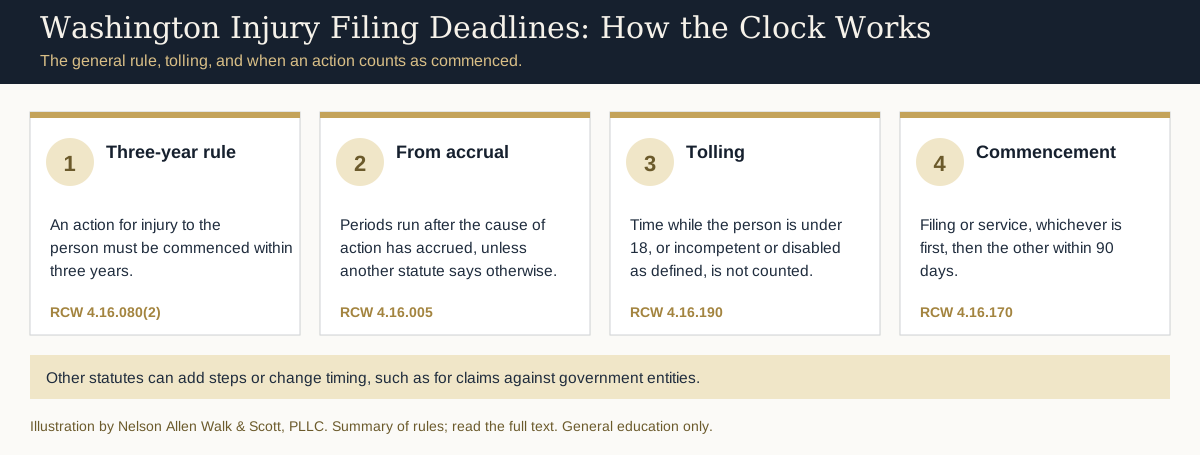
- An action for injury to the person generally must be commenced within three years (RCW 4.16.080(2)).
- Limitation periods run after the cause of action has accrued, unless another statute says otherwise (RCW 4.16.005).
- Time while an injured person is under 18, or incompetent or disabled as the statute defines, is not counted (RCW 4.16.190).
- An action is commenced when the complaint is filed or the summons is served, whichever is first, with a 90-day requirement to complete the other step (RCW 4.16.170).
- Talking with an insurer does not appear in these statutes as something that stops the clock.
Hypothetical example: a driver is rear-ended and spends months in treatment while negotiating with the other driver's insurer. As the anniversary dates pass, the driver starts to wonder how long there is to file a lawsuit.
Washington law sets that deadline by statute. This article explains the general rule for personal injury claims, how the clock can pause, and what it takes to commence an action. It is general education, not advice about any one claim.
The General Three-Year Rule
RCW 4.16.080 lists actions that must be commenced within three years. Subsection (2) includes an action for taking, detaining or injuring personal property, or for any other injury to the person or rights of another not otherwise listed.
That subsection is the general limitation period for many personal injury claims, such as claims from car crashes, falls and dog bites. Some claims are governed by other statutes, so the type of claim matters.
RCW 4.16.005 says actions can only be commenced within the periods in chapter 4.16 after the cause of action has accrued. It also recognizes that a statute outside the chapter may prescribe a different limitation in special cases.
Key point
Key point: three years is the general rule, not a guarantee
- RCW 4.16.080(2) sets the general period for injury to the person.
- Other statutes can prescribe different periods or add steps, so confirm the deadline for your claim.
When the Clock Starts
Under RCW 4.16.005, the limitation period runs after the cause of action has accrued. In many injury cases, that is when the injury happens.
Exactly when a particular claim accrues can be a legal question that depends on the facts. If the date is unclear, treat the earliest possible date as the one to plan around and get advice promptly.
Tolling for Minors and Incapacity
RCW 4.16.190 pauses the clock for certain personal disabilities. If, when the cause of action accrued, the person entitled to sue was under eighteen, the time of that disability is not part of the limitation period.
The same applies if the person was incompetent or disabled to such a degree that he or she cannot understand the nature of the proceedings, as determined under chapter 11.130 RCW. It also applies to a person imprisoned on a criminal charge before sentencing.
The statute looks at the person's status when the cause of action accrued. It begins with the words "unless otherwise provided in this section," so read the full text for exceptions.
Caution
Caution: hypothetical minor example
- Hypothetical: a 12-year-old passenger is hurt in a crash. Under RCW 4.16.190, the years before the child turns 18 are not counted toward the three-year period for the child's own claim.
- Claims by others, such as a parent's own claims, may be treated differently. Do not assume every related claim is paused.
When a Lawsuit Counts as Commenced
Meeting the deadline means commencing an action, which has a specific meaning. Under RCW 4.16.170, for tolling the statute of limitations, an action is deemed commenced when the complaint is filed or the summons is served, whichever occurs first.
If the complaint is filed first, the plaintiff must serve one or more defendants personally, or begin service by publication, within ninety days of filing. If service comes first, the plaintiff must file the summons and complaint within ninety days of service.
If that second step is not completed in time, the action is deemed not to have been commenced for purposes of tolling the statute of limitations. That can matter a great deal when a case is filed close to the deadline.
| Topic | What the statute says | Source |
|---|---|---|
| General period | Injury to the person: three years | RCW 4.16.080(2) |
| Start | After the cause of action has accrued | RCW 4.16.005 |
| Minors | Time under age 18 is not counted | RCW 4.16.190 |
| Incapacity | Time of qualifying incompetency or disability is not counted | RCW 4.16.190 |
| Commenced | Complaint filed or summons served, whichever is first | RCW 4.16.170 |
| Follow-up | Complete service or filing within 90 days | RCW 4.16.170 |
Hypothetical Timelines
The examples below are hypothetical and simplified. They show how the statutes fit together, not how any real claim would come out.
- Hypothetical A: an adult is hurt in a crash, and the claim accrues on the day of the crash. Under RCW 4.16.080(2), the general period is three years from that point.
- Hypothetical B: a 16-year-old is hurt. Under RCW 4.16.190, the time before the teen turns 18 is not counted, so the three-year period generally runs after that birthday for the teen's own claim.
- Hypothetical C: a complaint is filed shortly before the deadline, but no defendant is served within 90 days. Under RCW 4.16.170, the action is deemed not commenced for tolling purposes.
Each of these depends on facts the examples leave out, such as when the claim accrued and whether a special statute applies. Use them to understand the rules, not to set your own date.
Common Mistakes to Avoid
One common mistake is assuming that an open insurance claim protects the deadline. Another is waiting to file until treatment ends, without checking how much time is left.
A third is filing a complaint and then not completing service in time. RCW 4.16.170 ties the filing date to timely service, so both steps matter.
Finally, people sometimes assume a child's tolling also covers a parent's own claims. RCW 4.16.190 speaks to the person entitled to bring the action, so each claim should be checked separately.
Special Situations
Claims against the State or a local government entity involve a claim form and a 60-day waiting period before suit, with their own tolling rules. Our article on injury claims against government entities covers those steps.
When an injury causes death, different claims and parties are involved. Our article on wrongful death claims in Washington explains who may file.
If you are not sure whether a special statute applies to your claim, that is a reason to talk with a lawyer early, not late.
Insurance Talks Do Not Stop the Clock
Many injury claims are negotiated with an insurer before any lawsuit. The statutes above do not list insurance negotiations as something that pauses the limitation period.
That means a claim can be open with an insurer while the deadline keeps running. Our article on insurance claim handling rules explains what insurers must do, and our PIP and UIM article covers your own coverage.
Practical Steps to Protect Your Deadline
Write down the date of the injury and any dates that could matter for accrual. Keep that date somewhere you will see it.
Collect records early, including the police report, medical records, photos and witness information. Waiting can make evidence harder to find.
What to do
Next steps
- Note the injury date and calculate the general three-year date from it.
- Ask whether any tolling rule or special statute applies to your claim.
- Read our guide on what to do after a car accident in Washington.
- Contact us well before the deadline to talk about your situation.
Shared fault does not change the filing deadline, but it can affect damages. Our comparative fault article explains how.
To talk through a filing deadline, visit our personal injury practice page or contact us. Nelson Allen Walk & Scott, PLLC is at 1103 Shaw Road, Puyallup, WA 98372, and the phone is (253) 845-8895.
Written by Nathan D. Sukhia, Of Counsel.
Frequently Asked Questions
How long do I have to file a personal injury lawsuit in Washington?+
When does the three-year period start?+
Does the deadline pause for a child who was injured?+
What counts as starting a lawsuit on time?+
Does negotiating with an insurance company stop the clock?+
Are the deadlines different for claims against the government?+
Sources & Further Reading
- 1.RCW 4.16.080 — Actions Limited to Three YearsSubsection (2): injury to the person or rights of another.
- 2.RCW 4.16.005 — Commencement of ActionsPeriods run after accrual unless another statute prescribes otherwise.
- 3.RCW 4.16.190 — Statute Tolled by Personal DisabilityMinors, qualifying incompetency or disability, and pre-sentencing imprisonment.
- 4.RCW 4.16.170 — When an Action Is Deemed CommencedFiling or service, and the 90-day requirement.
Disclaimer
This article is provided for general informational purposes only and does not constitute legal advice. It is based on Washington law as of the date noted above; statutes, court rules, and case law can and do change, and this article may not reflect the most current legal developments or apply to your specific facts.
Reading this article, contacting Nelson Allen Walk & Scott through this website, or submitting information through our contact form does not create an attorney-client relationship. An attorney-client relationship is formed only after both parties sign a written engagement agreement. Please do not send any confidential or time-sensitive information until that relationship has been established.
Every case is different, and past outcomes described or implied on this site do not guarantee or predict a similar result in any future matter. If you need advice about your specific situation, please consult directly with Nathan D. Sukhia or another licensed Washington attorney.
Attorney Advertising.
Experience · Expertise · Excellence
Talk to Nathan D. Sukhia
Nathan D. Sukhia and our team are happy to talk through your specific situation.