
Merging and On-Ramp Crashes in Washington: Yield Duties, Lane Position, and Fault
Key Takeaways
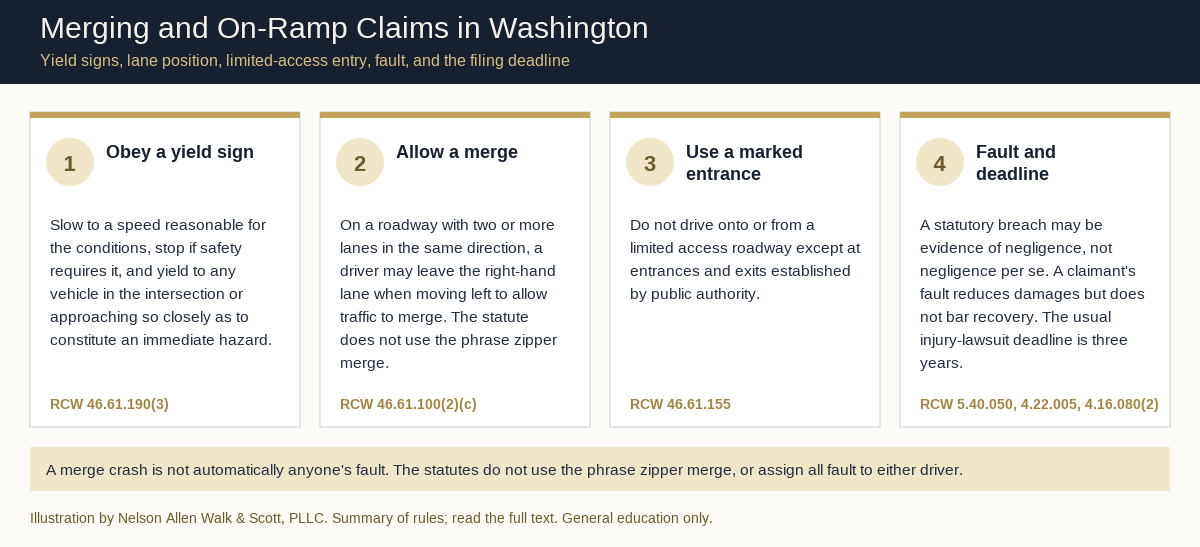
- A driver approaching a yield sign must slow to a speed reasonable for the existing conditions, stop if safety requires it, and yield to any vehicle in the intersection or approaching on another roadway so closely as to constitute an immediate hazard (RCW 46.61.190(3)).
- If a driver is involved in a collision with a vehicle in the intersection or junction of roadways after driving past a yield sign without stopping, the collision is deemed prima facie evidence of the driver's failure to yield right-of-way (RCW 46.61.190(3)).
- No person shall drive a vehicle onto or from a limited access roadway except at entrances and exits established by public authority (RCW 46.61.155).
- On a roadway with two or more lanes for traffic moving in the same direction, driving in the right-hand lane then available has an exception when moving left to allow traffic to merge (RCW 46.61.100(2)(c)). The statute does not use the phrase zipper merge, and it does not say a through driver must change lanes or is automatically at fault.
- A statutory breach of these rules may be considered as evidence of negligence, but it is not negligence per se (RCW 5.40.050). A claimant's own fault reduces damages proportionately but does not bar recovery (RCW 4.22.005). The general deadline for an injury lawsuit is three years (RCW 4.16.080(2)).
Hypothetical example: a driver enters a Pierce County limited-access highway from an on-ramp. At the end of the ramp, the entering car and a car already on the highway come together. Each driver says the other should have yielded or should have made room.
Crashes at on-ramps and merge points raise questions about yield and stop signs, where a driver may enter a limited-access roadway, and whether a through driver may move left to allow traffic to merge. This article explains those statutes. It is general education, not advice about any one crash.
Yield Signs at Highway Entry
RCW 46.61.190(1) says preferential right-of-way may be indicated by stop signs or yield signs as authorized in RCW 47.36.110. Drivers must also obey official traffic control devices under RCW 46.61.050.
RCW 47.36.110 addresses stop signs and yield signs on the state highway system. It provides that when the findings of a traffic engineering study show that the condition of an intersection is such that vehicles may safely enter the major artery without stopping, the department or local authorities in their respective jurisdictions shall install and maintain a Yield sign.
Under RCW 46.61.190(3), the driver of a vehicle approaching a yield sign shall, in obedience to such sign, slow down to a speed reasonable for the existing conditions and, if required for safety to stop, shall stop at a clearly marked stop line.
If there is no stop line, the driver shall stop before entering a marked crosswalk on the near side of the intersection, or if none, then at the point nearest the intersecting roadway where the driver has a view of approaching traffic on the intersecting roadway before entering the roadway.
After slowing or stopping, the driver shall yield the right-of-way to any vehicle in the intersection or approaching on another roadway so closely as to constitute an immediate hazard during the time such driver is moving across or within the intersection or junction of roadways.
The same subsection adds a proviso. If such a driver is involved in a collision with a vehicle in the intersection or junction of roadways, after driving past a yield sign without stopping, such collision shall be deemed prima facie evidence of the driver's failure to yield right-of-way.
Key point
Key point: a merge crash is not automatically anyone's fault
- A yield sign requires the approaching driver to slow, to stop if safety requires it, and to yield to vehicles that present an immediate hazard.
- No statute in this article says that the entering driver, or the driver already on the highway, is automatically at fault in every on-ramp or merge crash.
When the Entry Has a Stop Sign
Not every highway entry has a yield sign. Some junctions use a stop sign. Under RCW 46.61.190(2)(a), except when directed to proceed by a duly authorized flagger, police officer, or firefighter with authority to regulate traffic, every driver approaching a stop sign shall stop.
The stop is at a clearly marked stop line, or if none, before entering a marked crosswalk on the near side of the intersection, or if none, at the point nearest the intersecting roadway where the driver has a view of approaching traffic before entering the roadway.
After stopping, the driver shall yield the right-of-way to any vehicle in the intersection or approaching on another roadway so closely as to constitute an immediate hazard during the time when such driver is moving across or within the intersection or junction of roadways.
RCW 46.61.195 also provides that the operator of any vehicle entering upon any arterial highway from any other public highway or private way shall come to a complete stop before entering the arterial highway when stop signs are erected as provided by law.
Limited-Access Entrances
Many freeway and expressway on-ramps lead onto a limited access roadway. Under RCW 46.61.155, no person shall drive a vehicle onto or from any limited access roadway except at such entrances and exits as are established by public authority.
That rule is about where a driver may enter or leave. It does not, by itself, decide who must yield once the driver is on an established ramp or in a marked merge area.
Moving Left to Allow Traffic to Merge
RCW 46.61.100(2) applies upon all roadways having two or more lanes for traffic moving in the same direction. All vehicles shall be driven in the right-hand lane then available for traffic, with listed exceptions.
One of those exceptions is when moving left to allow traffic to merge (RCW 46.61.100(2)(c)). The others include overtaking and passing, traveling at a speed greater than the traffic flow, and preparing for a legally permitted left turn at an intersection, exit, or into a private road or driveway.
The statute describes a permitted reason to leave the right-hand lane. It does not say that every through driver must change lanes for a merging vehicle. It also does not say that a through driver who stays in the right-hand lane is automatically at fault.
Caution
Caution: zipper merge is not a statutory phrase
- Washington's Revised Code does not use the phrase zipper merge in the statutes cited here.
- Hypothetical: two drivers disagree about whether they should have alternated at the end of a ramp. RCW 46.61.100(2)(c) allows a move left to allow traffic to merge. It does not create a separate zipper-merge duty or assign all fault to either driver.
Leaving a Lane Only When the Movement Is Safe
An acceleration lane or merge lane may be a clearly marked lane. Whenever a roadway has been divided into two or more clearly marked lanes for traffic, RCW 46.61.140(1) requires a vehicle to be driven as nearly as practicable entirely within a single lane.
The same subsection says the vehicle shall not be moved from such lane until the driver has first ascertained that such movement can be made with safety. That duty can apply when a driver leaves a ramp lane or a through lane.
RCW 46.61.205 is a different rule. It requires the driver of a vehicle about to enter or cross a highway from a private road or driveway to yield the right-of-way to all vehicles lawfully approaching on that highway. A public on-ramp is not that situation.
| Topic | What the statute requires | Source |
|---|---|---|
| Yield sign | Slow to a speed reasonable for the conditions, stop if safety requires it, and yield to a vehicle in the intersection or approaching so closely as to constitute an immediate hazard | RCW 46.61.190(3) |
| Passing a yield sign without stopping | A collision with a vehicle in the intersection or junction of roadways after driving past a yield sign without stopping is deemed prima facie evidence of failure to yield | RCW 46.61.190(3) |
| Stop sign | Stop, then yield to a vehicle in the intersection or approaching so closely as to constitute an immediate hazard | RCW 46.61.190(2)(a) |
| Limited-access entry | Do not drive onto or from a limited access roadway except at entrances and exits established by public authority | RCW 46.61.155 |
| Moving left to allow a merge | An exception to the right-hand-lane rule, when moving left to allow traffic to merge, on a roadway with two or more lanes in the same direction | RCW 46.61.100(2)(c) |
| Lane movement | Do not leave a marked lane until the driver has first ascertained that the movement can be made with safety | RCW 46.61.140(1) |
How a Violation Relates to a Negligence Claim
A traffic citation is not a civil verdict. Under RCW 5.40.050, a breach of a duty imposed by statute, ordinance, or administrative rule shall not be considered negligence per se, but may be considered by the trier of fact as evidence of negligence.
The same statute lists categories that are treated as negligence per se, including driving under the influence. The yield, stop, limited-access, right-lane, and lane-movement rules discussed here are not in that list.
The prima facie language in RCW 46.61.190(3) addresses failure to yield right-of-way when a driver goes past a yield sign without stopping and then collides with a vehicle in the intersection or junction of roadways. It does not, by itself, convert that breach into negligence per se under RCW 5.40.050.
Comparative Fault
Both drivers in a merge-area crash may have duties. One may have passed a yield sign without slowing or stopping as required. The other may have left a lane without first ascertaining that the movement could be made with safety, or may have followed too closely.
Under RCW 4.22.005, any contributory fault chargeable to the claimant diminishes damages proportionately but does not bar recovery.
Our comparative fault article explains that rule. Hypothetical: an entering driver moves into a through lane at the same time a highway driver changes speed or position. The statutes in this article do not automatically assign all of the fault to either driver.
Evidence and Practical Steps
Useful evidence after an on-ramp or merge crash can include photos of any yield or stop sign, pavement markings, and the point of contact. Dashcam or other video, and witness accounts of speed, signals, and whether a driver stopped or slowed, often matter.
- Photos of yield or stop signs, lane markings, and vehicle damage, if you can take them safely
- Dashcam, traffic-camera, or other video of the ramp, the merge, and each vehicle's path
- Names of witnesses and what they say about slowing, stopping, signals, and lane position
- The police report number and any citation numbers
- Medical records and your insurance declarations page
This is practical guidance, not a list of what any court will require or admit.
Get medical care promptly, even if you feel fine at the scene. Some injuries show up later. Keep copies of bills and notes about missed work.
Insurance and Filing Deadline
Personal injury protection and underinsured motorist coverage may apply, depending on the policies. Our PIP and UIM article explains both, and our article on insurance claim handling rules covers dealing with adjusters.
RCW 4.16.080(2) requires an action for injury to the person to be commenced within three years. Our article on the personal injury statute of limitations explains accrual, tolling, and what counts as commencing an action.
If the issue is the public roadway itself, claims against a government entity have extra pre-suit steps. Our article on injury claims against government entities covers those rules.
What to do
Next steps
- Get medical care and keep every record.
- Photograph any yield or stop sign, lane markings, and vehicle damage if you can do so safely.
- Preserve dashcam or other video and write down witness names.
- Contact us to talk about your situation.
Related reading includes our guide on what to do after a car accident in Washington, and our articles on distracted driving, truck accident claims, and hit-and-run claims.
To talk through an on-ramp or merge crash, visit our personal injury practice page or contact us. Nelson Allen Walk & Scott, PLLC is at 1103 Shaw Road, Puyallup, WA 98372, and the phone is (253) 845-8895.
Written by Nathan D. Sukhia, Of Counsel.
Frequently Asked Questions
Is the driver who was merging always at fault in a Washington on-ramp crash?+
What does a yield sign require at a highway entrance?+
If I go past a yield sign without stopping and there is a crash, does that prove I failed to yield?+
Do Washington statutes require a zipper merge?+
Can a driver already on the highway share fault in a merge crash?+
How long do I have to file a lawsuit after an on-ramp or merge crash?+
Sources & Further Reading
- 1.RCW 46.61.190 — Vehicle Entering Stop or Yield IntersectionYield-sign duties, including slowing, stopping if required for safety, yielding to an immediate hazard, and the prima facie proviso after passing a yield sign without stopping.
- 2.RCW 47.36.110 — Stop Signs, Yield SignsAuthority to require stops at intersections on the state highway system, and to install a Yield sign when a traffic engineering study supports entering without stopping.
- 3.RCW 46.61.050 — Obedience to Traffic Control DevicesDrivers shall obey official traffic control devices, subject to listed exceptions.
- 4.RCW 46.61.195 — Arterial Highways DesignatedA driver entering an arterial highway from another public highway or private way shall stop when stop signs are erected as provided by law.
- 5.RCW 46.61.155 — Restricted AccessEnter or leave a limited access roadway only at entrances and exits established by public authority.
- 6.RCW 46.61.100 — Keep Right Except When Passing, etc.Right-hand-lane rule, including the exception for moving left to allow traffic to merge.
- 7.RCW 46.61.140 — Driving on Roadways Laned for TrafficStay in a single lane as nearly as practicable; do not move until the driver has first ascertained that the movement can be made with safety.
- 8.RCW 46.61.205 — Vehicle Entering Highway from Private Road or DrivewayA different yield rule that applies when entering or crossing a highway from a private road or driveway.
- 9.RCW 5.40.050 — Breach of Duty as Evidence of NegligenceA statutory breach may be evidence of negligence; listed negligence-per-se exceptions.
- 10.RCW 4.22.005 — Effect of Contributory FaultA claimant's fault reduces damages but does not bar recovery.
- 11.RCW 4.16.080 — Actions Limited to Three YearsSubsection (2): injury to the person.
Disclaimer
This article is provided for general informational purposes only and does not constitute legal advice. It is based on Washington law as of the date noted above; statutes, court rules, and case law can and do change, and this article may not reflect the most current legal developments or apply to your specific facts.
Reading this article, contacting Nelson Allen Walk & Scott through this website, or submitting information through our contact form does not create an attorney-client relationship. An attorney-client relationship is formed only after both parties sign a written engagement agreement. Please do not send any confidential or time-sensitive information until that relationship has been established.
Every case is different, and past outcomes described or implied on this site do not guarantee or predict a similar result in any future matter. If you need advice about your specific situation, please consult directly with Nathan D. Sukhia or another licensed Washington attorney.
Attorney Advertising.
Experience · Expertise · Excellence
Talk to Nathan D. Sukhia
Nathan D. Sukhia and our team are happy to talk through your specific situation.