
Injury Claims Against Government Entities in Washington: Notice-of-Claim Rules
Key Takeaways
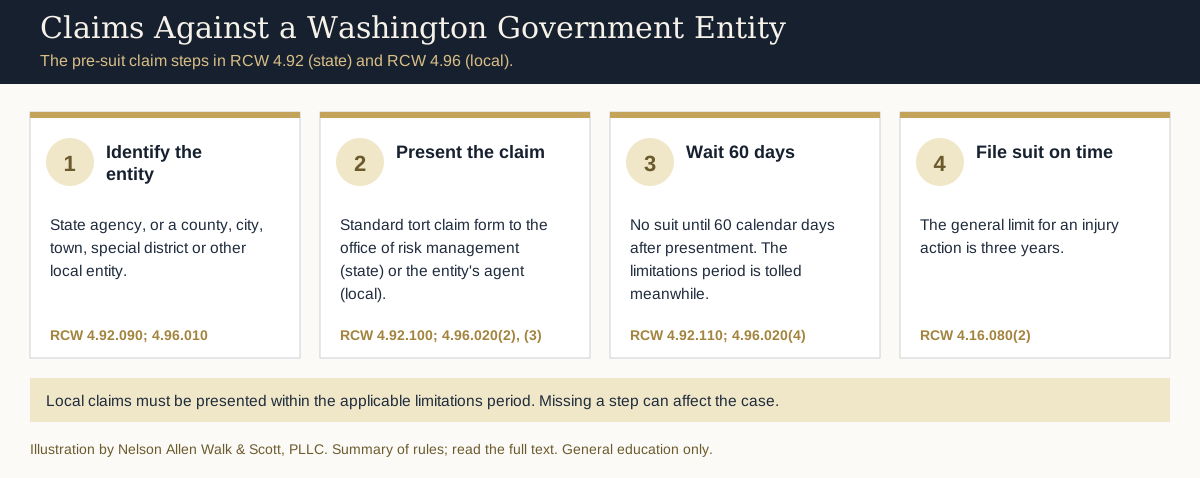
- The State and local governmental entities are liable for their tortious conduct to the same extent as a private person or corporation (RCW 4.92.090; 4.96.010(1)).
- Claims against the State go to the office of risk management on the standard tort claim form (RCW 4.92.100).
- Claims against a local entity go to the agent its governing body appoints, within the applicable limitations period (RCW 4.96.020(2)).
- No lawsuit may be filed until 60 calendar days after the claim is presented, and the limitations period is tolled during that time (RCW 4.92.110; 4.96.020(4)).
- The general deadline for an action for injury to the person is three years (RCW 4.16.080(2)).
Hypothetical example: a driver is hurt when a city maintenance truck runs a stop sign. The driver expects to deal with an ordinary insurer, but the claim is against a city.
Claims against government entities in Washington follow extra steps before any lawsuit. This article explains what the statutes say. It is general education, not advice about any one claim.
Government Entities Can Be Liable
Under RCW 4.92.090, the State of Washington is liable for damages arising out of its tortious conduct to the same extent as if it were a private person or corporation. That applies whether the State acts in a governmental or proprietary capacity.
RCW 4.96.010(1) applies the same rule to local governmental entities, including for the tortious conduct of their officers, employees or volunteers performing official duties. It also makes filing a claim within the time allowed by law a condition precedent to suing.
Under RCW 4.96.010(2), a local governmental entity includes a county, city, town, special district, municipal corporation, quasi-municipal corporation, and public hospital, among others. Whether a particular agency, such as a transit agency, falls under RCW 4.92, RCW 4.96 or another statute depends on how it is organized.
Key point
Key point: identify the right entity first
- State agencies follow RCW 4.92. Counties, cities and other local entities follow RCW 4.96.
- The answer controls where the claim goes and which form and agent apply.
State Claims Under RCW 4.92
Under RCW 4.92.100(1), claims against the State or its officers, employees or volunteers for damages arising out of tortious conduct must be presented to the office of risk management. Claims must be on the standard tort claim form, posted on the Department of Enterprise Services' website.
A claim is deemed presented when the form is delivered in person, by regular, registered or certified mail, as an email attachment, or by fax to the office of risk management.
Local Claims Under RCW 4.96
Under RCW 4.96.020(2), each local entity's governing body must appoint an agent to receive claims. The agent's identity and address are public records, recorded with the county auditor.
All claims against a local entity must be presented to that agent within the applicable period of limitations. A claim is deemed presented when delivered in person or received by the agent by regular, registered or certified mail.
Under RCW 4.96.020(3), claims must be on the standard tort claim form, or on the local entity's own form if it offers one. Presenting either satisfies the chapter (RCW 4.96.020(3)(e)).
What the Claim Form Must Ask For
Both statutes list the minimum information the standard tort claim form must require. The lists in RCW 4.92.100(1)(a) and 4.96.020(3)(a) are the same.
- Your name, date of birth and contact information
- A description of the conduct and circumstances that caused the injury or damage
- A description of the injury or damage
- The time and place the injury or damage occurred
- The names and contact information of all persons involved, if known
- The amount of damages claimed
- Your actual residence when presenting the claim and when the claim arose
The form must be signed by the claimant, an attorney-in-fact under a written power of attorney, a Washington attorney, or a court-approved guardian or guardian ad litem. The amount of damages stated on the form is not admissible at trial.
| Topic | State (RCW 4.92) | Local (RCW 4.96) |
|---|---|---|
| Who receives it | Office of risk management | Agent appointed by the governing body |
| Form | Standard tort claim form | Standard form or the entity's own form |
| Ways to present | In person, mail, email attachment or fax | In person or received by mail |
| Waiting period | 60 calendar days | 60 calendar days |
| Tolling | Limitations period tolled for the 60 days | Limitations period tolled for the 60 days |
| Content rules | Liberally construed; substantial compliance | Liberally construed; substantial compliance |
The 60-Day Waiting Period
Under RCW 4.92.110 and RCW 4.96.020(4), no action may be commenced until sixty calendar days after the claim is presented. The applicable limitations period is tolled during those sixty days.
An action commenced within five court days after the sixty-day period ends is deemed presented on the first day after that period, for limitations purposes.
Caution
Caution: plan around the deadlines
- For local entities, the claim itself must be presented within the applicable limitations period (RCW 4.96.020(2)).
- Waiting until the end leaves little room to fix mistakes. Start early.
Deadlines
RCW 4.16.080(2) requires an action for injury to the person to be commenced within three years. Other statutes can affect deadlines in particular situations, so confirm the dates for your claim with a lawyer.
Substantial Compliance and Defective Forms
Both statutes say the content and procedural requirements are liberally construed so that substantial compliance is satisfactory (RCW 4.92.100(3); 4.96.020(5)). That does not mean the steps can be skipped.
Under RCW 4.96.020(3)(d), if a local entity's form fails to require the listed information or lists the wrong agent, the entity is deemed to have waived defenses related to that failure. Under RCW 4.96.020(2), a local entity that fails to comply with that section cannot raise a defense under the chapter.
What to do
Next steps
- Write down the date, place, vehicle numbers and names of employees involved.
- Find the right office: the office of risk management for the State, or the local entity's appointed agent.
- Read our guides on what to do after a car accident and pedestrian and bicycle crashes.
- Contact us to talk about your situation.
Other insurance may also apply. Our PIP and UIM article explains your own coverage, and our comparative fault article explains how shared fault reduces damages.
To talk through a claim against a government entity, visit our personal injury practice page or contact us. Nelson Allen Walk & Scott, PLLC is at 1103 Shaw Road, Puyallup, WA 98372, and the phone is (253) 845-8895.
Written by Nathan D. Sukhia, Of Counsel.
Frequently Asked Questions
Can I sue the State of Washington for an injury?+
Where do I file a claim against a city or county?+
How long must I wait after presenting a claim?+
What happens if I make a mistake on the form?+
Is the amount I list on the claim form binding?+
What is the deadline for an injury claim against a government entity?+
Sources & Further Reading
- 1.RCW 4.92.090 — Tortious Conduct of StateState liable to the same extent as a private person or corporation.
- 2.RCW 4.92.100 — State Claims: Presentment and ContentsOffice of risk management, standard tort claim form, signatures, substantial compliance.
- 3.RCW 4.92.110 — State Claims: Prerequisite to Suit60-day wait and tolling.
- 4.RCW 4.96.010 — Local Governmental Entities: LiabilityLiability, claim as condition precedent, definition of local governmental entity.
- 5.RCW 4.96.020 — Local Claims: Presentment and ContentsAppointed agent, forms, 60-day wait, tolling, substantial compliance.
- 6.RCW 4.16.080 — Actions Limited to Three YearsSubsection (2): injury to the person.
Disclaimer
This article is provided for general informational purposes only and does not constitute legal advice. It is based on Washington law as of the date noted above; statutes, court rules, and case law can and do change, and this article may not reflect the most current legal developments or apply to your specific facts.
Reading this article, contacting Nelson Allen Walk & Scott through this website, or submitting information through our contact form does not create an attorney-client relationship. An attorney-client relationship is formed only after both parties sign a written engagement agreement. Please do not send any confidential or time-sensitive information until that relationship has been established.
Every case is different, and past outcomes described or implied on this site do not guarantee or predict a similar result in any future matter. If you need advice about your specific situation, please consult directly with Nathan D. Sukhia or another licensed Washington attorney.
Attorney Advertising.
Experience · Expertise · Excellence
Talk to Nathan D. Sukhia
Nathan D. Sukhia and our team are happy to talk through your specific situation.