
Motorcycle Accidents in Washington: Helmet Law, Fault, and Your Injury Claim
Key Takeaways
- Washington requires a motorcycle helmet on public roads for most riders (RCW 46.37.530(1)(c)). The statute does not say how helmet use affects a civil injury claim, so do not assume either way.
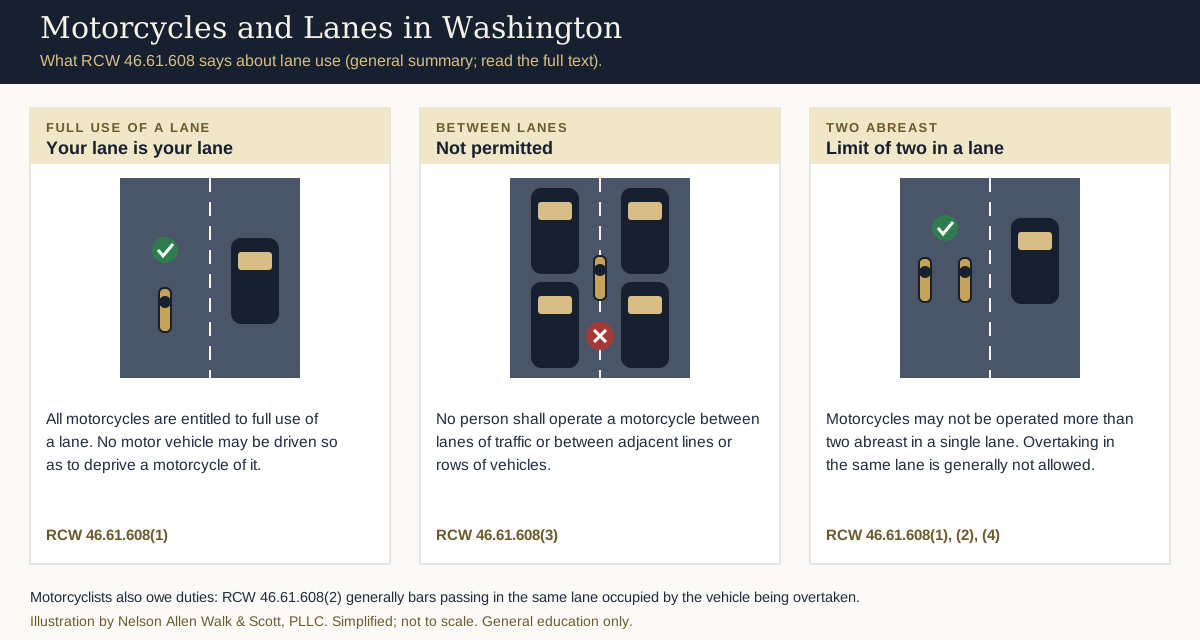
- All motorcycles are entitled to full use of a lane, and no motor vehicle may be driven so as to deprive a motorcycle of it. Operating a motorcycle between lanes of traffic is prohibited (RCW 46.61.608(1), (3)).
- Fault is allocated by percentage, and a rider's share of fault reduces damages but does not bar recovery (RCW 4.22.005; RCW 4.22.070).
- The PIP statutes are written for "automobile" policies, and that term excludes motorcycles. Check the motorcycle's own policy for UIM and any medical coverage (RCW 48.22.005; RCW 48.22.030).
- The general deadline to sue for injury to the person is three years (RCW 4.16.080(2)).
Hypothetical example: a rider is traveling straight through an intersection when an oncoming driver turns left across the lane. The rider brakes hard, goes down, and is taken to the hospital. The driver says they "never saw the bike."
Crashes like this raise questions about the helmet, the rider's lane position, and which insurance applies. This article walks through what the statutes say. It is general education, not advice about any one crash.
Rules That Apply to Motorcycles
Washington has several rules written specifically for motorcycles. Under RCW 46.20.500(1), a person may not drive a two-wheeled or three-wheeled motorcycle or a motor-driven cycle without a license specially endorsed for it. Violating that is a traffic infraction.
There is an exception: a person holding a valid driver's license may operate a motorcycle that has an enclosed seating area, safety belts, and a steering wheel without an endorsement (RCW 46.20.500(6); RCW 46.04.330).
| Topic | What the statute says | Source |
|---|---|---|
| Endorsement | A motorcycle driver needs a license specially endorsed for motorcycles, with exceptions | RCW 46.20.500 |
| Helmet | Unlawful to operate or ride on a motorcycle on a public road without a helmet, with an exception for enclosed vehicles | RCW 46.37.530(1)(c) |
| Lane use | Motorcycles are entitled to full use of a lane | RCW 46.61.608(1) |
| Between lanes | No person shall operate a motorcycle between lanes of traffic or between adjacent lines or rows of vehicles | RCW 46.61.608(3) |
| Passing | No overtaking in the same lane as the vehicle being passed, except when passing a pedestrian or bicyclist with at least three feet of space | RCW 46.61.608(2) |
| Abreast | No more than two abreast in a single lane | RCW 46.61.608(4) |
Key point
Key point: lane splitting is not authorized in the statute
- RCW 46.61.608(3) says no person shall operate a motorcycle between lanes of traffic or between adjacent lines or rows of vehicles.
- This article reflects the codified text as currently published. Check for later legislation if the date of your crash matters.
The Helmet Law and Your Claim
RCW 46.37.530(1)(c) makes it unlawful to operate or ride on a motorcycle, motor-driven cycle, or moped on a state highway, county road, or city street without wearing a motorcycle helmet. The exception covers certain vehicles with a steering wheel, seat belts, and an enclosed seating area, and the chin strap must be fastened.
Subsection (3) defines a "motorcycle helmet" as one with a hard outer shell, padding, and a retention system, with a manufacturer's certification that it meets U.S. Department of Transportation standards.
The statute sets the equipment duty. The text does not say whether helmet use or non-use may be considered in a civil claim, or how it would affect damages. Because the statute is silent, this article does not state a rule on that question.
Caution
Caution: do not assume the helmet decides the claim
- An insurer may raise helmet use when arguing about damages or fault. Whether and how that argument is allowed is a legal question for a lawyer to evaluate.
- Keep the helmet, unaltered, as evidence.
Driver Duties That Often Come Up
Left turns are a common source of motorcycle crashes. Under RCW 46.61.185(1), a driver turning left within an intersection or into a driveway must yield the right-of-way to a vehicle approaching from the opposite direction that is within the intersection or so close as to constitute an immediate hazard.
RCW 46.61.145(1) bars following another vehicle more closely than is reasonable and prudent. Both sections add a fine when the vehicle involved is a "vulnerable user of a public way." RCW 46.61.5259 defines that term to include a person riding a motorcycle or motor-driven cycle.
A driver who negligently causes substantial or great bodily harm to a vulnerable user may also face a separate infraction under RCW 46.61.526, and one who causes death may face a gross misdemeanor under RCW 46.61.5259. Those penalties are separate from a civil claim for compensation.
How Shared Fault Works
RCW 4.22.005 says contributory fault chargeable to the injured person reduces the damages proportionately but does not bar recovery. Under RCW 4.22.070, when more than one entity is at fault, the trier of fact determines each entity's percentage, and the percentages total 100 percent.
Hypothetical example: the left-turning driver is found mostly at fault, but the rider was also traveling between lanes, which RCW 46.61.608(3) prohibits. A fact-finder could assign the rider a share of fault. Any award would be reduced by that share but not eliminated.
This illustrates the rule and is not a prediction about any real case. Our article on Washington's pure comparative fault rule explains the rule in more detail.
Insurance After a Motorcycle Crash
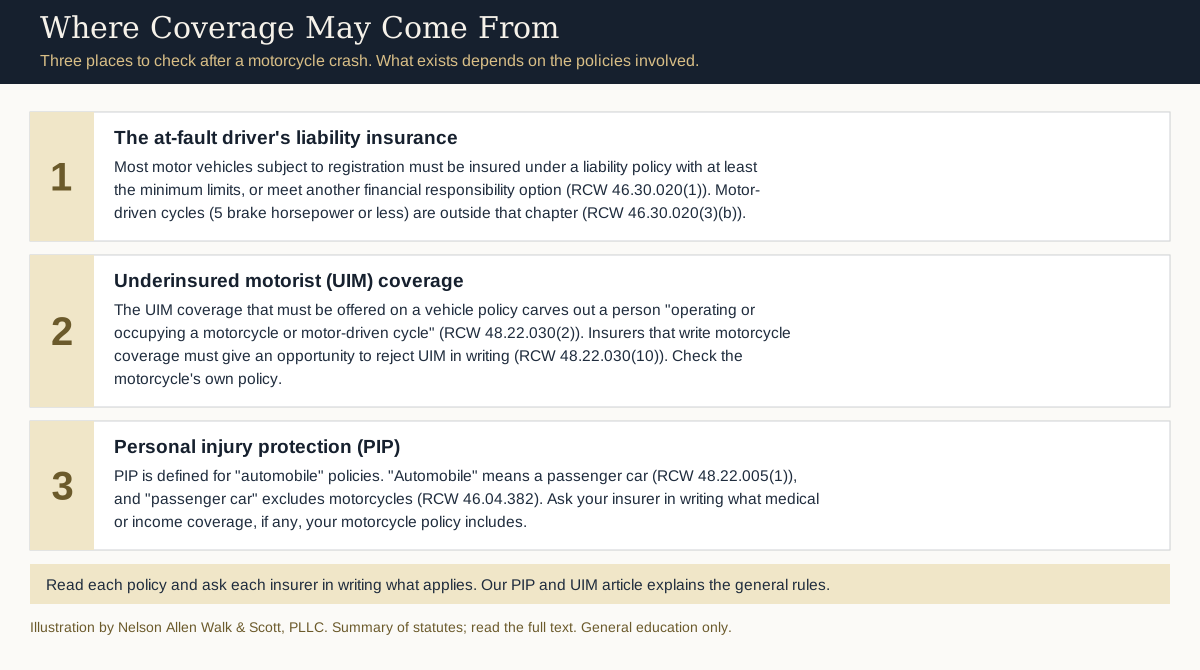
Insurance for motorcycles works differently than for cars. RCW 46.30.020(1) requires most registered motor vehicles to be covered by liability insurance meeting minimum limits or another financial responsibility option. The chapter does not govern a motor-driven cycle, which the statute defines by a five-horsepower limit.
On PIP, RCW 48.22.085 applies to "automobile liability insurance" policies. RCW 48.22.005(1) defines "automobile" as a passenger car, and RCW 46.04.382 says "passenger car" excludes motorcycles and motor-driven cycles. So the statutory PIP offer is not written for motorcycle policies.
On UIM, RCW 48.22.030(2) carves out a person "operating or occupying a motorcycle or motor-driven cycle" from the UIM coverage required on a vehicle policy. Insurers that write motorcycle insurance must give named insureds an opportunity to reject UIM in writing. Our PIP and UIM article covers those coverages in general.
Caution
Caution: read your own motorcycle policy
- Whether your policy includes UIM or medical coverage depends on the policy, not on this summary.
- Ask your insurer in writing what coverages you have and keep the answer.
After the Crash: Reports and Evidence
RCW 46.52.020 requires the driver of any vehicle in an injury accident to stop, remain at the scene, give identifying and insurance information, and render reasonable assistance. RCW 46.52.030(1) requires a driver to make a written accident report within four days when someone is injured, unless a law enforcement officer is required to make the report.
If you were hurt, ask the officer for the report number and a copy of the report. Evidence can disappear quickly, so collect it early.
- The helmet, jacket, gloves, boots, and other gear, unwashed and unrepaired.
- The motorcycle itself, until it has been documented, and photographs of the damage and the road.
- Photographs of skid marks, signals, signs, lighting, and sight lines at the scene.
- Names, phone numbers, and plate numbers for the driver and witnesses.
- Medical records and bills from the first visit, and a short note of symptoms each day.
What to do
What to do soon after a crash
- Get medical care and keep all records.
- Photograph the scene, your injuries, and your gear before anything is moved or repaired.
- Report a hit-and-run to police right away. For a phantom vehicle with no contact, RCW 48.22.030(8) sets a 72-hour reporting window.
Our guide on what to do after a car accident in Washington covers the early steps. If an insurer calls, our article on dealing with insurance adjusters explains the claim-handling rules.
Deadlines
RCW 4.16.080(2) requires an action for injury to the person to be commenced within three years. That is the general rule, not a calculation for any one person. Policies and claims against a government entity can have different notice requirements.
To talk through a motorcycle crash, visit our personal injury practice page or contact us. Nelson Allen Walk & Scott, PLLC is at 1103 Shaw Road, Puyallup, WA 98372, and the phone is (253) 845-8895.
Written by Nathan D. Sukhia, Of Counsel.
Frequently Asked Questions
Is lane splitting legal in Washington?+
Do I have to wear a helmet, and does not wearing one end my claim?+
Do I need a motorcycle endorsement, and what if I did not have one?+
Does my fault as a rider bar my claim?+
Does PIP cover motorcycle crashes?+
How long do I have to file a lawsuit after a motorcycle crash?+
Sources & Further Reading
- 1.RCW 46.37.530 — Motorcycle Helmets and Other EquipmentHelmet requirement, the enclosed-vehicle exception, and the definition of motorcycle helmet.
- 2.RCW 46.20.500 — Special EndorsementMotorcycle endorsement requirement, penalty, and exceptions.
- 3.RCW 46.04.330 — Motorcycle, and RCW 46.04.332 — Motor-Driven CycleDefinitions used in the endorsement and insurance rules.
- 4.RCW 46.61.608 — Operating Motorcycles on Roadways Laned for TrafficFull use of a lane, no operation between lanes, passing, and two-abreast limits.
- 5.RCW 46.61.185 and 46.61.145 — Left Turns and Following Too CloselyDriver duties and added fines when a vulnerable user is involved.
- 6.RCW 46.61.5259 and 46.61.526 — Negligent Driving With a Vulnerable User VictimDefines vulnerable user of a public way, including motorcycle riders.
- 7.RCW 4.22.005 and 4.22.070 — Contributory Fault and Percentage of FaultReduction of damages by the claimant's share of fault and allocation by percentage.
- 8.RCW 46.30.020 — Liability Insurance or Other Financial Responsibility RequiredLiability insurance requirement and its exclusion of motor-driven cycles.
- 9.RCW 48.22.005 and RCW 46.04.382 — DefinitionsDefinition of automobile and of passenger car, which excludes motorcycles.
- 10.RCW 48.22.085 and 48.22.030 — PIP and UIM CoveragePIP offering, and UIM requirements, the motorcycle carve-out, and the opportunity to reject UIM.
- 11.RCW 46.52.020 and 46.52.030 — Accident Duties and ReportsDuties of a driver in an injury accident and the written report requirement.
- 12.RCW 4.16.080 — Actions Limited to Three YearsSubsection (2) covers an action for any other injury to the person not otherwise enumerated.
Disclaimer
This article is provided for general informational purposes only and does not constitute legal advice. It is based on Washington law as of the date noted above; statutes, court rules, and case law can and do change, and this article may not reflect the most current legal developments or apply to your specific facts.
Reading this article, contacting Nelson Allen Walk & Scott through this website, or submitting information through our contact form does not create an attorney-client relationship. An attorney-client relationship is formed only after both parties sign a written engagement agreement. Please do not send any confidential or time-sensitive information until that relationship has been established.
Every case is different, and past outcomes described or implied on this site do not guarantee or predict a similar result in any future matter. If you need advice about your specific situation, please consult directly with Nathan D. Sukhia or another licensed Washington attorney.
Attorney Advertising.
Experience · Expertise · Excellence
Talk to Nathan D. Sukhia
Nathan D. Sukhia and our team are happy to talk through your specific situation.