
Bad-Weather Car Crashes in Washington: Speed, Following Distance, and Fault
Key Takeaways
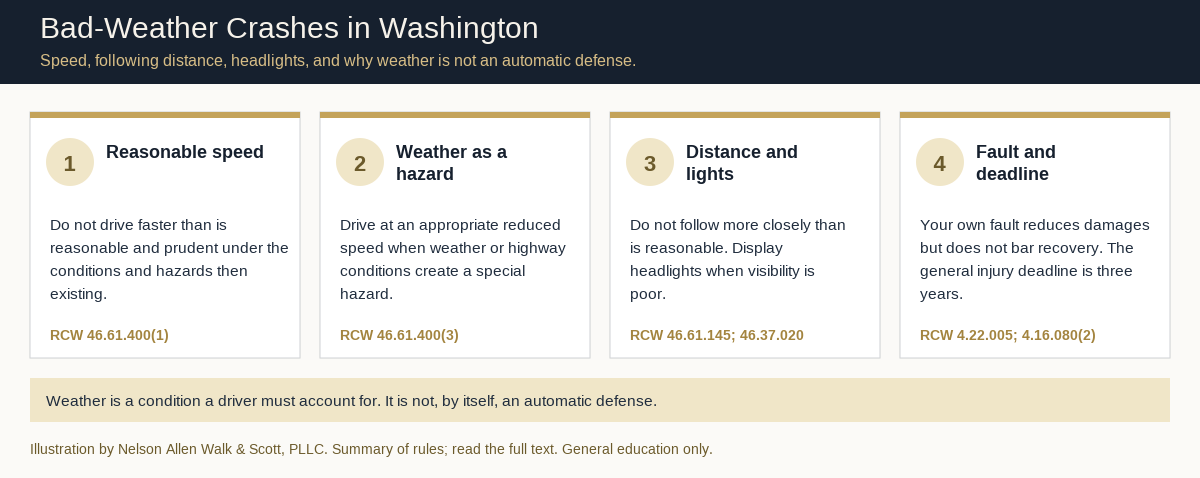
- A driver must not go faster than is reasonable and prudent under the conditions, with regard to the actual and potential hazards then existing, and must use due care (RCW 46.61.400(1)).
- A driver must drive at an appropriate reduced speed when a special hazard exists by reason of weather or highway conditions (RCW 46.61.400(3)).
- A driver must not follow more closely than is reasonable and prudent, having due regard for speed, traffic, and the condition of the highway (RCW 46.61.145(1)).
- Headlights and other required lights must be on from a half hour after sunset to a half hour before sunrise, and whenever persons and vehicles are not clearly discernible at 1,000 feet ahead because of insufficient light or unfavorable atmospheric conditions (RCW 46.37.020).
- A claimant's own fault reduces damages proportionately but does not bar recovery (RCW 4.22.005). The general deadline for an injury lawsuit is three years (RCW 4.16.080(2)).
Hypothetical example: a driver on a Pierce County road in heavy rain rear-ends another car. The driver says the downpour caused the crash and that no one could have stopped in time.
Weather is a real hazard, but Washington statutes place duties on the driver to account for it. This article explains those duties. It is general education, not advice about any one crash.
The Basic Speed Rule
Under RCW 46.61.400(1), no person shall drive a vehicle on a highway at a speed greater than is reasonable and prudent under the conditions and having regard to the actual and potential hazards then existing.
In every event, speed shall be so controlled as may be necessary to avoid colliding with any person, vehicle, or other conveyance on or entering the highway in compliance with legal requirements and the duty of all persons to use due care.
Posted or statutory limits are maximums, not a safe-speed guarantee. Subsection (2) says those limits apply except when a special hazard exists that requires a lower speed for compliance with subsection (1).
Weather Is a Special Hazard
RCW 46.61.400(3) requires the driver of every vehicle, consistent with subsection (1), to drive at an appropriate reduced speed in several situations. Those include approaching and crossing an intersection or railway grade crossing, approaching and going around a curve, approaching a hill crest, and traveling on a narrow or winding roadway.
The same subsection also requires an appropriate reduced speed when a special hazard exists with respect to pedestrians or other traffic, or by reason of weather or highway conditions.
Rain, ice, snow, and fog can be weather conditions that create that kind of hazard. The statute does not list every type of weather, and it does not set a fixed lower speed. What is an appropriate reduced speed depends on the conditions and hazards then existing.
Key point
Key point: weather is not an automatic defense
- The speed statute requires a driver to account for weather and highway conditions, not to treat them as an excuse by themselves.
- No statute in this article says that a crash in rain, ice, snow, or fog is automatically anyone's fault, or no one's.
Following Distance in Poor Conditions
Under RCW 46.61.145(1), the driver of a motor vehicle shall not follow another vehicle more closely than is reasonable and prudent, having due regard for the speed of such vehicles and the traffic upon and the condition of the highway.
The condition of the highway includes a wet, icy, or snow-covered surface. The statute does not set a fixed number of car lengths. What is reasonable and prudent can change with speed, traffic, and the road surface.
Our article on rear-end collision claims covers this following rule in more detail, including that no statute says the rear driver is always at fault.
Headlights in Rain, Fog, and Darkness
RCW 46.37.020 requires every vehicle on a highway to display lighted headlights, other required lights, and illuminating devices at any time from a half hour after sunset to a half hour before sunrise.
The same section also requires those lights at any other time when, due to insufficient light or unfavorable atmospheric conditions, persons and vehicles on the highway are not clearly discernible at a distance of one thousand feet ahead.
Unfavorable atmospheric conditions can include heavy rain, snow, or fog that cuts visibility to less than that distance. The statute also requires that stop lights, turn signals, and other signaling devices be lighted as prescribed for their use.
| Topic | What the statute requires | Source |
|---|---|---|
| Basic speed | Not greater than is reasonable and prudent under the conditions and hazards then existing | RCW 46.61.400(1) |
| Weather or highway hazard | An appropriate reduced speed when a special hazard exists by reason of weather or highway conditions | RCW 46.61.400(3) |
| Following distance | Not more closely than is reasonable and prudent, with due regard for speed, traffic, and highway conditions | RCW 46.61.145(1) |
| Lights after dark | Lighted headlights and other required lights from a half hour after sunset to a half hour before sunrise | RCW 46.37.020 |
| Lights in poor visibility | The same lights when persons and vehicles are not clearly discernible at 1,000 feet because of insufficient light or unfavorable atmospheric conditions | RCW 46.37.020 |
How a Violation Relates to a Negligence Claim
A traffic citation is not a civil verdict. Under RCW 5.40.050, a breach of a duty imposed by statute, ordinance, or administrative rule shall not be considered negligence per se, but may be considered by the trier of fact as evidence of negligence.
The same statute lists categories that are treated as negligence per se, including driving under the influence. The speed, following-distance, and headlight rules discussed here are not in that list.
So if a driver violated RCW 46.61.400, 46.61.145, or 46.37.020, the trier of fact may consider that breach as evidence of negligence. It does not automatically establish negligence as a matter of law.
Comparative Fault
Both drivers in a weather-related crash may have been going too fast for the conditions, or following too closely. Under RCW 4.22.005, any contributory fault chargeable to the claimant diminishes damages proportionately but does not bar recovery.
Our comparative fault article explains that rule. Our follow-up on contribution and settlements among multiple defendants covers how fault is split when more than one person may be responsible.
Caution
Caution: 'I was under the speed limit' is not the whole inquiry
- Hypothetical: a driver was under the posted limit on ice and still could not stop. RCW 46.61.400 looks at whether the speed was reasonable and prudent under the conditions, and whether a special hazard required a lower speed.
- The posted maximum is a ceiling, not a finding that the speed was safe that day.
Road Conditions and Government Claims
Sometimes the issue is the road itself, such as untreated ice or standing water on a public highway. Claims against the State or a local government have extra pre-suit steps. Our article on injury claims against government entities covers those rules.
This article does not address those notice and waiting-period requirements beyond that link.
Evidence and Practical Steps
Useful evidence after a weather-related crash can include photos of the roadway, weather, and lighting, the posted limit if there is one, vehicle positions, and any police report. Witness accounts of speed, following distance, and visibility often matter.
- Photos of the road surface, weather, lighting, and vehicle damage, if you can take them safely
- The time of day, and whether headlights or other lights were on
- The police report number and any citation numbers
- Names of witnesses and what they say about speed, distance, and visibility
- Medical records and your insurance declarations page
Get medical care promptly, even if you feel fine at the scene. Some injuries show up later. Keep copies of bills and notes about missed work.
This is practical guidance, not a list of what any court will require or admit.
Insurance and Filing Deadline
Personal injury protection and underinsured motorist coverage may apply, depending on the policies. Our PIP and UIM article explains both, and our article on insurance claim handling rules covers dealing with adjusters.
RCW 4.16.080(2) requires an action for injury to the person to be commenced within three years. Our article on the personal injury statute of limitations explains accrual, tolling, and what counts as commencing an action.
What to do
Next steps
- Get medical care and keep every record.
- Photograph the road, weather, and lighting if you can do so safely.
- Read our guide on what to do after a car accident in Washington.
- Contact us to talk about your situation.
Related reading includes our articles on distracted driving and hit-and-run claims.
To talk through a bad-weather crash, visit our personal injury practice page or contact us. Nelson Allen Walk & Scott, PLLC is at 1103 Shaw Road, Puyallup, WA 98372, and the phone is (253) 845-8895.
Written by Nathan D. Sukhia, Of Counsel.
Frequently Asked Questions
Does bad weather automatically excuse a crash in Washington?+
Is driving under the posted speed limit enough in rain or ice?+
How close may I follow another car in the rain?+
When do I have to turn on my headlights in fog or heavy rain?+
Does a ticket for driving too fast for conditions prove negligence?+
How long do I have to file a lawsuit after a weather-related crash?+
Sources & Further Reading
- 1.RCW 46.61.400 — Basic Rule and Maximum LimitsReasonable and prudent speed under the conditions; appropriate reduced speed for weather or highway hazards.
- 2.RCW 46.61.145 — Following Too CloselyReasonable and prudent following distance, with due regard for highway conditions.
- 3.RCW 46.37.020 — When Lighted Lamps and Signaling Devices Are RequiredHeadlights after dark and when visibility is less than 1,000 feet because of insufficient light or unfavorable atmospheric conditions.
- 4.RCW 5.40.050 — Breach of Duty as Evidence of NegligenceA statutory breach may be evidence of negligence; listed negligence-per-se exceptions.
- 5.RCW 4.22.005 — Effect of Contributory FaultA claimant's fault reduces damages but does not bar recovery.
- 6.RCW 4.16.080 — Actions Limited to Three YearsSubsection (2): injury to the person.
Disclaimer
This article is provided for general informational purposes only and does not constitute legal advice. It is based on Washington law as of the date noted above; statutes, court rules, and case law can and do change, and this article may not reflect the most current legal developments or apply to your specific facts.
Reading this article, contacting Nelson Allen Walk & Scott through this website, or submitting information through our contact form does not create an attorney-client relationship. An attorney-client relationship is formed only after both parties sign a written engagement agreement. Please do not send any confidential or time-sensitive information until that relationship has been established.
Every case is different, and past outcomes described or implied on this site do not guarantee or predict a similar result in any future matter. If you need advice about your specific situation, please consult directly with Nathan D. Sukhia or another licensed Washington attorney.
Attorney Advertising.
Experience · Expertise · Excellence
Talk to Nathan D. Sukhia
Nathan D. Sukhia and our team are happy to talk through your specific situation.