
Distracted Driving Crashes in Washington: Phone Use, Fault, and Injury Claims
Key Takeaways
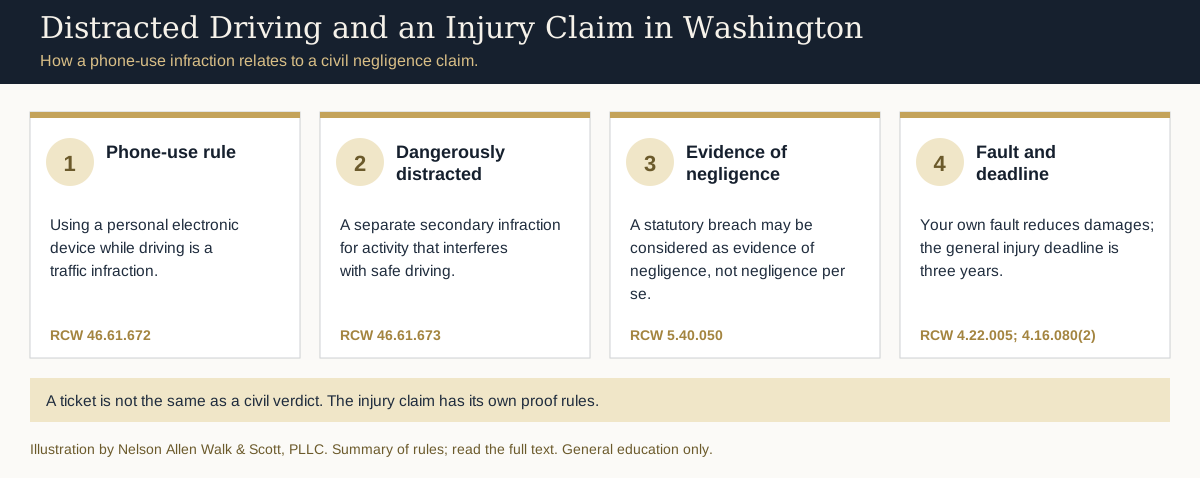
- Using a personal electronic device while driving on a public highway is a traffic infraction under RCW 46.61.672, with defined exceptions.
- RCW 46.61.673 makes driving dangerously distracted a separate secondary traffic infraction.
- Under RCW 5.40.050, a breach of a statute may be considered by the trier of fact as evidence of negligence; it is not negligence per se except for listed categories that do not include these phone rules.
- Your own fault reduces damages proportionately but does not bar recovery (RCW 4.22.005).
- The general deadline for an injury lawsuit is three years (RCW 4.16.080(2)).
Hypothetical example: a driver looks down at a phone at a green light in Tacoma, drifts into the next lane, and hits another car. Police cite the driver for using a personal electronic device. The other driver needs treatment and wants to know what the ticket means for an injury claim.
This article explains Washington's distracted-driving statutes and how they relate to a civil injury claim. It is general education, not advice about any one crash.
Using a Personal Electronic Device While Driving
Under RCW 46.61.672(1), a person who uses a personal electronic device while driving a motor vehicle on a public highway is guilty of a traffic infraction and must pay a fine as provided in RCW 46.63.110(3).
Subsection (6) defines the key terms. "Driving" means operating a motor vehicle on a public highway, including while temporarily stationary because of traffic, a traffic control device, or other momentary delays. It does not include when the vehicle has pulled over to the side of, or off of, an active roadway and has stopped where it can safely remain stationary.
A "personal electronic device" is any portable electronic device capable of wireless communication or electronic data retrieval that is not manufactured primarily for hands-free use in a motor vehicle. The statute lists examples such as a cell phone, tablet, laptop, two-way messaging device, or electronic game. It excludes two-way radio, citizens band radio, and amateur radio equipment.
"Use" means holding the device in either hand or both hands; using a hand or finger to compose, send, read, view, access, browse, transmit, save, or retrieve email, text messages, instant messages, photographs, or other electronic data (with a limited exception for minimal finger use to activate, deactivate, or initiate a function); or watching video on the device.
| Topic | What the statute says |
|---|---|
| Who it covers | A person who uses a personal electronic device while driving on a public highway |
| Driving | Includes temporary stops in traffic; excludes safely pulled over and stopped |
| Device | Portable device for wireless communication or data retrieval, not primarily hands-free |
| Use | Holding; hand or finger for messages or data; watching video |
| Penalty | Traffic infraction; second or later offense doubles the penalty |
Exceptions to the Phone-Use Rule
RCW 46.61.672(2) lists exceptions. The rule does not apply to a driver using a personal electronic device to contact emergency services.
It also does not apply to a transit system employee using a system for time-sensitive relay with dispatch, to certain commercial motor vehicle drivers whose use is permitted under 49 U.S.C. Sec. 31136 as it existed on July 23, 2017, or to a person operating an authorized emergency vehicle.
Subsection (3) says the State preempts the field of regulating personal electronic devices in motor vehicles while driving, so this section supersedes local ordinances on that topic.
Dangerously Distracted Driving
RCW 46.61.673 creates a separate traffic infraction for driving dangerously distracted. The base penalty is thirty dollars.
"Dangerously distracted" means a person who engages in any activity not related to the actual operation of a motor vehicle in a manner that interferes with the safe operation of that vehicle on any highway.
Enforcement is secondary only. An officer may cite this infraction only when the driver has been detained for a suspected violation of a separate traffic infraction or an equivalent local ordinance.
Key point
Key point: two different infractions
- RCW 46.61.672 targets personal electronic device use while driving.
- RCW 46.61.673 covers other distracting activity and can be charged only as a secondary action.
How a Violation Relates to a Negligence Claim
A traffic ticket is not a civil verdict. Under RCW 5.40.050, a breach of a duty imposed by statute, ordinance, or administrative rule shall not be considered negligence per se, but may be considered by the trier of fact as evidence of negligence.
The same statute lists categories that are treated as negligence per se, including driving under the influence of intoxicating liquor or any drug. The personal-electronic-device and dangerously-distracted rules are not in that list.
So if a driver violated RCW 46.61.672 or 46.61.673, the trier of fact may consider that breach as evidence of negligence. It does not automatically establish negligence as a matter of law.
Caution
Caution: a ticket does not decide the civil case
- Hypothetical: a driver is cited under RCW 46.61.672 after a crash. That citation may be relevant evidence, but the injured person still has to prove the civil claim under the usual rules.
- Whether a citation is admissible, and how much weight it gets, depends on the facts and the rules of evidence.
Comparative Fault
Under RCW 4.22.005, any contributory fault chargeable to the claimant diminishes damages proportionately but does not bar recovery. Our comparative fault article explains how that works.
Hypothetical: if you were also looking at a phone when another driver hit you, your share of fault can reduce your recovery. That does not erase the other driver's share.
Evidence: Practical Guidance
Whether someone was using a phone at the time of a crash is often a fact question. Practical sources of information can include the police report, witness statements, photos or video from the scene, and records related to a device.
Phone records and similar materials are sometimes requested in civil cases. What you can obtain, and what a court will allow, depends on the case. This paragraph is general practical guidance, not a promise that any particular record will be available or admissible.
- Police report and any citation numbers
- Witness names and what they say they saw
- Photos or video of the scene, vehicles, and roadway
- Your medical records and proof of missed work
- Your own insurance declarations page
What the Crash Scene Can Show
Hypothetical: a witness says the other driver was looking down just before impact, and a phone is later found unlocked on the floor of that car. Those facts may matter, but they are not the same as a conviction or a civil finding.
Scene evidence can also include skid marks, vehicle positions, traffic-signal timing, and weather. None of those facts appears in the distracted-driving statutes themselves. They are ordinary crash evidence that lawyers and insurers often review.
If you are hurt, your first job is medical care and safety. Writing down what you saw, while it is fresh, can help later. Keep names and phone numbers of witnesses when you can.
Insurance After a Distracted-Driving Crash
The other driver's liability insurance is usually the first place a claim is made. Your own personal injury protection and underinsured motorist coverage may also apply. Our PIP and UIM article explains those coverages, and our article on insurance claim handling rules covers dealing with adjusters.
Filing Deadline
RCW 4.16.080(2) requires an action for injury to the person to be commenced within three years. Our article on the personal injury statute of limitations explains accrual, tolling and what counts as commencing an action.
What to do
Next steps
- Get medical care and keep every record.
- Write down what you remember about the other driver's conduct, including any phone use you saw.
- Read our guide on what to do after a car accident in Washington.
- Contact us to talk about your situation.
Related reading includes our articles on drunk and impaired driver crashes, hit-and-run claims, and truck accidents.
To talk through a distracted-driving crash, visit our personal injury practice page or contact us. Nelson Allen Walk & Scott, PLLC is at 1103 Shaw Road, Puyallup, WA 98372, and the phone is (206) 279-5835.
Written by Nathan D. Sukhia, Of Counsel.
Frequently Asked Questions
Is texting while driving illegal in Washington?+
What is dangerously distracted driving?+
Does a phone-use ticket automatically prove the driver was negligent?+
What if I was also distracted?+
What evidence can show phone use?+
How long do I have to file a lawsuit?+
Sources & Further Reading
- 1.RCW 46.61.672 — Using a Personal Electronic Device While DrivingInfraction, definitions of driving, device, and use, and exceptions.
- 2.RCW 46.61.673 — Dangerously Distracted DrivingSecondary infraction and definition of dangerously distracted.
- 3.RCW 5.40.050 — Breach of Duty as Evidence of NegligenceStatutory breach may be evidence of negligence; listed negligence-per-se exceptions.
- 4.RCW 4.22.005 — Effect of Contributory FaultContributory fault reduces damages but does not bar recovery.
- 5.RCW 4.16.080 — Actions Limited to Three YearsSubsection (2): injury to the person.
Disclaimer
This article is provided for general informational purposes only and does not constitute legal advice. It is based on Washington law as of the date noted above; statutes, court rules, and case law can and do change, and this article may not reflect the most current legal developments or apply to your specific facts.
Reading this article, contacting Nelson Allen Walk & Scott through this website, or submitting information through our contact form does not create an attorney-client relationship. An attorney-client relationship is formed only after both parties sign a written engagement agreement. Please do not send any confidential or time-sensitive information until that relationship has been established.
Every case is different, and past outcomes described or implied on this site do not guarantee or predict a similar result in any future matter. If you need advice about your specific situation, please consult directly with Nathan D. Sukhia or another licensed Washington attorney.
Attorney Advertising.
Experience · Expertise · Excellence
Talk to Nathan D. Sukhia
Nathan D. Sukhia and our team are happy to talk through your specific situation.