
Parking-Lot Crash and Injury Claims in Washington: Private Property, Fault, and Insurance
Key Takeaways
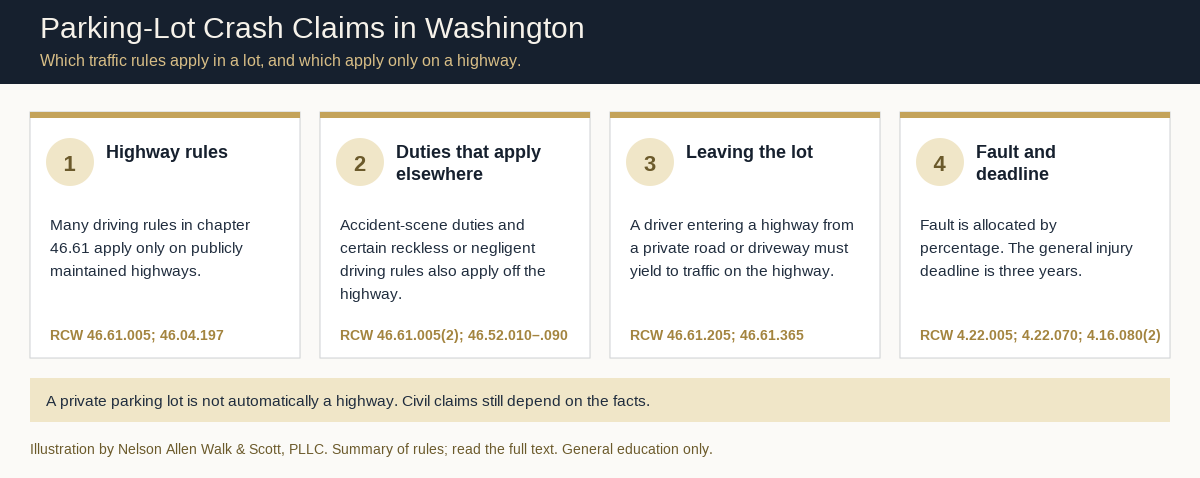
- Many vehicle-operation rules in chapter 46.61 apply only on highways, meaning publicly maintained ways open to vehicular travel (RCW 46.61.005; 46.04.197).
- Accident-scene duties in RCW 46.52.010 through 46.52.090, and the reckless and negligent driving rules in RCW 46.61.500 through 46.61.525 and 46.61.5249, also apply elsewhere throughout the state (RCW 46.61.005(2)).
- A driver entering a highway from a private road or driveway must yield to traffic lawfully approaching on the highway (RCW 46.61.205).
- Fault in a civil claim is allocated by percentage, and a claimant's own fault reduces damages but does not bar recovery (RCW 4.22.005; 4.22.070).
- The general deadline for an injury lawsuit is three years (RCW 4.16.080(2)).
Hypothetical example: two drivers back out of neighboring stalls at a Puyallup grocery store and collide. One is hurt. Both assume the usual highway right-of-way rules will decide the claim.
Parking-lot crashes raise a question that highway crashes often do not: which traffic statutes actually apply? This article explains what the statutes say. It is general education, not advice about any one crash.
Many Traffic Rules Apply Only on Highways
Under RCW 46.61.005, the provisions of chapter 46.61 relating to the operation of vehicles refer exclusively to operation upon highways, with two exceptions discussed below.
RCW 46.04.197 defines a highway as the entire width between the boundary lines of every way publicly maintained when any part is open to the use of the public for purposes of vehicular travel.
A privately maintained parking lot generally does not meet that definition. Whether a particular lot, access lane or driveway is a highway, a private road or driveway, or something else depends on how it is owned, maintained and used.
Key point
Key point: a parking lot is not automatically a highway
- Highway driving rules in chapter 46.61 do not automatically apply just because the public can park there.
- Some other duties, listed in RCW 46.61.005(2), do apply off the highway as well.
Duties That Also Apply Off the Highway
RCW 46.61.005(2) lists exceptions. The provisions of RCW 46.52.010 through 46.52.090, RCW 46.61.500 through 46.61.525, and RCW 46.61.5249 apply upon highways and elsewhere throughout the state.
That means accident-scene and reporting duties can apply in a parking lot. Under RCW 46.52.010, a driver who collides with an unattended vehicle must stop and either notify the operator or owner, or leave a written notice with the striking driver's and owner's name and address.
Under RCW 46.52.020, a driver involved in an accident that injures or kills someone, or that damages an attended vehicle or other property, must stop and remain, give name, address, insurance company, policy number and license plate, exhibit a driver's license, and render reasonable assistance to an injured person. Our hit-and-run article covers those duties in more detail.
The same exception brings in reckless driving and negligent driving, including first and second degree, and driving under the influence. Our article on drunk and impaired driver crashes explains the DUI rules.
| Topic | Where it applies | Source |
|---|---|---|
| Most chapter 46.61 driving rules | On highways, unless a section refers to a different place | RCW 46.61.005; 46.04.197 |
| Accident-scene and reporting duties | Highways and elsewhere throughout the state | RCW 46.61.005(2); 46.52.010–.090 |
| Reckless and negligent driving; DUI | Highways and elsewhere throughout the state | RCW 46.61.005(2); 46.61.500–.525; 46.61.5249 |
| Entering a highway from a private road or driveway | Yield to traffic lawfully approaching on the highway | RCW 46.61.205 |
| Emerging from an alley, driveway or building | Stop before a sidewalk; yield to pedestrians and then to roadway traffic | RCW 46.61.365 |
| Civil fault and filing deadline | Civil injury claims, wherever the crash occurred | RCW 4.22.005; 4.22.070; 4.16.080(2) |
A Note on Negligent Driving on Private Property
RCW 46.61.525 defines negligent driving in the second degree as operating a motor vehicle in a manner that is both negligent and endangers, or is likely to endanger, any person or property. "Negligent" means the failure to exercise ordinary care.
The same section provides an affirmative defense, which the defendant must prove by a preponderance of the evidence: that the driver was operating the vehicle on private property with the owner's consent, in a manner consistent with that consent.
That defense is part of the traffic-infraction statute. It does not, by its terms, decide a civil injury claim. Civil fault is still allocated under chapter 4.22.
Leaving the Lot and Entering a Highway
Crashes often happen at the exit, not in a stall. Under RCW 46.61.205, the driver of a vehicle about to enter or cross a highway from a private road or driveway shall yield the right-of-way to all vehicles lawfully approaching on the highway.
RCW 46.61.365 adds a rule in business or residence districts: a driver emerging from an alley, driveway or building must stop immediately before driving onto a sidewalk or sidewalk area, yield to any pedestrian as needed to avoid a collision, and upon entering the roadway yield to all vehicles approaching on that roadway.
RCW 46.04.420 defines a private road or driveway as a way or place in private ownership used for vehicle travel by the owner or those with express or implied permission, but not by other persons. Whether a particular lot exit fits that definition, or RCW 46.61.365, depends on the facts.
Pedestrians in a Parking Lot
People on foot are often hurt in lots, between stalls, at store entrances, or on a sidewalk at the exit. Some pedestrian statutes in chapter 46.61 refer to roadways, sidewalks and crosswalks, and the general rule is that chapter 46.61 driving provisions apply on highways unless a section refers to a different place.
RCW 46.61.365 does specifically require a yield to pedestrians when a driver in a business or residence district emerges from an alley, driveway or building onto a sidewalk area. Crosswalk rules on public roadways are covered in our pedestrian and bicycle accident article.
In a civil claim, fault involving a pedestrian is still allocated under RCW 4.22.005 and 4.22.070. No statute says a pedestrian in a lot is always, or never, at fault.
Caution
Caution: right-of-way in the aisle is often a fact question
- Hypothetical: a driver backs out of a stall while a pedestrian walks behind the car, or another car comes down the aisle.
- Highway intersection rules do not automatically decide that situation. The facts, and any statute that actually applies, do.
Comparative Fault
Under RCW 4.22.070(1), the trier of fact determines the percentage of total fault attributable to every entity that caused the claimant's damages. The percentages total one hundred percent.
Under RCW 4.22.005, any contributory fault chargeable to the claimant diminishes damages proportionately but does not bar recovery. Our comparative fault article explains how that works.
If a statute that does apply was breached, RCW 5.40.050 says that breach may be considered as evidence of negligence, but is not negligence per se except for listed categories such as driving under the influence.
Insurance After a Parking-Lot Crash
Liability, personal injury protection and underinsured motorist coverage are not, in the statutes discussed here, limited to crashes on public highways. PIP is defined around bodily injury sustained in an automobile accident, and UIM protects insured persons legally entitled to recover from an underinsured, hit-and-run or phantom vehicle. Our PIP and UIM article explains both coverages.
Policy terms still control who is an insured and what is excluded. Our article on insurance claim handling rules covers dealing with adjusters.
Property Conditions Versus Driver Conduct
Sometimes a crash is connected to the lot itself, such as ice, a pothole or poor lighting. Those issues are closer to premises liability than to the traffic rules above. Our article on slip-and-fall and premises liability addresses duties related to property conditions.
This article focuses on collisions involving vehicles and people in the lot, not on every possible claim against a property owner.
Evidence and Practical Steps
Get medical care first if anyone is hurt. Then exchange the information RCW 46.52.020 requires, and photograph the stall markings, arrows, signs, damage and positions of the vehicles before they are moved, if you can do so safely.
- Photos of both vehicles, stall lines, arrows or signs, and the surrounding lot
- Names, phone numbers and insurance information for every driver
- Names of witnesses, including store employees or other shoppers
- Any note left on an unattended vehicle, and the police report number if one was made
- Medical records and your insurance declarations page
Under RCW 46.52.030, a driver in an accident that causes injury, death, or property damage at or above the amount set by state patrol rule generally must file a written report within four days, unless an officer is making a report. Our guide on what to do after a car accident in Washington covers those first steps.
Filing Deadline
RCW 4.16.080(2) requires an action for injury to the person to be commenced within three years. Our article on the personal injury statute of limitations explains accrual, tolling and what counts as commencing an action.
What to do
Next steps
- Get medical care and keep every record.
- Exchange identifying and insurance information, and photograph the lot and vehicles if you can do so safely.
- Contact us to talk about your situation.
Related reading includes our articles on passenger claims, rear-end collisions and intersection and left-turn crashes.
To talk through a parking-lot crash, visit our personal injury practice page or contact us. Nelson Allen Walk & Scott, PLLC is at 1103 Shaw Road, Puyallup, WA 98372, and the phone is (206) 279-5835.
Written by Nathan D. Sukhia, Of Counsel.
Frequently Asked Questions
Do regular traffic laws apply in a Washington parking lot?+
Do I have to leave a note if I hit a parked car?+
Who is at fault if two cars back out and collide?+
What if I was hit as a pedestrian in a parking lot?+
Does car insurance apply if the crash was in a parking lot?+
How long do I have to file a lawsuit after a parking-lot injury?+
Sources & Further Reading
- 1.RCW 46.61.005 — Chapter Refers to Vehicles Upon Highways; ExceptionsMost chapter 46.61 driving rules apply on highways; listed provisions also apply elsewhere.
- 2.RCW 46.04.197 — HighwayPublicly maintained way open to the public for vehicular travel.
- 3.RCW 46.04.420 — Private Road or DrivewayPrivately owned way used by the owner or persons with permission, but not by others.
- 4.RCW 46.52.010 — Duty on Striking Unattended Car or Other PropertyStop and notify or leave a written notice.
- 5.RCW 46.52.020 — Duty in Case of Injury, Death or Damage to Attended PropertyStop, exchange information and render reasonable assistance.
- 6.RCW 46.52.030 — Accident ReportsWritten report within four days unless an officer is making a report.
- 7.RCW 46.61.205 — Entering a Highway from a Private Road or DrivewayYield to vehicles lawfully approaching on the highway.
- 8.RCW 46.61.365 — Emerging from Alley, Driveway or BuildingStop before the sidewalk; yield to pedestrians and then to roadway traffic.
- 9.RCW 46.61.525 — Negligent Driving, Second DegreeDefinition of negligent driving and the private-property affirmative defense.
- 10.RCW 5.40.050 — Breach of Duty as Evidence of NegligenceStatutory breach may be evidence of negligence; listed exceptions.
- 11.RCW 4.22.005 and 4.22.070 — Comparative FaultContributory fault reduces damages; fault is allocated by percentage.
- 12.RCW 4.16.080 — Actions Limited to Three YearsSubsection (2): injury to the person.
Disclaimer
This article is provided for general informational purposes only and does not constitute legal advice. It is based on Washington law as of the date noted above; statutes, court rules, and case law can and do change, and this article may not reflect the most current legal developments or apply to your specific facts.
Reading this article, contacting Nelson Allen Walk & Scott through this website, or submitting information through our contact form does not create an attorney-client relationship. An attorney-client relationship is formed only after both parties sign a written engagement agreement. Please do not send any confidential or time-sensitive information until that relationship has been established.
Every case is different, and past outcomes described or implied on this site do not guarantee or predict a similar result in any future matter. If you need advice about your specific situation, please consult directly with Nathan D. Sukhia or another licensed Washington attorney.
Attorney Advertising.
Experience · Expertise · Excellence
Talk to Nathan D. Sukhia
Nathan D. Sukhia and our team are happy to talk through your specific situation.