
Intersection and Left-Turn Crash Claims in Washington: Right-of-Way and Fault
Key Takeaways
- A driver intending to turn left in an intersection, or into an alley, private road or driveway, must yield to any oncoming vehicle that is in the intersection or so close as to be an immediate hazard (RCW 46.61.185(1)).
- When two vehicles approach or enter an intersection from different highways at about the same time, the driver on the left must yield to the vehicle on the right, except as that rule is modified for arterials and elsewhere in the chapter (RCW 46.61.180).
- Under RCW 5.40.050, a breach of these traffic rules may be considered as evidence of negligence; it is not negligence per se.
- Fault is allocated by percentage, and a claimant's own fault reduces damages but does not bar recovery (RCW 4.22.005; 4.22.070).
- The general deadline for an injury lawsuit is three years (RCW 4.16.080(2)).
Hypothetical example: a driver in Puyallup waits to turn left at a green light. An oncoming car comes through, the two collide, and both drivers say they had the right-of-way.
Intersection and left-turn crashes often come down to who had to yield. This article explains what Washington statutes say. It is general education, not advice about any one crash.
The Left-Turn Yield Rule
Under RCW 46.61.185(1), the driver of a vehicle intending to turn left within an intersection, or into an alley, private road, or driveway, shall yield the right-of-way to any vehicle approaching from the opposite direction which is within the intersection or so close thereto as to constitute an immediate hazard.
The statute does not say the left-turning driver is always at fault. It requires a yield to oncoming traffic that is already in the intersection, or close enough to be an immediate hazard.
Whether an oncoming vehicle was an immediate hazard depends on the facts, such as speed, distance and visibility.
Key point
Key point: yield is required, but fault is still a fact question
- RCW 46.61.185 requires a left-turning driver to yield to oncoming traffic that is in or so close to the intersection as to be an immediate hazard.
- No statute says the left-turning driver is always civilly at fault.
Uncontrolled Intersections
Not every intersection has a signal or a stop sign. Under RCW 46.61.180(1), when two vehicles approach or enter an intersection from different highways at approximately the same time, the driver of the vehicle on the left shall yield the right-of-way to the vehicle on the right.
Subsection (2) says that rule is modified at arterial highways and otherwise as stated in the chapter. Stop signs, yield signs and signals can change who must yield.
Stop Signs and Yield Signs
RCW 46.61.190 covers vehicles entering a stop or yield intersection. After stopping at a stop sign, a driver must yield to any vehicle in the intersection, or approaching so closely as to constitute an immediate hazard, while the driver is moving across or within the intersection.
A driver approaching a yield sign must slow to a speed reasonable for the conditions, stop if safety requires it, and then yield to vehicles in the intersection or approaching so closely as to be an immediate hazard.
The same section states that if a driver is involved in a collision in the intersection after driving past a yield sign without stopping, the collision shall be deemed prima facie evidence of the driver's failure to yield right-of-way. That language is part of the traffic statute. How it is used in a civil claim is still subject to RCW 5.40.050, discussed below.
| Situation | What the statute requires | Source |
|---|---|---|
| Left turn | Yield to oncoming traffic in or so close to the intersection as to be an immediate hazard | RCW 46.61.185(1) |
| Uncontrolled intersection | Driver on the left yields to the vehicle on the right, unless modified | RCW 46.61.180 |
| Stop sign | Stop, then yield to traffic in or approaching so closely as to be an immediate hazard | RCW 46.61.190(2) |
| Yield sign | Slow, stop if needed, and yield; a collision after passing without stopping is prima facie evidence of failure to yield | RCW 46.61.190(3) |
| Green signal | May go straight or turn unless a sign prohibits the turn; turning drivers must stop to allow vehicles already lawfully in the intersection to complete their movements | RCW 46.61.055(1) |
Traffic Signals
RCW 46.61.055 sets out what green, yellow and red indications mean. Vehicle operators facing a circular green signal may proceed straight through or turn right or left unless a sign prohibits the turn.
Drivers turning right or left on green must stop to allow other vehicles lawfully within the intersection control area to complete their movements, and must also stop for pedestrians lawfully in that area as required by RCW 46.61.235(1).
A green arrow permits only the movement indicated by the arrow, or another movement permitted by indications shown at the same time. A steady circular red signal requires a stop. After stopping, a right turn, or a left turn from a street into a one-way street carrying traffic in the direction of the left turn, may be allowed unless a sign prohibits it.
How a Violation Relates to a Negligence Claim
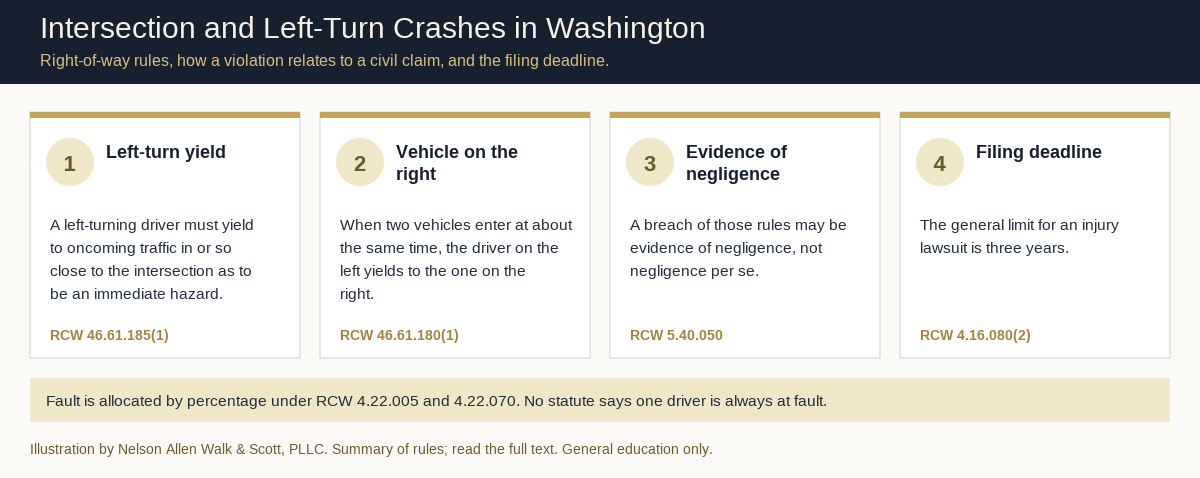
A traffic citation is not a civil verdict. Under RCW 5.40.050, a breach of a duty imposed by statute, ordinance, or administrative rule shall not be considered negligence per se, but may be considered by the trier of fact as evidence of negligence.
The same statute lists categories that are treated as negligence per se, including driving under the influence. The left-turn and intersection right-of-way rules are not in that list.
So if a driver violated RCW 46.61.185, 46.61.180, 46.61.190 or 46.61.055, the trier of fact may consider that breach as evidence of negligence. It does not automatically establish negligence as a matter of law.
Shared Fault
Under RCW 4.22.070(1), the trier of fact determines the percentage of total fault attributable to every entity that caused the claimant's damages. The percentages total one hundred percent.
Under RCW 4.22.005, any contributory fault chargeable to the claimant diminishes damages proportionately but does not bar recovery. Our comparative fault article explains how that works.
Caution
Caution: both drivers can share fault
- Hypothetical: a left-turning driver starts the turn when an oncoming car is speeding and close. Both drivers' conduct may be examined.
- Speed, signals, visibility, distraction and who entered first can all affect the percentages.
Protected Left Turns and Unprotected Gaps
A green arrow is a protected turn under RCW 46.61.055(1)(b): the driver may enter only to make the movement the arrow indicates, and must still stop for vehicles already lawfully in the intersection and for pedestrians as the statute requires.
A circular green light is different. The left turn is allowed unless a sign prohibits it, but the left-turn yield rule in RCW 46.61.185 still applies to oncoming traffic.
Evidence and Practical Steps
Intersection crashes often turn on timing and position. Useful evidence can include the signal sequence, skid marks, vehicle resting positions, photos of damage, and witness accounts of who entered first.
- Photos of the intersection, signals or signs, skid marks and vehicle damage
- The police report number and any citation numbers
- Names of witnesses and what they say they saw about the light or the turn
- Medical records and a timeline of symptoms
- Your insurance declarations page for PIP and UIM
Get medical care promptly, even if you feel fine at the scene. Some injuries show up later. Keep copies of bills and notes about missed work.
This is practical guidance, not a list of what any court will require or admit.
Related Crash Types
If a driver was using a phone, see our article on distracted driving crashes. Passengers hurt in the same crash may have their own claims, explained in our passenger injury claims article. Rear-end collisions at a light are covered in our rear-end collision article.
Crashes that involve a pedestrian or cyclist in the crosswalk are covered in our pedestrian and bicycle accident article.
Insurance and Filing Deadline
Personal injury protection and underinsured motorist coverage may apply, depending on the policies. Our PIP and UIM article explains both, and our article on insurance claim handling rules covers dealing with adjusters.
RCW 4.16.080(2) requires an action for injury to the person to be commenced within three years. Our article on the personal injury statute of limitations explains accrual, tolling and what counts as commencing an action.
What to do
Next steps
- Get medical care and keep every record.
- Photograph the intersection, signals or signs, and the vehicles if you can do so safely.
- Read our guide on what to do after a car accident in Washington.
- Contact us to talk about your situation.
To talk through an intersection or left-turn crash, visit our personal injury practice page or contact us. Nelson Allen Walk & Scott, PLLC is at 1103 Shaw Road, Puyallup, WA 98372, and the phone is (206) 279-5835.
Written by Nathan D. Sukhia, Of Counsel.
Frequently Asked Questions
Is the left-turning driver always at fault in Washington?+
Who has the right-of-way at an intersection with no signs or signals?+
Does a failure-to-yield ticket prove negligence?+
What does a green arrow mean for a left turn?+
What if I was a passenger?+
How long do I have to file a lawsuit?+
Sources & Further Reading
- 1.RCW 46.61.185 — Vehicle Turning LeftYield to oncoming traffic in or so close to the intersection as to be an immediate hazard.
- 2.RCW 46.61.180 — Vehicle Approaching IntersectionDriver on the left yields to the vehicle on the right, modified at arterials.
- 3.RCW 46.61.190 — Stop or Yield IntersectionsStop and yield duties, and prima facie language after passing a yield sign without stopping.
- 4.RCW 46.61.055 — Traffic Control Signal LegendGreen, yellow and red indications, including turns.
- 5.RCW 5.40.050 — Breach of Duty as Evidence of NegligenceStatutory breach may be evidence of negligence; listed negligence-per-se exceptions.
- 6.RCW 4.22.005 — Effect of Contributory FaultContributory fault reduces damages but does not bar recovery.
- 7.RCW 4.22.070 — Percentage of FaultFault allocation and exceptions to several-only liability.
- 8.RCW 4.16.080 — Actions Limited to Three YearsSubsection (2): injury to the person.
Disclaimer
This article is provided for general informational purposes only and does not constitute legal advice. It is based on Washington law as of the date noted above; statutes, court rules, and case law can and do change, and this article may not reflect the most current legal developments or apply to your specific facts.
Reading this article, contacting Nelson Allen Walk & Scott through this website, or submitting information through our contact form does not create an attorney-client relationship. An attorney-client relationship is formed only after both parties sign a written engagement agreement. Please do not send any confidential or time-sensitive information until that relationship has been established.
Every case is different, and past outcomes described or implied on this site do not guarantee or predict a similar result in any future matter. If you need advice about your specific situation, please consult directly with Nathan D. Sukhia or another licensed Washington attorney.
Attorney Advertising.
Experience · Expertise · Excellence
Talk to Nathan D. Sukhia
Nathan D. Sukhia and our team are happy to talk through your specific situation.