
Passenger Injury Claims After a Washington Car Crash: Fault, PIP, and UIM
Key Takeaways
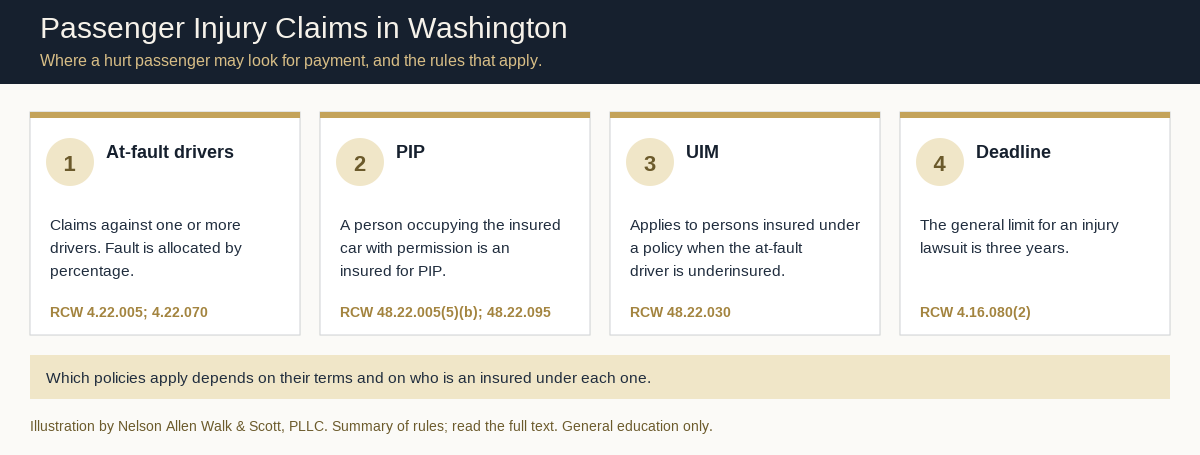
- A passenger may have claims against one or more drivers, and fault is allocated by percentage among every entity that caused the harm (RCW 4.22.070(1)).
- If the injured claimant is found not at fault, the defendants against whom judgment is entered are jointly and severally liable for the sum of their shares (RCW 4.22.070(1)(b)).
- A person injured while occupying the insured automobile with the named insured's permission is an insured for PIP purposes (RCW 48.22.005(5)(b)).
- UIM coverage protects persons insured under a policy who are legally entitled to recover from an underinsured driver (RCW 48.22.030).
- The general deadline for an injury lawsuit is three years (RCW 4.16.080(2)).
Hypothetical example: a passenger is riding with a friend in Puyallup when another car runs a stop sign and hits them. Both drivers blame each other, and the passenger is left with medical bills and missed work.
Passengers face a different set of questions than drivers do. This article explains what Washington law says about fault, insurance and deadlines for passengers. It is general education, not advice about any one crash.
Who May Be Responsible
A passenger can be hurt because of the driver of the car they were in, the driver of another car, or both. In some crashes, more than two vehicles are involved.
Under RCW 4.22.070(1), the trier of fact determines the percentage of total fault attributable to every entity that caused the claimant's damages. The percentages total one hundred percent.
Each defendant's liability is generally several only, which means each pays its own share. The statute lists exceptions, described below.
Key point
Key point: a passenger may claim against more than one driver
- The driver of your car and another driver can both share fault.
- Fault is split by percentage, so identifying every driver involved matters.
The Not-at-Fault Claimant Rule
Passengers often did nothing to cause the crash. That matters under RCW 4.22.070(1)(b).
If the trier of fact determines that the claimant was not at fault, the defendants against whom judgment is entered are jointly and severally liable for the sum of their proportionate shares of the claimant's total damages. Joint and several liability means each such defendant can be required to pay that combined amount.
RCW 4.22.070(1)(a) adds that a party is responsible for another's fault when both acted in concert, or when a person was acting as the party's agent or servant.
When a Passenger Shares Fault
Passengers are not always fault-free. Under RCW 4.22.005, any contributory fault chargeable to the claimant diminishes damages proportionately but does not bar recovery.
Whether a passenger's conduct counts as fault depends on the facts. Our comparative fault article explains how shared fault works in Washington.
PIP for Passengers
Personal injury protection (PIP) is no-fault coverage for certain losses. Under RCW 48.22.085, insurers must offer PIP with new and renewed automobile liability policies, but a named insured may reject it in writing.
RCW 48.22.005(5) defines who is an insured for PIP. It includes the named insured and certain resident relatives, and a person who sustains bodily injury caused by accident while occupying or using the insured automobile with the permission of the named insured.
That means a passenger in a car with PIP coverage may be an insured under that policy. A passenger may also have PIP through his or her own policy or a household member's policy, depending on its terms.
RCW 48.22.095 sets the minimum PIP benefit limits insurers must offer for each insured. These are minimum offered limits, not amounts anyone receives.
| Benefit | Minimum limit offered |
|---|---|
| Medical and hospital | $10,000 |
| Funeral expense | $2,000 |
| Income continuation | $10,000, up to $200 per week |
| Loss of services | $5,000, up to $200 per week |
RCW 48.22.005 also defines these benefits. For example, medical and hospital benefits are payable for expenses incurred within three years from the date of the accident, and income continuation benefits begin fourteen days after the accident.
Caution
Caution: PIP depends on the policy
- PIP must be offered, but it can be rejected in writing, so not every car has it.
- Which policy pays first, and how much, depends on policy terms. Ask before you assume.
UIM for Passengers
Underinsured motorist (UIM) coverage protects insured persons who are legally entitled to recover damages from an underinsured, hit-and-run, or phantom vehicle. Under RCW 48.22.030(1), an underinsured vehicle includes one with no applicable liability insurance, or limits less than the damages the covered person is legally entitled to recover.
Under RCW 48.22.030(2), covered auto policies must include this coverage for the persons insured under them, unless a named insured or spouse rejects it in writing under subsection (4). Whether a passenger is an insured under a given policy's UIM coverage depends on how that policy defines an insured.
Our PIP and UIM article explains both coverages in more depth.
Rideshare Passengers
Passengers in Uber or Lyft vehicles face added insurance rules. Our article on rideshare accident insurance explains what Washington requires during each stage of a trip.
Practical Steps for Passengers
Get medical care first. Then collect what you can about every vehicle and driver involved.
- Names, phone numbers and insurance information for every driver
- The police report number and agency
- Photos of the vehicles, the scene and your injuries
- Names of other passengers and witnesses
- Your own policy and any household policies that may include PIP or UIM
Report the crash to the insurers involved promptly, and keep copies of what you send. Be cautious about recorded statements until you understand your claims.
When the Driver Is a Friend or Family Member
Hypothetical: a passenger is hurt when her friend, the driver, misjudges a turn. The passenger may worry about making a claim against a friend.
In many cases a claim like this is handled by the driver's insurer under the driver's liability coverage. Whether and how that applies depends on the policy and the facts, so it is worth asking before deciding not to pursue a claim.
Distracted or Impaired Drivers
If a driver was using a phone, our article on distracted driving crashes explains Washington's device rules. If a driver was impaired, see our article on drunk and impaired driver crashes.
Children Riding as Passengers
Children are often passengers. Their claims raise extra questions about who handles the claim and when deadlines run.
Under RCW 4.16.190, if a person entitled to bring an action was under eighteen when the cause of action accrued, the time of that disability is not part of the time limited for commencing the action. That applies to the child's own claim.
Hypothetical: a 10-year-old passenger is hurt in a crash. The years before the child turns 18 are not counted toward the general three-year period for the child's own claim. Related claims by a parent may follow different rules, so check each claim separately.
Filing Deadline
RCW 4.16.080(2) requires an action for injury to the person to be commenced within three years. Our article on the personal injury statute of limitations explains accrual, tolling for minors, and what counts as commencing an action.
What to do
Next steps
- Get medical care and keep every record.
- Collect insurance information for every driver and check your own policies.
- Read our guide on what to do after a car accident in Washington.
- Contact us to talk about your situation.
To talk through a passenger injury claim, visit our personal injury practice page or contact us. Nelson Allen Walk & Scott, PLLC is at 1103 Shaw Road, Puyallup, WA 98372, and the phone is (206) 279-5835.
Written by Nathan D. Sukhia, Of Counsel.
Frequently Asked Questions
Can a passenger sue both drivers?+
What if I, as a passenger, did nothing wrong?+
Does the driver's PIP cover me as a passenger?+
What are the minimum PIP benefits?+
Can I use UIM coverage as a passenger?+
How long do passengers have to file a lawsuit?+
Sources & Further Reading
- 1.RCW 4.22.005 — Effect of Contributory FaultContributory fault reduces damages but does not bar recovery.
- 2.RCW 4.22.070 — Percentage of FaultAllocation, several liability, and the not-at-fault claimant exception.
- 3.RCW 48.22.005 — DefinitionsWho is an insured for PIP, and benefit definitions.
- 4.RCW 48.22.085 — PIP Must Be Offered; Written RejectionOptional PIP coverage and rejection in writing.
- 5.RCW 48.22.095 — Minimum PIP CoverageMinimum benefit limits insurers must offer.
- 6.RCW 48.22.030 — Underinsured Motorist CoverageDefinition, required coverage, and written rejection.
- 7.RCW 4.16.080 — Actions Limited to Three YearsSubsection (2): injury to the person.
Disclaimer
This article is provided for general informational purposes only and does not constitute legal advice. It is based on Washington law as of the date noted above; statutes, court rules, and case law can and do change, and this article may not reflect the most current legal developments or apply to your specific facts.
Reading this article, contacting Nelson Allen Walk & Scott through this website, or submitting information through our contact form does not create an attorney-client relationship. An attorney-client relationship is formed only after both parties sign a written engagement agreement. Please do not send any confidential or time-sensitive information until that relationship has been established.
Every case is different, and past outcomes described or implied on this site do not guarantee or predict a similar result in any future matter. If you need advice about your specific situation, please consult directly with Nathan D. Sukhia or another licensed Washington attorney.
Attorney Advertising.
Experience · Expertise · Excellence
Talk to Nathan D. Sukhia
Nathan D. Sukhia and our team are happy to talk through your specific situation.