
Pedestrian and Bicycle Accidents in Washington: Right-of-Way, Fault and Your Options
Key Takeaways
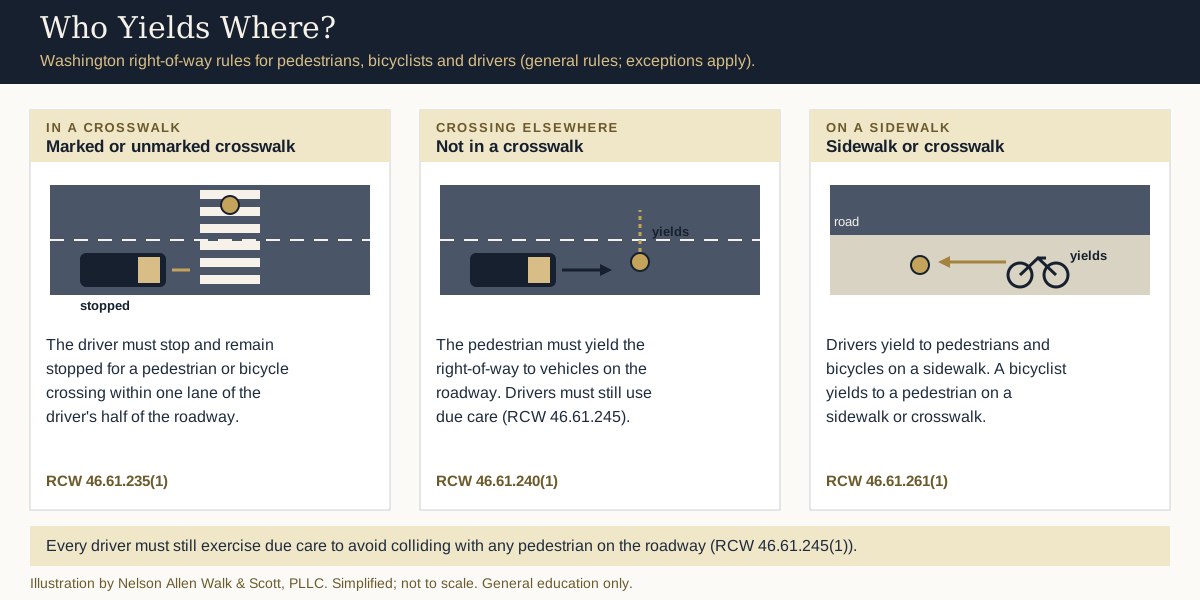
- A driver must stop and remain stopped for a pedestrian or bicycle crossing within a marked or unmarked crosswalk when that person is on or within one lane of the driver's half of the roadway (RCW 46.61.235(1)).
- A pedestrian who crosses somewhere other than a marked crosswalk, or an unmarked crosswalk at an intersection, must yield to vehicles on the roadway. Drivers must still use due care to avoid colliding with a pedestrian (RCW 46.61.240(1); RCW 46.61.245(1)).
- A bicyclist on the roadway has the rights and duties of a vehicle driver, subject to the special bicycle rules. On a sidewalk or crosswalk, a bicyclist has the rights and duties of a pedestrian (RCW 46.61.755).
- Shared fault reduces damages but does not bar recovery (RCW 4.22.005). The general deadline to file a lawsuit for injury to the person is three years (RCW 4.16.080(2)), and claims against local governments have their own claim-filing steps.
Pedestrians and bicyclists have little protection in a collision, so the question of who had the right-of-way often shapes the whole claim. Washington's traffic code gives each road user specific duties, and the rule that applies depends on where the crash happened.
This article walks through the main statutes in plain language, then explains how shared fault, insurance, evidence and deadlines fit in. It is general education, not advice about any one crash.
Crosswalks: When a Driver Must Stop
Under RCW 46.61.235(1), the operator of an approaching vehicle must stop and remain stopped to allow a pedestrian or bicycle to cross within an unmarked or marked crosswalk. The duty applies when that person is upon or within one lane of the half of the roadway the vehicle is traveling on or turning onto.
A second driver approaching from behind may not overtake and pass a vehicle that has stopped for someone at a marked crosswalk, or at an unmarked crosswalk at an intersection (RCW 46.61.235(4)).
At signals, RCW 46.61.060 adds that vehicle operators must stop for pedestrians lawfully moving within the intersection on a WALK signal. They must also stop for pedestrians who began crossing before a steady or flashing DON'T WALK signal appeared.
Key point
Key point: pedestrians also have duties
- A pedestrian or bicycle may not suddenly leave a curb or other place of safety and move into the path of a vehicle so close that the driver cannot stop (RCW 46.61.235(2)). The facts of the approach matter.
Crossing Elsewhere and Walking Along the Road
RCW 46.61.240(1) says a pedestrian crossing at any point other than a marked crosswalk, or an unmarked crosswalk at an intersection, must yield the right-of-way to all vehicles on the roadway. Between adjacent intersections with operating traffic signals, pedestrians may cross only in a marked crosswalk (RCW 46.61.240(4)).
That does not turn a driver's duties off. RCW 46.61.245(1) begins with the words "notwithstanding the foregoing provisions," and requires every driver to exercise due care to avoid colliding with any pedestrian on a roadway. It also requires a warning by horn when necessary and proper precaution around a child or an obviously confused or incapacitated person.
Pedestrians have separate rules for walking along a road. Where accessible sidewalks exist, RCW 46.61.250 makes it unlawful to walk along the adjacent roadway. Without sidewalks, a pedestrian must use an accessible shoulder, facing traffic when possible, or walk as near as practicable to the outside edge of the roadway facing traffic.
Washington also lets cities designate shared streets, and several of these rules, including RCW 46.61.240 and RCW 46.61.250(1), (2) and (4), do not apply on a shared street. On a shared street, vehicles yield to pedestrians and bicyclists, and bicyclists yield to pedestrians (RCW 46.61.197).
Bicyclists: Rights and Duties
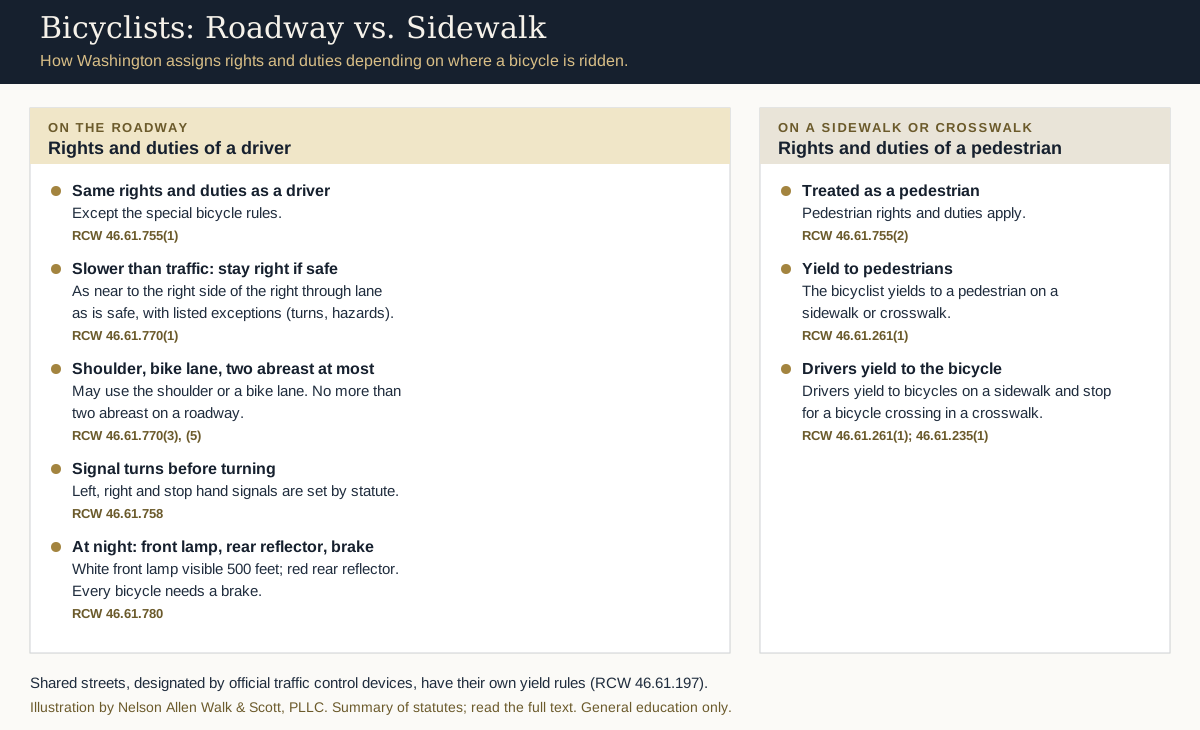
RCW 46.61.755(1) gives every person riding a bicycle on a roadway all of the rights, and subjects them to all of the duties, of the driver of a vehicle. The exceptions are the special bicycle rules and provisions that by their nature cannot apply. Under subsection (2), a person riding on a sidewalk or crosswalk has the rights and duties of a pedestrian.
The special rules are detailed. RCW 46.61.770 tells a bicyclist moving slower than the normal flow of traffic to ride as near to the right side of the right through lane as is safe. It lists exceptions, including turning movements, passing, and avoiding fixed or moving objects, parked vehicles, pedestrians, and surface hazards.
| Where | Who must yield | Statute |
|---|---|---|
| Marked or unmarked crosswalk | Driver stops and remains stopped for a pedestrian or bicycle crossing | RCW 46.61.235(1) |
| Crossing a roadway elsewhere | Pedestrian yields to vehicles; driver still owes due care | RCW 46.61.240(1); 46.61.245(1) |
| Sidewalk | Drivers yield to pedestrians and bicycles; bicyclist yields to pedestrian | RCW 46.61.261(1) |
| Roadway, bicycle among traffic | Bicyclist has a driver's rights and duties | RCW 46.61.755(1) |
| Shared street | Vehicles yield to bicyclists and pedestrians; bicyclists yield to pedestrians | RCW 46.61.197 |
Caution
Caution: equipment rules can come up
- After dark, a bicycle must have a white front lamp visible from at least 500 feet and a red rear reflector, and every bicycle needs a brake (RCW 46.61.780).
- Hand signals are also set by statute and must be given before a turn begins (RCW 46.61.758).
Enhanced Penalties for Drivers Who Harm Vulnerable Users
Washington has separate traffic offenses for negligent driving that harms a "vulnerable user of a public way." RCW 46.61.5259 defines that term to include a pedestrian and a person riding a bicycle or electric-assisted bicycle, among others.
The first-degree offense involves a death and is a gross misdemeanor. The second-degree offense in RCW 46.61.526 involves great or substantial bodily harm and is a traffic infraction with set penalties.
These sections set penalties for the driver. They do not set the compensation in a civil injury claim, which is a separate process.
How Shared Fault Comes Up
In a civil claim, RCW 4.22.005 says any contributory fault chargeable to the injured person diminishes the damages proportionately but does not bar recovery. Our article on Washington's pure comparative fault rule explains the rule in more detail.
Hypothetical example: a pedestrian steps off the curb mid-block while a driver, looking at a phone, fails to slow. A fact-finder could assign part of the fault to each person. Any award would then be reduced by the share assigned to the pedestrian.
This is an illustration of the legal rule, not a prediction about any real case. Missing a crosswalk or a lamp does not by itself end a claim, but an insurer may raise these facts to argue for a larger share of blame.
Key point
Key point: fault is decided on the facts
- The right-of-way statutes describe duties for each person. A claim turns on what each person actually did, and sometimes on what a witness, camera, or physical evidence shows.
- Do not accept an insurer's early view of fault as final.
Insurance: Where Coverage May Come From
Several policies can be involved. The at-fault driver's liability policy is the usual first source. Your own coverage may also matter, and our article on Washington PIP and UIM coverage covers it in depth.
On personal injury protection (PIP), RCW 48.22.085 requires insurers to offer it as optional coverage, and a named insured may reject it in writing. RCW 48.22.095 sets the minimum benefits insurers must offer, such as $10,000 in medical and hospital benefits.
RCW 48.22.005 defines who is an "insured" for PIP. It includes a named insured, certain household members, and a pedestrian accidentally struck by the insured automobile. The statute defines "pedestrian" as a natural person not occupying a motor vehicle, so how it applies to a person on a bicycle is a policy question to ask about directly.
Underinsured motorist (UIM) coverage is addressed in RCW 48.22.030. It applies to underinsured, hit-and-run, and phantom vehicles. For a phantom vehicle with no physical contact, the statute requires corroborating evidence beyond the insured's own testimony, and a report to law enforcement within 72 hours.
What to do
What to do: report a hit-and-run quickly
- Report a hit-and-run to police right away. For a phantom vehicle with no contact, the statute sets a 72-hour reporting window.
- Tell your own insurer about the crash, and ask which coverages are on the policy.
- Keep the claim number and every adjuster's name.
Evidence to Keep After a Pedestrian or Bicycle Crash
Evidence can disappear quickly, so start collecting as soon as you are able, or ask a friend to help.
- Photographs of the location: crosswalk markings, signs, signals, curb ramps, lighting, and sight lines.
- Photographs of injuries, torn clothing, and the bicycle, plus the bicycle itself, its lamp, and any helmet or gear, unrepaired.
- Names and numbers of drivers and witnesses, plus the vehicle's plate and any camera footage from nearby homes or businesses.
- The police report number, the responding officer's name, and the time you called.
- Medical records and bills from the first visit forward, and a short note of symptoms each day.
- Pay stubs or other records of missed work.
Our guide on what to do after a car accident in Washington covers the first hours in more detail. Before you sign a release or give a recorded statement to an insurer, talk with a lawyer.
Deadlines
RCW 4.16.080(2) requires an action for injury to the person to be commenced within three years. That is the general rule, and it is not a calculation for any one person. Some situations have different rules.
For example, claims against a local government, such as a city that maintains the road, require presenting a claim to its designated agent. Under RCW 4.96.020, a lawsuit may not be commenced until 60 calendar days after the claim is first presented, and the claim must be presented within the applicable limitations period.
If a crash killed someone, see our article on Washington wrongful death claims.
To talk through a pedestrian or bicycle crash, visit our personal injury practice page or contact us. Nelson Allen Walk & Scott, PLLC is at 1103 Shaw Road, Puyallup, WA 98372, and the phone is (253) 845-8895.
Written by Nathan D. Sukhia, Of Counsel.
Frequently Asked Questions
Does a driver have to stop for a pedestrian at an unmarked crosswalk?+
Can I still make a claim if I was not in a crosswalk?+
Do bicyclists have the same rights as drivers in Washington?+
Does a bicyclist have to ride on the far right?+
Will my own car insurance pay if I am hit while walking or biking?+
How long do I have to file a lawsuit after a pedestrian or bicycle crash?+
Sources & Further Reading
- 1.RCW 46.61.235 — CrosswalksDriver's duty to stop and remain stopped, the sudden-entry limit on pedestrians and bicycles, and the no-passing rule at a stopped vehicle.
- 2.RCW 46.61.240 — Crossing at Other Than CrosswalksPedestrian duty to yield outside crosswalks and the shared street exception.
- 3.RCW 46.61.245 — Drivers to Exercise CareDue care to avoid colliding with any pedestrian on a roadway.
- 4.RCW 46.61.250, 46.61.060, 46.61.261 and 46.61.197Pedestrians on roadways, pedestrian signals, sidewalk right-of-way, and shared streets.
- 5.RCW 46.61.755 — Traffic Laws Apply to Persons Riding BicyclesDriver's rights and duties on the roadway and pedestrian rights and duties on a sidewalk or crosswalk. See also RCW 46.61.758, 46.61.770 and 46.61.780.
- 6.RCW 46.61.5259 and 46.61.526 — Negligent Driving With a Vulnerable User VictimDefines vulnerable user of a public way and sets the offenses and penalties for the driver.
- 7.RCW 4.22.005 — Effect of Contributory FaultContributory fault diminishes damages proportionately and does not bar recovery.
- 8.RCW 48.22.005, 48.22.030, 48.22.085 and 48.22.095PIP offering and rejection, minimum PIP benefits, who is an insured, and underinsured, hit-and-run and phantom vehicle coverage.
- 9.RCW 4.16.080 — Actions Limited to Three YearsSubsection (2) covers an action for any other injury to the person not otherwise enumerated.
- 10.RCW 4.96.020 — Claims Against Local Governmental EntitiesPresentment of a claim to the agent and the 60-day waiting period.
Disclaimer
This article is provided for general informational purposes only and does not constitute legal advice. It is based on Washington law as of the date noted above; statutes, court rules, and case law can and do change, and this article may not reflect the most current legal developments or apply to your specific facts.
Reading this article, contacting Nelson Allen Walk & Scott through this website, or submitting information through our contact form does not create an attorney-client relationship. An attorney-client relationship is formed only after both parties sign a written engagement agreement. Please do not send any confidential or time-sensitive information until that relationship has been established.
Every case is different, and past outcomes described or implied on this site do not guarantee or predict a similar result in any future matter. If you need advice about your specific situation, please consult directly with Nathan D. Sukhia or another licensed Washington attorney.
Attorney Advertising.
Experience · Expertise · Excellence
Talk to Nathan D. Sukhia
Nathan D. Sukhia and our team are happy to talk through your specific situation.