
Drunk and Impaired Driver Crashes in Washington: Your Injury Claim Explained
Key Takeaways
- RCW 46.61.502 makes it a crime to drive with an alcohol concentration of 0.08 or higher within two hours after driving, or while affected by liquor, cannabis or any drug.
- A DUI prosecution is brought by the State. An injury claim is a separate civil action brought by the injured person.
- Washington allocates fault by percentage, and your own fault reduces but does not bar recovery (RCW 4.22.005; 4.22.070).
- RCW 5.40.060 gives a defense against an intoxicated injured person who was more than 50 percent at fault, with a limit when the claim is against an impaired driver.
- Your own underinsured motorist coverage may apply if the impaired driver has no insurance or too little (RCW 48.22.030).
- The general deadline to sue for injury to the person is three years (RCW 4.16.080(2)).
Hypothetical example: a driver leaving a party runs a red light in Puyallup and hits a car crossing the intersection. Police arrest the driver for DUI, and the injured driver wonders what that means for medical bills and lost work.
This article explains what Washington law says about crashes caused by drunk or impaired drivers. It is general education, not advice about any one crash.
What Washington's DUI Law Says
Under RCW 46.61.502(1), a person is guilty of driving under the influence if the person drives a vehicle in Washington and, within two hours after driving, has an alcohol concentration of 0.08 or higher, or a THC concentration of 5.00 or higher, as shown by a test under RCW 46.61.506.
A person is also guilty if driving while under the influence of or affected by intoxicating liquor, cannabis or any drug, or under their combined influence. Being entitled to use a drug under state law is not a defense (RCW 46.61.502(2)).
Under RCW 46.61.506(1), in a civil or criminal action, a test result below those levels is evidence that may be considered with other competent evidence of whether the person was under the influence.
| Rule | What the statute says | Source |
|---|---|---|
| Alcohol | 0.08 or higher within two hours after driving | 46.61.502(1)(a) |
| THC | 5.00 or higher in blood within two hours after driving | 46.61.502(1)(b) |
| Affected by | Under the influence of or affected by liquor, cannabis or any drug | 46.61.502(1)(c) |
| Combined | Under the combined influence of liquor, cannabis and any drug | 46.61.502(1)(d) |
| Vehicular assault | Driving under the influence and causing substantial bodily harm; a class B felony | 46.61.522(1)(b), (2) |
The Criminal Case and Your Injury Claim Are Separate
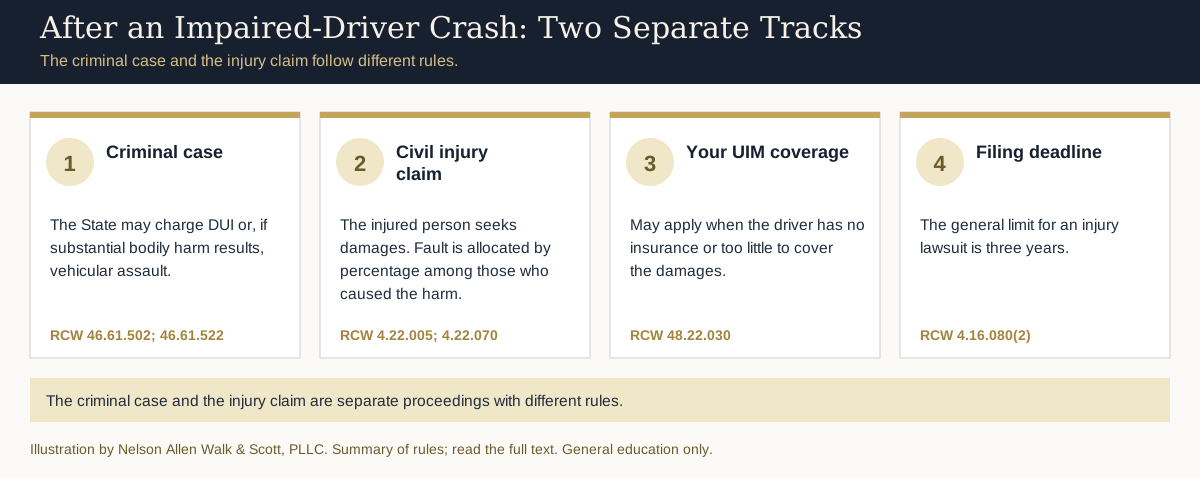
The State decides whether to charge DUI or, where substantial bodily harm results, vehicular assault under RCW 46.61.522. The injured person is not a party to that prosecution.
An injury claim is a separate civil action for damages. It has its own rules, its own deadline, and usually involves the at-fault driver's insurer.
Key point
Key point: keep both tracks in view
- Get the police report number and the name of the investigating agency.
- Talk with a lawyer before giving a recorded statement to the other driver's insurer.
- Keep medical records, bills, photos, and witness names.
How Fault Is Allocated
Under RCW 4.22.070(1), the trier of fact determines the percentage of total fault attributable to every entity that caused the claimant's damages, and the percentages total one hundred percent. Each defendant's liability is generally several only, meaning it pays its own share.
The statute lists exceptions. A party is responsible for another's fault when both acted in concert or when the person was acting as the party's agent or servant (RCW 4.22.070(1)(a)).
If the claimant is found not at fault, the defendants against whom judgment is entered are jointly and severally liable for the sum of their shares (RCW 4.22.070(1)(b)). The statute does not have a separate exception just for intoxication.
Under RCW 4.22.005, a claimant's own fault reduces damages proportionately but does not bar recovery. Our comparative fault article explains how that works.
The Intoxication Defense and Its Limit
RCW 5.40.060(1) makes it a complete defense to a personal injury or wrongful death action that the injured person was under the influence, that the condition was a proximate cause of the injury, and that the trier of fact finds the person more than fifty percent at fault.
Subsection (2) limits that defense in a claim against an impaired driver. If the driver's condition was a proximate cause, the defense does not apply just because the injured person was also under the influence, as long as that person's condition was not a proximate cause of the crash.
Caution
Caution: passengers and other impaired people
- Hypothetical: a passenger who had been drinking rides with an impaired driver. Whether RCW 5.40.060 affects the claim depends on the facts, including causation and fault percentages.
- These questions are fact-specific. Talk with a lawyer about your situation.
Insurance After an Impaired-Driver Crash
The impaired driver's liability insurance is usually the first place a claim is made. If that driver has no insurance or too little, your own underinsured motorist coverage may apply.
RCW 48.22.030(1) defines an underinsured motor vehicle to include one with no applicable liability insurance, or with limits less than the damages the covered person is legally entitled to recover. Under subsection (2), covered auto policies must include this coverage unless a named insured or spouse rejects it in writing under subsection (4).
Personal injury protection (PIP) may also help with medical bills. Our PIP and UIM article explains both coverages, and our article on insurance claim handling rules covers dealing with adjusters.
Can a Bar or Restaurant Be Involved?
RCW 66.44.200(1) provides that no person shall sell any liquor to any person apparently under the influence of liquor. That statute sets a licensing rule and provides for administrative action.
Whether a seller can also face a civil injury claim is governed largely by court decisions, not by that statute alone. It depends on the facts and is a question to raise with a lawyer.
Evidence That Can Matter
In an impaired-driver crash, useful evidence often comes from several places. It can include the police report, any breath or blood test results, and the investigating officer's observations.
Other evidence may include photos of the scene and vehicles, witness statements, receipts or records showing where the driver had been, and video from nearby businesses or dashcams. Some of it may be kept only for a short time.
- Police report and case number
- Test results, if any, and how they were obtained
- Photos, video, and witness contact information
- Medical records, bills, and proof of missed work
- Your insurance policy declarations page
A lawyer can ask the right people to preserve records early. That is general information, not a promise about what any record will show.
Deadlines
RCW 4.16.080(2) requires an action for injury to the person to be commenced within three years. That is the general rule, and other deadlines can apply, for example to claims involving a government entity.
What to do
Next steps
- Get medical care and keep every record.
- Write down what you remember, including where the driver came from, if known.
- Read our guide on what to do after a car accident in Washington.
- Contact us to talk about your situation.
Related reading: our articles on hit-and-run crashes, truck accidents, and wrongful death claims.
To talk through a crash caused by an impaired driver, visit our personal injury practice page or contact us. Nelson Allen Walk & Scott, PLLC is at 1103 Shaw Road, Puyallup, WA 98372, and the phone is (253) 845-8895.
Written by Nathan D. Sukhia, Of Counsel.
Frequently Asked Questions
Do I need the driver to be convicted of DUI to bring an injury claim?+
What blood alcohol level counts as DUI in Washington?+
What if I was partly at fault for the crash?+
What if the drunk driver had no insurance?+
Can a bar that served the driver be responsible?+
How long do I have to file a lawsuit?+
Sources & Further Reading
- 1.RCW 46.61.502 — Driving Under the InfluenceAlcohol, THC and affected-by standards.
- 2.RCW 46.61.506 — Evidence and TestsUse of test results in civil or criminal actions.
- 3.RCW 46.61.522 — Vehicular AssaultImpaired driving causing substantial bodily harm; class B felony.
- 4.RCW 4.22.005 — Effect of Contributory FaultContributory fault reduces damages but does not bar recovery.
- 5.RCW 4.22.070 — Percentage of FaultFault allocation, several liability, and exceptions.
- 6.RCW 5.40.060 — Intoxication DefenseDefense where an impaired injured person is more than 50 percent at fault, and its limit.
- 7.RCW 48.22.030 — Underinsured Motorist CoverageDefinition, required coverage, and written rejection.
- 8.RCW 66.44.200 — Sales to Persons Apparently Under the InfluenceProhibition on selling liquor to apparently intoxicated persons.
- 9.RCW 4.16.080 — Actions Limited to Three YearsSubsection (2): injury to the person.
Disclaimer
This article is provided for general informational purposes only and does not constitute legal advice. It is based on Washington law as of the date noted above; statutes, court rules, and case law can and do change, and this article may not reflect the most current legal developments or apply to your specific facts.
Reading this article, contacting Nelson Allen Walk & Scott through this website, or submitting information through our contact form does not create an attorney-client relationship. An attorney-client relationship is formed only after both parties sign a written engagement agreement. Please do not send any confidential or time-sensitive information until that relationship has been established.
Every case is different, and past outcomes described or implied on this site do not guarantee or predict a similar result in any future matter. If you need advice about your specific situation, please consult directly with Nathan D. Sukhia or another licensed Washington attorney.
Attorney Advertising.
Experience · Expertise · Excellence
Talk to Nathan D. Sukhia
Nathan D. Sukhia and our team are happy to talk through your specific situation.