
When Several Parties Share Fault in Washington: Contribution, Settlements, and Joint Liability
Key Takeaways
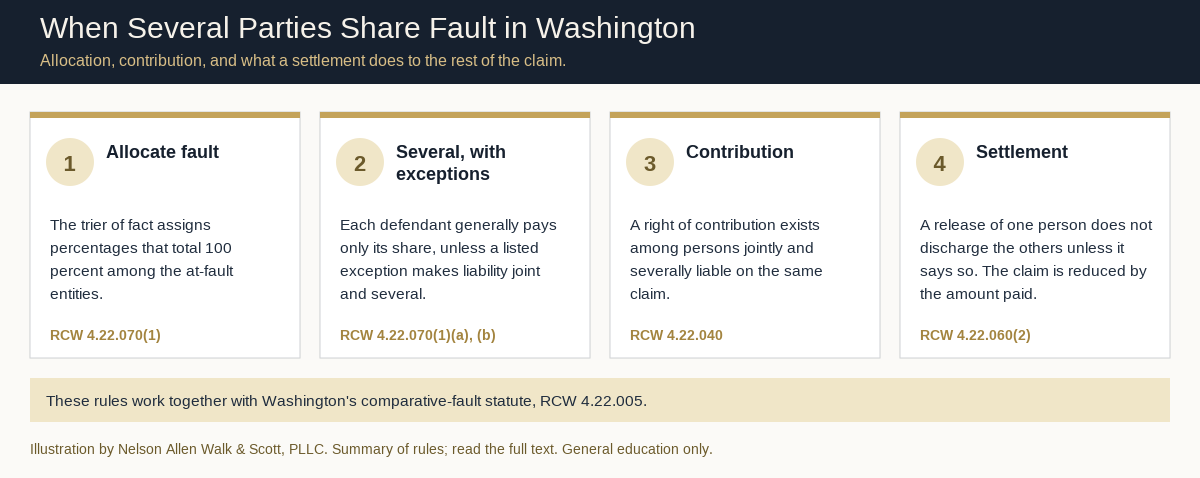
- In cases involving the fault of more than one entity, the trier of fact assigns percentages that total 100 percent, including released entities, but not entities immune under Title 51 RCW (RCW 4.22.070(1)).
- Each defendant's liability is several only, except when the statute makes a party responsible for another's fault or when the claimant is found not at fault (RCW 4.22.070(1)(a), (b)).
- A right of contribution exists among persons who are jointly and severally liable on the same indivisible claim, and it is based on each person's comparative fault (RCW 4.22.040(1)).
- Before entering a settlement, a party must give five days' written notice to the other parties and the court, and the court must determine that the amount to be paid is reasonable (RCW 4.22.060(1)).
- A release of one person discharges that person from contribution but does not discharge others unless it says so. The claim against the others is reduced by the amount paid, or by a reasonable amount if the payment was unreasonable (RCW 4.22.060(2)).
Hypothetical example: a driver is hurt in a multi-vehicle crash in Puyallup. Two other drivers may share fault, and one of them wants to settle. The injured driver needs to know what that settlement does to the rest of the claim.
Washington's basic comparative-fault rule is in RCW 4.22.005: a claimant's own fault reduces damages proportionately but does not bar recovery. Our comparative fault article explains that rule, what counts as fault, and the complete defenses. This article goes further, on how fault is split among several defendants, when they share liability, and what a settlement changes.
It is general education, not advice about any one claim.
How Fault Is Split Among Several Parties
Under RCW 4.22.070(1), in all actions involving fault of more than one entity, the trier of fact determines the percentage of the total fault attributable to every entity that caused the claimant's damages, except entities immune from liability to the claimant under Title 51 RCW. The percentages assigned to at-fault entities must total 100 percent.
The entities whose fault is determined include the claimant, defendants, third-party defendants, entities the claimant has released, entities with any other individual defense against the claimant, and entities immune from liability to the claimant, other than those immune under Title 51.
Judgment is entered against each defendant, except those who have been released, are immune, or prevailed on another individual defense, in an amount that represents that party's proportionate share of the claimant's total damages.
Key point
Key point: released and immune parties still affect the math
- A share of fault assigned to a released entity is still part of the 100 percent.
- That share is generally not shifted onto the defendants who remain in the case.
Several Liability, and When It Becomes Joint
RCW 4.22.070(1) says the liability of each defendant shall be several only and shall not be joint, except in the situations the statute names. Several liability means each defendant is responsible for its own percentage, and not for another defendant's unpaid share.
The exceptions are in subsections (1)(a) and (1)(b). A party is responsible for the fault of another person, or for payment of another party's proportionate share, where both were acting in concert, or when a person was acting as an agent or servant of the party.
If the trier of fact determines that the claimant was not at fault, the defendants against whom judgment is entered are jointly and severally liable for the sum of their proportionate shares of the claimant's total damages. That sum does not include a share assigned to a released or immune entity.
Under RCW 4.22.070(2), if a defendant is jointly and severally liable under one of those exceptions, that defendant's rights to contribution, and the effect of a settlement by either such defendant, are determined under RCW 4.22.040, RCW 4.22.050, and RCW 4.22.060.
The Right of Contribution
Contribution is a claim among defendants, not a claim the injured person brings. Under RCW 4.22.040(1), a right of contribution exists between or among two or more persons who are jointly and severally liable upon the same indivisible claim for the same injury, death, or harm, whether or not judgment has been recovered against all or any of them.
It may be enforced in the original action or in a separate action. The basis for contribution among liable persons is the comparative fault of each such person. The court may determine that two or more persons are to be treated as a single person for purposes of contribution.
Contribution is available to a person who settles with a claimant only if two conditions in RCW 4.22.040(2) are met: the settlement extinguished the liability of the person against whom contribution is sought, and the amount paid was reasonable at the time of the settlement, and then only to that extent.
How Contribution Is Enforced, and When
If the court already established the parties' comparative fault in the original action, a party who paid more than that party's equitable share may, on motion, recover judgment for contribution (RCW 4.22.050(1)).
If comparative fault was not established in the original action, contribution may be enforced in a separate action, whether or not a judgment has been rendered against the person seeking contribution or the person from whom it is sought (RCW 4.22.050(2)).
If a judgment has been rendered, the contribution action must be commenced within one year after the judgment becomes final. If no judgment has been rendered, RCW 4.22.050(3) requires either that the person discharged the common liability by payment within the limitations period on the claimant's action and then commenced the contribution action within one year after payment, or that the person agreed while the action was pending to discharge the common liability and, within one year after the agreement, paid it and commenced the contribution action.
| Topic | What the statute provides | Source |
|---|---|---|
| Who may seek contribution | Persons jointly and severally liable on the same indivisible claim | RCW 4.22.040(1) |
| How shares are set | Comparative fault of each liable person | RCW 4.22.040(1) |
| Settling party seeking contribution | Only if the settlement extinguished the other person's liability, and only to the extent the amount paid was reasonable | RCW 4.22.040(2) |
| Deadline after a judgment | One year after the judgment becomes final | RCW 4.22.050(3) |
| Notice before a settlement | Five days' written notice to all other parties and the court, unless the court shortens the period for good cause | RCW 4.22.060(1) |
| Effect on the rest of the claim | Others are not discharged unless the agreement says so; the claim is reduced by the amount paid, or by a reasonable amount | RCW 4.22.060(2) |
What a Settlement With One Party Does
RCW 4.22.060(1) requires a party, before entering into a release, covenant not to sue, covenant not to enforce judgment, or a similar agreement with a claimant, to give five days' written notice of that intent to all other parties and the court. The court may authorize a shorter notice period for good cause. The notice must contain a copy of the proposed agreement.
A hearing is held on whether the amount to be paid is reasonable, and all parties must have an opportunity to present evidence. A determination that the amount is reasonable must be secured. The burden of proof on reasonableness is on the party requesting the settlement.
If the agreement was entered into before the lawsuit was filed, a hearing on whether the amount paid was reasonable at that time may be held at any time before final judgment, on motion of a party.
Caution
Caution: a settlement with one defendant is not automatically the end
- Hypothetical: you settle with one driver and later sue another. The first settlement does not discharge the second driver unless the agreement says so.
- The remaining claim is reduced by the amount paid, so the terms and the reasonableness hearing both matter.
How the Remaining Claim Is Reduced
Under RCW 4.22.060(2), a release or similar agreement discharges the settling person from all liability for contribution, but it does not discharge any other persons liable on the same claim unless it so provides.
The claim of the releasing person against the others is reduced by the amount paid under the agreement, unless that amount was unreasonable when the agreement was made. In that case, the claim is reduced by an amount the court determines to be reasonable.
If the court finds the amount paid was unreasonable, that finding does not affect the validity of the agreement between the released and releasing persons, and no adjustment is made in the amount paid between those parties (RCW 4.22.060(3)).
The figures below are a hypothetical illustration of the arithmetic only. They are not a case result and do not predict the value of any claim.
- Hypothetical: the claimant is found not at fault. Driver A is assigned 70 percent and Driver B 30 percent of $100,000 in damages. Drivers A and B are jointly and severally liable for $100,000.
- If the claimant settles with Driver B for $20,000, and the court finds that amount reasonable, the claim against Driver A is reduced by $20,000, leaving $80,000.
- If the settlement agreement does not release Driver A, Driver A is not discharged. Contribution between the drivers is then governed by RCW 4.22.040 through 4.22.060.
Workers' Compensation and Other Limits
RCW 4.22.070(1) leaves Title 51-immune entities out of the fault allocation. Title 51 is Washington's workers' compensation law. Whether a particular employer is immune is a separate question, and this article does not address every Title 51 rule.
RCW 4.22.070(3) also says that section does not affect certain other causes of action, including those relating to hazardous wastes or solid waste disposal sites, tortious interference with contracts or business relations, and the manufacture or marketing of a generic fungible product with no clearly identifiable shape, color, or marking.
What to do
Next steps
- Write down every person or company that may have caused the injury.
- Talk with a lawyer before signing a release that might affect claims against others.
- Read our comparative fault article for the basic rule and the complete defenses.
- Contact us to talk about your situation.
If the crash involved a passenger who was not at fault, our passenger injury claims article discusses the not-at-fault exception. For first steps after a crash, see our guide on what to do after a car accident in Washington.
Our article on the personal injury statute of limitations covers the usual three-year deadline for the injury claim itself. Contribution claims have the separate one-year periods in RCW 4.22.050.
To talk through a claim involving more than one at-fault party, visit our personal injury practice page or contact us. Nelson Allen Walk & Scott, PLLC is at 1103 Shaw Road, Puyallup, WA 98372, and the phone is (206) 279-5835.
Written by Nathan D. Sukhia, Of Counsel.
Frequently Asked Questions
If one defendant cannot pay, can I collect that share from the others?+
What is contribution?+
Does settling with one defendant release the others?+
Why is there a hearing about whether a settlement is reasonable?+
How long does a defendant have to sue another defendant for contribution?+
Are employers included when fault is allocated?+
Sources & Further Reading
- 1.RCW 4.22.005 — Effect of Contributory FaultA claimant's fault reduces damages proportionately but does not bar recovery.
- 2.RCW 4.22.070 — Percentage of FaultAllocation among at-fault entities, several liability, joint-and-several exceptions, and a cross-reference to contribution and settlement.
- 3.RCW 4.22.040 — Right of ContributionContribution among persons jointly and severally liable; reasonableness limit after a settlement.
- 4.RCW 4.22.050 — Enforcement of ContributionMotions and separate actions, and the one-year periods to sue for contribution.
- 5.RCW 4.22.060 — Effect of Settlement AgreementFive-day notice, reasonableness hearing, discharge from contribution, and reduction of the remaining claim.
Disclaimer
This article is provided for general informational purposes only and does not constitute legal advice. It is based on Washington law as of the date noted above; statutes, court rules, and case law can and do change, and this article may not reflect the most current legal developments or apply to your specific facts.
Reading this article, contacting Nelson Allen Walk & Scott through this website, or submitting information through our contact form does not create an attorney-client relationship. An attorney-client relationship is formed only after both parties sign a written engagement agreement. Please do not send any confidential or time-sensitive information until that relationship has been established.
Every case is different, and past outcomes described or implied on this site do not guarantee or predict a similar result in any future matter. If you need advice about your specific situation, please consult directly with Nathan D. Sukhia or another licensed Washington attorney.
Attorney Advertising.
Experience · Expertise · Excellence
Talk to Nathan D. Sukhia
Nathan D. Sukhia and our team are happy to talk through your specific situation.