
Uber and Lyft Accidents in Washington: Whose Insurance Applies?
Key Takeaways
- Washington requires a primary commercial policy on a personal vehicle used for commercial transportation services. That period starts when the driver logs in to the app and runs until the passenger has left the vehicle, whichever is later (RCW 46.72B.180(1); RCW 48.177.005(1)). The requirement was formerly RCW 48.177.010.
- While the driver is logged in but has not accepted a ride, the policy must carry liability of $50,000 per person and $100,000 per accident for bodily injury and $30,000 for property damage, plus underinsured motorist (UIM) and personal injury protection (PIP) coverage to the extent the general insurance statutes require.
- Once a ride is accepted, the policy must carry a $1,000,000 combined single limit for death, personal injury, and property damage, plus PIP. From the moment a passenger enters until the passenger exits, it must also carry UIM coverage of $100,000 per person and $300,000 per accident.
- If more than one policy applies, the company that matched the driver and passenger must provide coverage once the driver is traveling to pick up or carrying the passenger. If the driver's required policy does not cover for any reason, the company must provide the coverage from the first dollar of a claim (RCW 46.72B.180(2)(b), (10)).
- A driver's private passenger policy may exclude coverage while the driver is logged in or providing a ride (RCW 46.72B.180(6)). The driver's personal policy is therefore often not the answer for a rideshare-period crash.
- These rules say which coverage must exist. They do not decide fault. RCW 4.16.080(2) generally requires an action for injury to the person to be commenced within three years.
Here is a hypothetical. A rider in Tacoma is on the way home when the car is hit at an intersection. The driver had the rideshare app open. Whose insurance is supposed to respond: the driver's, or the app company's?
Washington answers by the phase of the trip, not with one rule. This article walks through each phase based on the statute and notes what the statute does not decide. It is general education, not advice about one crash. Our personal injury practice page describes how the firm approaches these matters.
What Washington Calls a Rideshare Company
Washington's statutes do not use the word rideshare. The insurance rules refer to a "commercial transportation services provider" and to "commercial transportation services." The licensing chapter (RCW 46.72B.020) calls the same kind of company a "transportation network company."
RCW 48.177.005 defines the key terms. A provider uses a digital network or software application to connect passengers to drivers for a prearranged ride. A driver uses a personal vehicle to provide those services.
The insurance requirement itself is now in RCW 46.72B.180. It was formerly RCW 48.177.010 and was recodified in 2022. Older articles and policy forms may still cite the old number.
Key point
When the coverage clock runs
- "Commercial transportation services" means all times the driver is logged in to the provider's app, or until the passenger has left the vehicle, whichever is later (RCW 48.177.005(1)).
- A prearranged ride begins when the driver accepts a requested ride, continues while the passenger is transported, and ends when the passenger departs (RCW 48.177.005(6)).
- Those two definitions drive the three phases below.
Coverage at a Glance
The diagram and table summarize the minimum coverage RCW 46.72B.180(1)(b) requires in each phase. They are statutory requirements. They do not describe any particular policy.
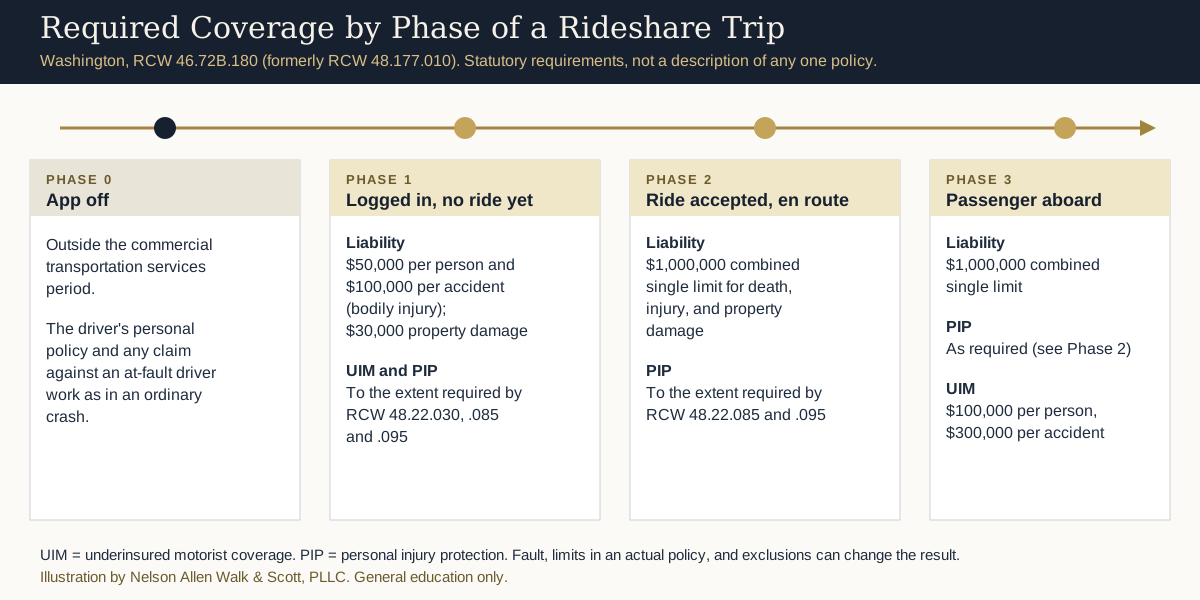
| Phase | When it applies | Liability | UIM | PIP |
|---|---|---|---|---|
| App off | Not logged in, no passenger aboard | Driver's personal policy and ordinary rules | Personal policy | Personal policy |
| 1 | Logged in, no ride accepted | $50,000 per person and $100,000 per accident (bodily injury); $30,000 property damage | To the extent required under RCW 48.22.030 | To the extent required under RCW 48.22.085 and 48.22.095 |
| 2 | Ride accepted, driver heading to pickup | $1,000,000 combined single limit | No amount listed for this period | To the extent required under RCW 48.22.085 and 48.22.095 |
| 3 | Passenger in the vehicle | $1,000,000 combined single limit | $100,000 per person and $300,000 per accident | To the extent required under RCW 48.22.085 and 48.22.095 |
Phase 1: App On, No Ride Accepted
A driver who is logged in and waiting for a request is already providing commercial transportation services. The required commercial policy must be in force at that point.
The liability limits are lower than during a ride. They are $50,000 per person and $100,000 per accident for bodily injury, and $30,000 for property damage.
The statute also requires UIM and PIP coverage "to the extent required" by the general automobile insurance statutes. How those general rules work is covered in our PIP and UIM article.
Phase 2: Ride Accepted, Driver on the Way
When the driver accepts a requested ride, the requirement steps up. The policy must carry a combined single limit of $1,000,000 for death, personal injury, and property damage, plus PIP to the extent required.
This applies even before the passenger is picked up. A third party hurt by a rideshare car that is heading to a pickup would generally look to this liability coverage.
Caution
Do not guess the phase
- The app status at the moment of the crash decides which row of the table applies.
- Screenshots of the trip screen, receipts, and the time of the crash help show the phase. Memory alone may not.
- Do not assume that anyone has accepted responsibility because someone said so at the scene.
Phase 3: Passenger in the Vehicle
From the moment a passenger enters the vehicle until the passenger exits, the policy must also carry UIM coverage of $100,000 per person and $300,000 per accident. That sits on top of the $1,000,000 liability coverage and the PIP requirement.
UIM matters when a different driver caused the crash and that driver's liability coverage is too low. Hypothetically, a passenger is hurt when a driver in another car runs a red light. If that driver's limits are low, the rideshare vehicle's UIM coverage is one place to look.
Which coverage actually pays depends on the policy language and the facts. The general rules are in our PIP and UIM article, linked above.
When the Driver's Personal Policy Applies
A driver's private policy is the one most people think of first. For rideshare-period crashes, Washington lets insurers write it out.
Under RCW 46.72B.180(6), an insurer may exclude coverage under a private passenger policy for loss or injury while the driver is logged in or providing a prearranged ride. That can reach liability, PIP, UIM, medical payments, comprehensive, and collision coverage.
Subsection (7) adds that the section does not require a private passenger policy to provide primary or excess coverage, or a duty to defend, during that period. Subsection (13) separately bars an insurer from denying an otherwise covered claim from purely personal use solely because the insured used the car for rideshare at other times.
Caution
Check which period you were in
- If you were driving for an app, your own policy may exclude that period. Read the exclusion language instead of assuming.
- If you were driving only for personal use, subsection (13) limits one reason an insurer can give for denial.
- The facts that separate those two situations are time-sensitive, so write down what you remember now.
Which Policy Is First in Line
More than one policy can apply to one crash. Subsection (10) of the statute says how responsibility is divided when more than one policy provides valid and collectible coverage.
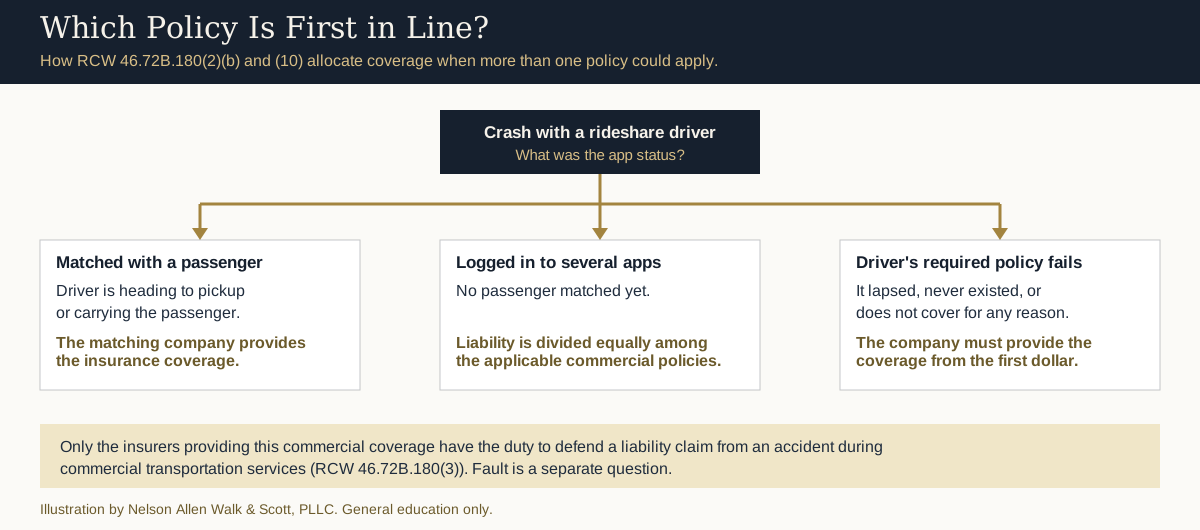
- If the driver has been matched with a passenger and is traveling to pick up the passenger, or is providing services to a passenger, the company that matched them must provide insurance coverage (subsection (10)(a)).
- If the driver is logged in to more than one company's app and has not been matched, liability is divided equally among the applicable policies that specifically cover commercial transportation services (subsection (10)(b)).
- If the driver's own required policy does not provide coverage for any reason, including a lapse or no policy, the company must provide the required coverage beginning with the first dollar of a claim (subsection (2)(b)).
The required policy can be bought by the company, by the driver, or by a combination of both (subsection (2)(c)). Only the insurers providing that coverage have the duty to defend a liability claim from an accident during commercial transportation services (subsection (3)).
Getting the App Records
Proof of timing matters. Subsection (11) requires the company or its insurer to cooperate with other insurers in a coverage investigation, including by providing the dates and times of the accident.
Within ten business days after a request, they must provide a copy of the electronic record showing when the driver logged on and off that day. They must also keep related data, communications, and documents for at least the applicable limitation periods plus two years from the accident.
The statute states this duty as running to the insurers involved. It does not describe a separate request process for an injured rider, so tell each insurer when the crash happened.
What to do
What to do after a rideshare crash
- Call 911, get medical care, and follow the basic steps in our car accident guide.
- If it is safe, photograph the trip screen, the driver's profile, and the license plate.
- Write down the exact time of the crash and whether a ride was accepted or in progress.
- Tell your own insurer, and keep every insurer name, claim number, and adjuster name in one place.
- Before you sign a release or give a recorded statement, talk with a lawyer.
Insurance Is Not the Same as Fault
The statute decides which coverage must exist and who provides it. It does not decide who caused the crash. Fault is decided separately, and our article on Washington's pure comparative fault rule explains how shared blame is handled.
If a rideshare crash killed someone, a different set of claims applies. Our article on Washington wrongful death claims explains who may file and what those claims can include.
Deadlines and Next Steps
RCW 4.16.080(2) requires an action for injury to the person to be commenced within three years. That is the general rule. Other deadlines can apply, for example when a government vehicle is involved, so do not treat three years as the answer for every crash.
Policies can also set their own notice requirements, so check yours early.
To talk through a rideshare crash, visit our personal injury practice page or contact us. Nelson Allen Walk & Scott, PLLC is at 1103 Shaw Road, Puyallup, WA 98372, and the phone is (253) 845-8895.
Written by Nathan D. Sukhia, Of Counsel.
Frequently Asked Questions
Does my own car insurance cover me when I drive for a rideshare app?+
I was a passenger in a rideshare car that was hit. Whose insurance applies?+
What if the driver was logged in but had not accepted a ride?+
What happens if the driver's insurance lapsed or never existed?+
Can I get the app's records showing when the driver was logged in?+
How long do I have to file a lawsuit after a rideshare crash in Washington?+
Sources & Further Reading
- 1.RCW 46.72B.180 — Insurance That Covers Commercial Transportation ServicesRequired coverage by phase, the company's first-dollar obligation, the private-policy exclusion, allocation among policies, and the insurer cooperation and records duty. Formerly RCW 48.177.010.
- 2.RCW 48.177.005 — DefinitionsDefines commercial transportation services, provider, driver, passenger, personal vehicle, and prearranged ride.
- 3.RCW 46.72B.020 — Definitions (Transportation Network Companies)The licensing chapter's terms, which incorporate the prearranged ride and personal vehicle definitions in RCW 48.177.005.
- 4.RCW 4.16.080 — Actions Limited to Three YearsSubsection (2) includes an action for any other injury to the person or rights of another not otherwise enumerated.
Disclaimer
This article is provided for general informational purposes only and does not constitute legal advice. It is based on Washington law as of the date noted above; statutes, court rules, and case law can and do change, and this article may not reflect the most current legal developments or apply to your specific facts.
Reading this article, contacting Nelson Allen Walk & Scott through this website, or submitting information through our contact form does not create an attorney-client relationship. An attorney-client relationship is formed only after both parties sign a written engagement agreement. Please do not send any confidential or time-sensitive information until that relationship has been established.
Every case is different, and past outcomes described or implied on this site do not guarantee or predict a similar result in any future matter. If you need advice about your specific situation, please consult directly with Nathan D. Sukhia or another licensed Washington attorney.
Attorney Advertising.
Experience · Expertise · Excellence
Talk to Nathan D. Sukhia
Nathan D. Sukhia and our team are happy to talk through your specific situation.