
Ice and Snow Slip-and-Fall Claims in Washington: Premises Duties, Evidence, and Deadlines
Key Takeaways
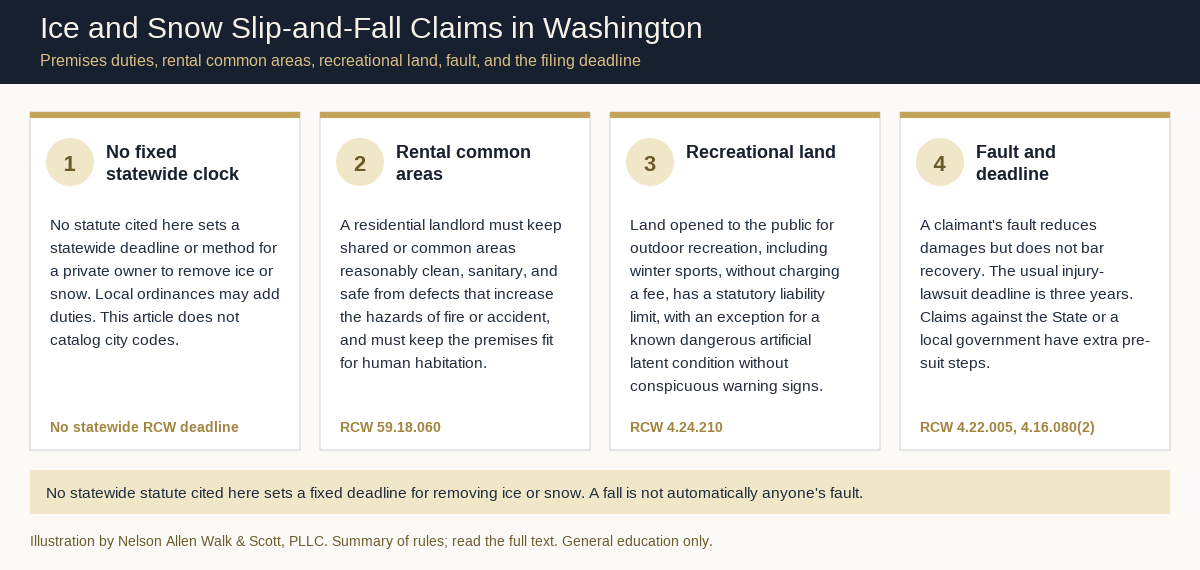
- No statute cited in this article sets a statewide deadline or method for a private property owner to remove ice or snow. A city or county ordinance may add duties. This article does not catalog local codes.
- The general framework for a possessor's duty after a fall is in our article on [slip-and-fall and premises liability](/blog/personal-injury/slip-and-fall/washington-slip-and-fall-premises-liability/).
- Under the Residential Landlord-Tenant Act, a landlord shall at all times during the tenancy keep the premises fit for human habitation, and shall keep any shared or common areas reasonably clean, sanitary, and safe from defects increasing the hazards of fire or accident (RCW 59.18.060).
- Land opened to the public for outdoor recreation, including winter sports, without charging a fee of any kind, has a statutory limit on liability for unintentional injuries, with an exception for a known dangerous artificial latent condition for which warning signs have not been conspicuously posted (RCW 4.24.210).
- A claimant's own fault reduces damages proportionately but does not bar recovery (RCW 4.22.005). The general deadline for an injury lawsuit is three years (RCW 4.16.080(2)). Claims against the State or a local government have extra pre-suit steps (RCW 4.92.100, 4.92.110, 4.96.010, 4.96.020).
Hypothetical example: after a freeze in Pierce County, a person slips on ice on a walkway or in a parking area and is hurt. The possessor says the ice was obvious, or that there was no time to treat it. The injured person says the surface was untreated and poorly lit.
Falls on ice or snow raise questions that the general premises-liability rules do not always answer in one place. This article explains the statewide statutes that most often come up, and it notes what those statutes do not say. It is general education, not advice about any one fall.
No Statewide Statute Sets a Fixed Ice-Removal Deadline
This article cites no Revised Code of Washington provision that requires a private owner, on a fixed statewide schedule, to shovel, salt, or otherwise treat ice or snow.
A city or county may adopt an ordinance about sidewalks, parking areas, or similar surfaces. RCW 59.18.060(1) can bring an applicable, enforceable maintenance ordinance into a residential landlord's statutory duties when the condition endangers or impairs the health or safety of the tenant. This article does not attempt to list local codes.
The usual legal framework for a fall on private property is still the premises-liability analysis in our article on slip-and-fall claims and premises liability. That article explains how Washington treats invitees, licensees, trespassers, notice, and open or obvious conditions.
Key point
Key point: a fall on ice is not automatically anyone's fault
- No statute in this article automatically assigns fault to a property possessor, or bars a claim, just because the surface was ice or snow.
- The premises-liability article explains the general duty and notice rules. This article adds the ice-and-snow statutes and limits that article does not develop in detail.
Residential Rentals and Common Areas
Falls sometimes happen on apartment walkways, steps, or other areas held out for tenants. RCW 59.18.060 is part of the Residential Landlord-Tenant Act. It says the landlord will at all times during the tenancy keep the premises fit for human habitation, and then lists particular duties.
One of those particular duties is to keep any shared or common areas reasonably clean, sanitary, and safe from defects increasing the hazards of fire or accident (RCW 59.18.060(3)). The statute does not mention ice or snow by name. It also does not set a number of hours after a storm in which treatment must occur.
Under RCW 59.18.030, premises means a dwelling unit, appurtenances thereto, grounds, and facilities held out for the use of tenants generally, and any other area or facility which is held out for use by the tenant. A landlord includes the owner, lessor, or sublessor of the dwelling unit or the property of which it is a part, and a designated representative such as an agent or property manager.
RCW 59.18.060(1) also requires the landlord to maintain the premises to substantially comply with any applicable code, statute, ordinance, or regulation governing their maintenance or operation, which the legislative body enacting it could enforce as to the premises rented, if such condition endangers or impairs the health or safety of the tenant.
RCW 59.18.040 lists situations to which the chapter does not apply, including certain occupancy in a hotel, motel, or other transient lodging. The common-area duty in RCW 59.18.060 is a residential-tenancy rule. It is not, by its terms, a statute about a retail store or a public highway.
Stores, Parking Lots, and Other Private Property
A fall on ice in a store entry, a business parking lot, or a similar private area is not governed by RCW 59.18.060 unless that area is also a residential rental premises under the Residential Landlord-Tenant Act.
This article cites no ice-specific statewide statute for those locations. The possessor's duty, if any, is analyzed under the premises-liability rules discussed in our slip-and-fall article. No statute cited here says that a visible patch of ice automatically ends a claim, or automatically proves one.
Recreational Land and Winter Sports
RCW 4.24.210(1) limits liability in a defined situation. With the exceptions in subsections (3) and (4), public or private landowners, hydroelectric project owners, or others in lawful possession and control of lands or water areas, who allow members of the public to use them for outdoor recreation without charging a fee of any kind, shall not be liable for unintentional injuries to such users.
The same subsection says that outdoor recreation includes, but is not limited to, a listed set of activities. That list expressly includes winter or water sports, as well as hiking, bicycling, hunting, fishing, camping, picnicking, snowmobiles, and other listed uses.
RCW 4.24.210(4)(a) preserves liability for injuries sustained to users by reason of a known dangerous artificial latent condition for which warning signs have not been conspicuously posted. The statute uses those words. This article does not decide whether a particular icy surface is, or is not, a known dangerous artificial latent condition.
Subsection (5) lists items that are not fees for purposes of the section. This article does not restate those items as dollar amounts. If a fall happened on land used for outdoor recreation, including winter sports, the text of RCW 4.24.210 should be read together with the recreational-use discussion in our premises-liability article.
Caution
Caution: recreational-use limits can apply to winter activity
- RCW 4.24.210 expressly includes winter or water sports in the definition of outdoor recreation.
- The liability limit applies when the land is allowed for that use without charging a fee of any kind, subject to the statute's listed exceptions, including a known dangerous artificial latent condition without conspicuous warning signs.
Falls on State or Local Government Property
Ice or snow on a public sidewalk, a government parking lot, or another public surface can involve a government entity. Claims against the State or a local government have extra pre-suit steps.
RCW 4.92.100 requires that a claim against the state, or against the state's officers, employees, or volunteers acting in such capacity, for damages arising out of tortious conduct, be presented to the office of risk management.
RCW 4.92.110 provides that no action subject to those claim-filing requirements shall be commenced until sixty calendar days have elapsed after the claim is presented. The applicable period of limitations is tolled during that sixty calendar day period.
RCW 4.96.010 makes local governmental entities liable for damages arising out of their tortious conduct, or the tortious conduct of their officers, employees, or volunteers in the circumstances the statute describes, to the same extent as if they were a private person or corporation. Filing a claim for damages within the time allowed by law is a condition precedent to commencing an action.
Under RCW 4.96.020, no action subject to that section's claim-filing requirements shall be commenced against a local governmental entity, or against its officers, employees, or volunteers acting in such capacity, until sixty calendar days have elapsed after the claim has first been presented to the agent of the governing body. The applicable period of limitations is tolled during that period.
Our articles on injury claims against government entities and on premises liability cover those presentation rules in more detail. This article does not add new government-claim procedures beyond the points just stated.
| Topic | What the statute addresses | Source |
|---|---|---|
| Fixed removal deadline | No statewide statute cited here sets a fixed deadline or method for a private owner to remove ice or snow | — |
| Residential common areas | Keep shared or common areas reasonably clean, sanitary, and safe from defects increasing the hazards of fire or accident; keep the premises fit for human habitation | RCW 59.18.060 |
| What 'premises' includes | A dwelling unit, appurtenances, grounds, and facilities held out for the use of tenants generally | RCW 59.18.030 |
| Recreational land | Limit on liability for unintentional injuries when land is opened for outdoor recreation, including winter sports, without charging a fee of any kind, with a listed exception for a known dangerous artificial latent condition | RCW 4.24.210 |
| Comparative fault | A claimant's contributory fault reduces damages proportionately but does not bar recovery | RCW 4.22.005 |
| Injury deadline | An action for injury to the person must be commenced within three years | RCW 4.16.080(2) |
Comparative Fault
A person who walks on a known icy surface may still have a claim, and may also be assigned a share of fault. The facts of lighting, a treated or untreated path, an alternative route, and footwear can matter. No statute cited here automatically bars recovery because the ice could be seen.
Under RCW 4.22.005, any contributory fault chargeable to the claimant diminishes damages proportionately but does not bar recovery. Our comparative fault article explains that rule.
Hypothetical: a visitor takes a shortcut across an untreated patch of ice when a cleared path is nearby. The statutes in this article do not automatically assign all of the fault to either the visitor or the possessor.
Evidence Worth Keeping
Useful evidence after a fall on ice or snow can include the surface itself, the lighting, the air and ground conditions, and whether any treatment was visible. Photos taken soon after the fall, if they can be taken safely, often matter.
- Photos of the ice or snow, lighting, nearby walkways, and any salt, sand, or untreated surface, if you can take them safely
- The date, time, and weather conditions, and names of witnesses who saw the surface
- Footwear and clothing from the fall, and a description of the path you were using
- The address or location, and whether it was a rental common area, a store or parking lot, recreational land, or government property
- Medical records and any incident report you are given
This is practical guidance, not a list of what any court will require or admit.
Get medical care promptly, even if you feel fine at the scene. Some injuries show up later. Keep copies of bills and notes about missed work.
Insurance and Filing Deadline
A possessor's liability insurance, or a household policy, may or may not respond, depending on the policy terms. This article does not describe any particular insurer's coverage.
Our article on insurance claim handling rules covers dealing with adjusters. RCW 4.16.080(2) requires an action for injury to the person to be commenced within three years.
Our article on the personal injury statute of limitations explains accrual, tolling, and what counts as commencing an action. If a government entity may be involved, the presentation and waiting-period rules described above also apply.
What to do
Next steps
- Get medical care and keep every record.
- Photograph the ice or snow, lighting, and any treated or untreated path if you can do so safely.
- Write down the location, the time, and any witness names.
- Contact us to talk about your situation.
Related reading includes our articles on slip-and-fall and premises liability, comparative fault, and injury claims against government entities.
To talk through a fall on ice or snow, visit our personal injury practice page or contact us. Nelson Allen Walk & Scott, PLLC is at 1103 Shaw Road, Puyallup, WA 98372, and the phone is (253) 845-8895.
Written by Nathan D. Sukhia, Of Counsel.
Frequently Asked Questions
Does Washington law require a property owner to shovel ice or snow within a set number of hours?+
If I fell on an icy apartment walkway, does any statute apply?+
Does that rental statute also apply to a fall in a store parking lot?+
If I fell while using public land for winter recreation, can the landowner be liable?+
I fell on ice on city or state property. Can I file a lawsuit right away?+
How long do I have to file a lawsuit after a fall on ice or snow?+
Sources & Further Reading
- 1.RCW 59.18.060 — Landlord DutiesKeep the premises fit for human habitation; keep shared or common areas reasonably clean, sanitary, and safe from defects increasing the hazards of fire or accident; comply with applicable maintenance ordinances in the circumstances the statute describes.
- 2.RCW 59.18.030 — DefinitionsPremises include a dwelling unit, appurtenances, grounds, and facilities held out for the use of tenants generally.
- 3.RCW 59.18.040 — Applicability of ChapterListed situations to which the Residential Landlord-Tenant Act does not apply, including certain transient lodging.
- 4.RCW 4.24.210 — Liability of Landowners to Recreational UsersLimit on liability for unintentional injuries when land is opened for outdoor recreation, including winter sports, without charging a fee of any kind; exception for a known dangerous artificial latent condition without conspicuous warning signs.
- 5.RCW 4.22.005 — Effect of Contributory FaultA claimant's fault reduces damages but does not bar recovery.
- 6.RCW 4.92.100 — Claims Against the StateA tort claim against the state must be presented to the office of risk management.
- 7.RCW 4.92.110 — Presentment Prerequisite to Suit Against the StateNo action until sixty calendar days after the claim is presented; the limitation period is tolled during that wait.
- 8.RCW 4.96.010 — Liability of Local Governmental EntitiesLocal governmental entities are liable for tortious conduct to the same extent as a private person; filing a claim is a condition precedent.
- 9.RCW 4.96.020 — Claim Filing Against Local Governmental EntitiesNo action until sixty calendar days after the claim is presented to the agent of the governing body; the limitation period is tolled during that wait.
- 10.RCW 4.16.080 — Actions Limited to Three YearsSubsection (2): injury to the person.
Disclaimer
This article is provided for general informational purposes only and does not constitute legal advice. It is based on Washington law as of the date noted above; statutes, court rules, and case law can and do change, and this article may not reflect the most current legal developments or apply to your specific facts.
Reading this article, contacting Nelson Allen Walk & Scott through this website, or submitting information through our contact form does not create an attorney-client relationship. An attorney-client relationship is formed only after both parties sign a written engagement agreement. Please do not send any confidential or time-sensitive information until that relationship has been established.
Every case is different, and past outcomes described or implied on this site do not guarantee or predict a similar result in any future matter. If you need advice about your specific situation, please consult directly with Nathan D. Sukhia or another licensed Washington attorney.
Attorney Advertising.
Experience · Expertise · Excellence
Talk to Nathan D. Sukhia
Nathan D. Sukhia and our team are happy to talk through your specific situation.