
When a Child Is Injured in Washington: Who Can Sue, Settlements, and Deadlines
Key Takeaways
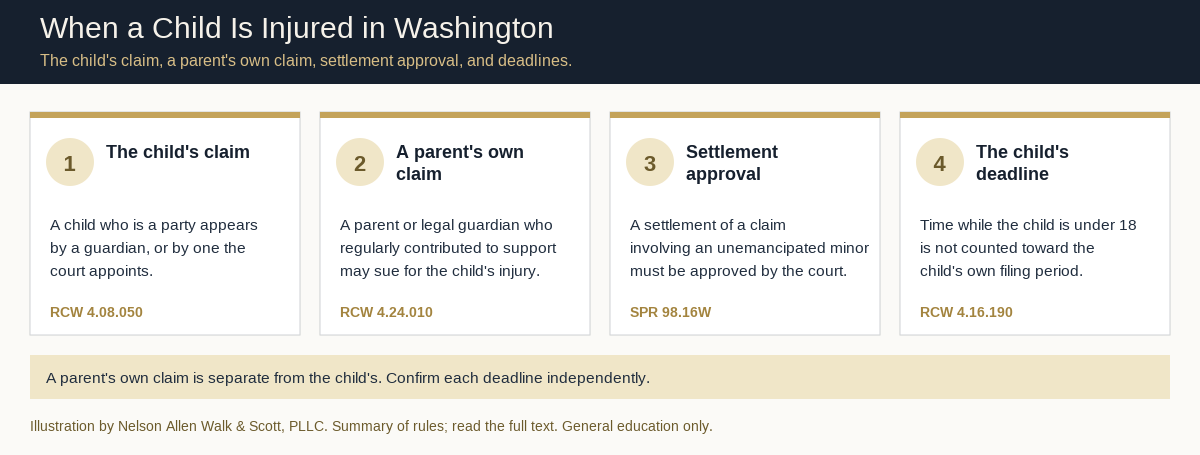
- A child who is a party to a lawsuit appears by a guardian, or by a guardian the court appoints if there is none or the existing guardian is improper (RCW 4.08.050).
- A parent or legal guardian who has regularly contributed to the support of a minor child may maintain or join a separate action for the injury of the child (RCW 4.24.010(1)).
- That parental claim can include the child's health care expenses and loss of the child's services, among other damages listed in RCW 4.24.010(2).
- Every settlement of a claim involving the beneficial interest of an unemancipated minor, whether or not a lawsuit has been filed, must be approved by the court (SPR 98.16W(a)).
- Time while the injured child is under 18 is not counted toward the child's own filing deadline (RCW 4.16.190). A parent's own claim should be checked separately. The general period for injury to the person is three years (RCW 4.16.080(2)).
Hypothetical example: a child is hurt in a Puyallup car crash, or in a fall, and needs medical care. The parents want to know who brings the claim, whether a settlement has to go before a judge, and how long they have.
A child's injury often involves more than one claim, and more than one deadline. This article explains what Washington statutes and a statewide court rule say. It is general education, not advice about any one child or family.
The Child's Own Claim
The child has a claim for his or her own injuries. Under RCW 4.08.050, when an infant is a party, he or she shall appear by guardian. If the child has no guardian, or the court finds the guardian is an improper person, the court shall appoint one to act.
The statute sets out how that appointment is made. When the child is the plaintiff and is 14 or older, the child may apply. If the child is under 14, a relative or friend may apply.
"Infant" in this statute means a minor. The person who appears for the child is not automatically the only person with a claim arising from the injury.
Key point
Key point: there may be more than one claim
- The child's own claim is brought in the child's name, and the child appears by a guardian or a court-appointed guardian.
- A parent may also have a separate claim under RCW 4.24.010. The two should not be treated as the same lawsuit automatically.
A Parent's Own Claim Under RCW 4.24.010
Under RCW 4.24.010(1), a parent or legal guardian who has regularly contributed to the support of his or her minor child may maintain or join as a party an action as plaintiff for the injury or death of the child.
The same subsection also addresses a parent or legal guardian who has had significant involvement in the life of an adult child. "Significant involvement" means demonstrated emotional, psychological, or financial support within the parent-child relationship, at or reasonably near the time of death, or of the incident causing death.
Under subsection (3), an action may be maintained under this section, whether or not the child has reached the age of majority, only if the child has no spouse, state registered domestic partner, or children.
If the injury caused a death, families should also read our wrongful death article. This article focuses on injury claims, not on who may sue after a death.
What a Parent's Claim Can Include
RCW 4.24.010(2) lists the damages that may be recovered in that parental action. In addition to the child's health care expenses, loss of the child's services, loss of the child's financial support, and other economic losses, damages may also be recovered for the loss of love and companionship of the child, loss of the child's emotional support, and injury to or destruction of the parent-child relationship, in amounts the trier of fact determines to be just under all the circumstances.
Subsection (4) says each parent is entitled to recover for his or her own loss separately from the other parent, regardless of marital status, even though the section creates only one cause of action.
If one parent brings the action and the other is not named as a plaintiff, subsection (5) requires that notice of the suit, with a copy of the complaint, be served on the other parent, but only if parentage has been duly established. That notice must comply with the statutory requirements for a summons and must state that the other parent must join within 20 days or the right to recover damages under this section shall be barred.
| Topic | The child's claim | A parent's claim under RCW 4.24.010 |
|---|---|---|
| Who is the plaintiff | The child, who appears by a guardian or a court-appointed guardian | A parent or legal guardian who regularly contributed to the minor child's support |
| What it can cover | The child's own injuries and losses | Listed items such as health care expenses, loss of services, and loss of love and companionship |
| Appearance in court | RCW 4.08.050 | The parent or guardian sues as plaintiff; the other parent may have to be notified |
| Deadline | General three-year period, with time under age 18 not counted for the child's own claim | The parent's own claim should be checked separately; 4.16.190 looks at the person entitled to sue |
Court Approval of a Minor's Settlement
Washington has a statewide court rule on this point. Under SPR 98.16W(a), in every settlement of a claim, whether or not filed in court, involving the beneficial interest of an unemancipated minor, the court shall determine the adequacy of the proposed settlement and reject or approve it.
If a suit for recovery on behalf of the child has already been maintained, the petition is filed in that county. If there is no such suit, it is filed in the county where the child resides, unless either court orders otherwise.
Under SPR 98.16W(c), the court shall appoint a settlement guardian ad litem to investigate and report on whether the settlement is adequate, unless the court finds that a guardian ad litem, guardian, or limited guardian was already appointed, or that the child is represented by independent counsel, and that person has the required qualifications and no conflicting interests.
SPR 98.16W(d) requires the settlement guardian ad litem to be an attorney with at least five years of pertinent legal experience. That person shall not have or represent an interest in conflict with the child, including conflicting interests of parents or others legally responsible for the child's medical care.
Caution
Caution: a handshake settlement is not the end of the process
- Hypothetical: an insurer offers to pay a child's medical bills if a parent signs a release. SPR 98.16W still requires court approval when the settlement involves the child's beneficial interest.
- Talk with a lawyer before signing anything that would release a child's claim.
Where Settlement Funds Go
Under SPR 98.16W(h), except for any structured portion, the total settlement is paid into the registry of the court, or as the court otherwise orders. Costs, attorney's fees, medical expenses, and other deductions are paid only upon the court's approval.
SPR 98.16W(j) then directs how remaining funds are held. If $50,000 or less remains after approved fees, bills and expenses, the court requires a blocked account, payment to a duly appointed guardian or limited guardian, or a court-approved trust. If more than $50,000 remains, the rule requires a blocked account if an approving guardian or limited guardian exists, appointment of a guardian or limited guardian, or a court-approved trust.
Those dollar figures are thresholds in the court rule for how remaining funds are held. They are not typical recoveries, and they are not a prediction of what any child will receive.
Deadlines for the Child and for a Parent
RCW 4.16.080(2) requires an action for injury to the person to be commenced within three years. That is the general rule.
RCW 4.16.190 pauses the clock for certain personal disabilities. If, when the cause of action accrued, the person entitled to sue was under 18, the time of that disability is not part of the limitation period. The statute begins with the words "unless otherwise provided in this section."
That tolling rule looks at the person entitled to bring the action. It applies to the child's own claim. A parent's claim under RCW 4.24.010 is the parent's action, so it should be checked separately and not assumed to wait until the child turns 18.
Our article on the personal injury statute of limitations explains accrual, commencement, and tolling in more detail.
What to do
Next steps
- Get medical care for the child and keep every record.
- Do not assume a parent's deadline is the same as the child's.
- Ask about court approval before settling a child's claim.
- Contact us to talk about your situation.
Related Situations
If the child was hurt in a car crash, our guide on what to do after a car accident in Washington and our PIP and UIM article may help. If the child was a passenger, see our passenger injury claims article. If the injury was a fall, see our slip-and-fall and premises liability article.
Claims against a government entity have extra pre-suit steps. Our article on injury claims against government entities covers those rules. This article does not address school or government claims beyond that link.
Shared fault can still affect a claim. Our comparative fault article explains how a claimant's fault reduces damages under RCW 4.22.005 but does not bar recovery.
To talk through a child's injury claim, visit our personal injury practice page or contact us. Nelson Allen Walk & Scott, PLLC is at 1103 Shaw Road, Puyallup, WA 98372, and the phone is (206) 279-5835.
Written by Nathan D. Sukhia, Of Counsel.
Frequently Asked Questions
Who brings a lawsuit when a child is injured in Washington?+
Can a parent recover medical bills and other losses?+
What if only one parent files the claim?+
Does a child's settlement have to be approved by a court?+
What is a settlement guardian ad litem?+
How long does a family have to file after a child is hurt?+
Sources & Further Reading
- 1.RCW 4.08.050 — Guardian ad Litem for InfantA child who is a party appears by a guardian, or by one the court appoints.
- 2.RCW 4.24.010 — Action for Injury or Death of ChildA parent's or legal guardian's claim, damages, and notice to the other parent.
- 3.SPR 98.16W — Settlement of Claims of Minors and Incapacitated PersonsCourt approval of settlements involving an unemancipated minor; settlement guardian ad litem; handling of remaining funds. Official text from courts.wa.gov, amended effective February 1, 2021.
- 4.RCW 4.16.080 — Actions Limited to Three YearsSubsection (2): injury to the person.
- 5.RCW 4.16.190 — Statute Tolled by Personal DisabilityTime while the person entitled to sue is under 18 is not counted.
- 6.RCW 4.22.005 — Effect of Contributory FaultA claimant's fault reduces damages but does not bar recovery.
Disclaimer
This article is provided for general informational purposes only and does not constitute legal advice. It is based on Washington law as of the date noted above; statutes, court rules, and case law can and do change, and this article may not reflect the most current legal developments or apply to your specific facts.
Reading this article, contacting Nelson Allen Walk & Scott through this website, or submitting information through our contact form does not create an attorney-client relationship. An attorney-client relationship is formed only after both parties sign a written engagement agreement. Please do not send any confidential or time-sensitive information until that relationship has been established.
Every case is different, and past outcomes described or implied on this site do not guarantee or predict a similar result in any future matter. If you need advice about your specific situation, please consult directly with Nathan D. Sukhia or another licensed Washington attorney.
Attorney Advertising.
Experience · Expertise · Excellence
Talk to Nathan D. Sukhia
Nathan D. Sukhia and our team are happy to talk through your specific situation.